Pesach at the Kotzker Rebbe’s Seder Table

The Lesson of Maror


A Chosid who used to travel to the Kotkzer, approximately 56 years earlier, was on his way home from Gur after the holiday of Succos.  He travelled by way of Sochatchov  and visited the Sochatchover Rebbe.  This event  took place in the early 1900’s.     The Sochatchover Rebbe was Rabbi Avrohom Bornsztain – 14 October 1838 to 7 February 1910,  and son-in-law of the Kotzker.

http://en.wikipedia.org/wiki/Avrohom_Bornsztain

When this Chosid visited the Rebbe, the Sochachover remembered that he sent this Chosed on two missions.  Once regarding the Ran and once regarding the Rashba. (I do not know what this means).

 The Chosid asked the Sochatchover Rebbe to tell him rest of the story at the Kotzker Rebbe’s Seder.    

 The Kotzker Rebbe’s Seder:

The Kotzker failed to pass out Maror to his family and those at the Seder.  This story of the Seder took place in the mid to late 1850’s.  The people around the table whispered to the Sochatchover that he should remind the Kotzker to pass out Maror.   The Sochatchover in a light-hearted comment to the Kotzker Rebbe mentioned a disagreement in the Talmud whether Marror today is Rabbinic or Biblical.  The Sochatchover said to his father-in-law that I have a proof from the Rebbe that Maror is Biblical because the Rebbe has not passed out the Maror.

 This is the extent of the story that the Chosid heard from Reb Hersh Tomashover and the Chosid wanted to know what happened afterwards.   Reb Hersh Tomashovor was the Kotzker’s Gabbai for many years.

The Sochatchover told  the Chosid the rest of the story.

 The Rest of the Story:

The Kotzker responded to his son-in-law, you are correct and gave Maror to everyone.  Suddenly, the Kotzker declared in a loud vice, “Maror Fressers”, Maror Fressers translates into, People who indulge in  Maror.  Due to the fear of the Rebbe everyone around the table scattered and only the Sochatchover remained.

 The Kotzker asked his son-in-law, what new insight have you said on the topic of Pesach. The Kotzker and Sochatchover talked in learning.   After a while Reb Hersh Tomashover came in the room and the Kotzker asked him, where is everyone.  Reb Hersh answered that the Rebbe chased them out of the house when the Rebbe screamed out, Maror Fressers.  The Kotzker replied that he did not mean the people around the table.

Understanding the Story – Understanding the Greatness of the Kotzker:

What is the meaning of this story?  Is it just a Chassidic tale that has no meaning or even worse.  Rabbi Farkas, my nephew’s father-in-law, repeated this story to me at Avrohom Yisroel Chase’s Bar MItzva two years ago and said he had no clue to what it meant.   Rabbi Farkas’s words were a little harsher and used this story almost as a metaphor for Kotzk.  Luckily I knew the story and explained to him what the story meant, why it had to be written, and how we can see the greatness of the Kotzker Rebbe.

 This Seder took place in the 1850s well into the period the Kotzker’s “Yimai Hester”, when the Kotzker withdrew from the world.    Even during this 20 year period the Kotzker never for one moment stopped being a leader.  During the 20 year period he raised a family, taught students, married off kids, was consulted by other leaders on communal matters, did not stop from praying to God for the salvation of the nation of Israel, learned Torah day and night not only for himself but for all Jews.  He was a beacon of light to all those seeking Torah and the Truth.  The best and brightest of Poland flocked to the study hall of Kotzk to be in his shadow.  The Kotzker established Poland as a Makom Torah, a place for top level Torah study.

 When the Kotzker  screamed out Maror Fressers, he was praying to God.  Enough already.  It is time for Moshaich.  The Jews have suffered and suffered and suffered.   The Jews are constantly eating Maror and it is time for salvation.  This is a leader, someone who is constantly worried and praying for his people, exhorting his community to be fierce in the worship  of God, excel in Torah learning,  and doing the right thing. 

  I wish everyone a Chag Kosher V’Sameach.

Hunger Games

A KOTZKER VIEW

On Friday, March 3, 1995 I was in LA for the 10th running of the Los Angeles Marathon.  I went to the Beverly- Grand Hotel to check in for Shabbos.  The Beverly-Grand was a Kosher hotel and planned to order eat at the hotel.   I asked for a single room and the front desk attendant told me it was $55 per day.  He looked for a room and only had rooms with two beds.  He told me the rate is $65.  I bristle at terrible business practices and asked for the location of the nearest motel.  He directed me to the Park Motor Inn on 3rd and Martel.  I checked in and got ready for Shabbos.  I remember walking to Synagogue Friday night feeling slightly discomforted.  I did not know anyone in LA and had no food for Shabbos.  Entering Sharei Tefillah on Beverly Boulevard for Friday night services and looking around I felt at home.  The Synagogue was Every Synagogue, USA.  No different than an Orthodox Shul in Chicago, Boro Park, Houston, or Williamsburg.   A doctor invited me over for the Shabbos night meal.  I had a delightful meal with his family and stayed for hours.  Although I considered myself at that time center – right and they were center –left on religious matters, there was no gap between us.  Their issues were the same as the issues my wife and I had. 

The main point of the above is that despite the fact that I had money and a family in Chicago, and my discomfort would only be for Friday night, I still felt a sense of loneliness, a sense of emptiness.   

This past Friday, March 23, 2012, I did not have my car so Mayer Chase picked me up from work.  I stopped by the cleaners on Devon and two gentlemen asked Mayer Chase for directions to the nearest Synagogue.  I came out and asked if they had a place to eat for Shabbos.  They did not and I invited them over.  That afternoon they arrived in Chicago, having driven for 15 hours straight, had  never been to Chicago, knew no one in Chicago, and had no place to eat.  They were down on their luck and came to Chicago to raise money.     Feel their sense of emotional distress, isolation and loneliness at being in a strange location in unfamiliar surroundings.  I had it in 1995 for only one Friday night, when I was on a high, in gorgeous LA to run the marathon.   They had a permanent heaviness as their problems would be there after Shabbos and will take huge effort with God’s help to solve.

My family had a delightful Friday night meal with the two guests.    They were great.   I received much more that I gave.   My kids stayed at the Shabbos table throughout extended meal and joined in on the conversation.   I felt privileged that I was able to relieve their pain for just a few hours.   I was also able to assist them throughout the week. 

This hunger is reality, it exists.   Things do not go right in life, there is unfairness, and evil prospers.  We try our best and it is not good enough.  The year is 1940 and you live in Warsaw.  You had a great life in Spain for years and it is July 1492.  Your job did not work out.    You went on your 20th job interview and did not find a job, while all of your friends found jobs. 

As a Jew, we have to feel this hunger – pain –anxiety that exists in others. not just understand it, but as the Kotzker Rebbe said, we have to feel it in our gut.    It has to be part of us.  We have to put the other person’s hunger – pain – anxiety on our shoulders and do what we can to help that person.  An Orthodox Jew can take a vacation cruise or  go to Florida for the winter,  however,  if he forgets about what is real, his mission, that people are suffering, that as Jews we have to feel the burden of others, then that person is “nisht a Yid”.   He is living for himself, and his Torah and prayers mean nothing.  Of course we cannot always be in this mode and opportunities as such do not come up often, but we have to be aware that at times we have to step forward.

In prewar Europe, travelers needing meals or a place to sleep went to Synagogue Friday night and everyone was taken care of by the community.  I first saw this in 1978 in Kesher Israel located in Georgetown, one of the great Synagogues in America.   After prayer services, an announcement was made that anyone who needs a place to eat, please see the Gabbai.   This is the ceremony of the Egulah Arufa.  The need to take care of people, that no person feels isolated and alone.

Avrumi Perl’s Bar Mitzvah – February 25-27, 2012

Last week at this time I was in Toronto for Avrohom – Avrumi Perl’s bar Mitzvah.  Great weekend and the following is my diary with some Kotzker Torah.

Thursday, February 24, 2012:

Departure date.  I was trying to leave before 3:00 PM for my drive to Toronto for Avrumi Perl’s Bar Mitzvah.  Too much drama with my customers and I ended up leaving at 5:00 PM.  My mother, Bubbi Jean, and the two Chase girls were in the car with me for the trip, Penina Leah and Sarah.   Hit rush hour traffic and took an extra 45 minutes.  I told over Yehuda Avneir’s inspirational stories from his speech at the 2008 Lubavitch Shilach convention, the story that Chazzen Silber told to David Willner the Kiddush Hashem his  grandchildren are doing in the IDF.    I listened to two classes on tape.  My son- in-law burned them for me last week when I was in Indianapolis.  I heard Eli Mansour and Zacharya Wallerstein.  Both were excellent, both talked about faith and belief in God – Emunah and Bitachon.   Eli Mansour talked how we think one thing and the opposite happens.  Hamen set up a tree 50 Amos high for Mordechai.   Hamen was on top of the world, and within a few days he was hanging from  the tree.   Zecharya Wallerstein spoke that we cannot live in the past and dwell on our sins.  We have to always look forward.  Zecharya Wallerstein quoted a Midrash that said when Hamen was walking home at the height of his glory; he stopped into a Yeshiva to see what the students were learning.  They were learning the laws of the incense that the Cohen burned on the alter, the laws of Kemitzah.  Hamen goes homes and tells his family that despite the fact that there is a decree to kill all Jews and that Hamen was at the peak of power and influence, the Jews would prevail and all is lost.

The meaning of this Midrash per Zacharya Wallenstein is that Hamen expected the students to be studying the laws of Kiddush Hashem, how to die sanctifying Gods name due to their impending destruction at the hands of Hamen and Achesveirosh.  Yet the students were looking toward the future when the Temple would be rebuilt in Jerusalem.  They looked forward and not back.   They did not beg Hamen for mercy.  They ignored Hamen as if Hamen was meaningless.  This is the concept of Bitachon, everything is in God’s hands and Hamen is a puppet.  He cannot do anything unless God wants it to happen.   This is the message of the Midrash.

Arrived in Toronto at 3:00 AM. 

Friday, February 14, 2012:

Woke up at 10:00 AM.  Did not realize it was really 11:00 AM.  Spoke to work and arrived at the boat Synagogue at 11:30 AM, hoping to catch a Minyan.  It was then that I realized how late it was.   I went up the Amud to lead the prayer services.  We had 4 people praying with us, not a Minyan, however, we davened as if we had a MInyan, including saying Kiddusha out loud.  We read from the Torah and davened Musaf together.  It was highly satisfying for me.  After the prayer services, I spoke about my joy at davening with other Jews at this late hour, as we all felt connected.   I told over the story of the Kotzker when he was in yeshiva in Zamusz.  One morning when the Kotzker was late in praying morning services, the dean of the school, Rabbi Yosef Hochgalenter 1740 -1807, chased the Kotzker to the Synagogue.  The Kotzker bolted the doors and davened.

At Shul I saw Rabbi Yosef Spiro, my roommate from Ner Yisroel in Toronto.  He is not well.  He needs a kidney transplant.  I asked him for a D’var Halalch.  He told me about the law of “C’dei Achelas Peras”, that to be considered a valid Acelah -“eating” for Jewish law, the complete eating has to be within a certain time limit called “C’dei Achelas Peras” .   Rabbi Spiro said that there is a disagreement between the Mishna Berurah and the Pri Migadim or the Magan Avrohom that to say the grace after meals one  has to have an Acelah.  The question is what happens if one eats less than the amount that is considered an Aceliah, but one is satisfied, does he have to say grace after meals.  The Mishna Berurah says no and the Pri Migadim says yes.

One of the 4 people praying with us is from the old city of Jerusalem was Goldberg, and is good friends with Rabbi Yosef Soloveichik, “Joe Brisker”.

After Shul, I received a call from work that highly agitated me.   I raised my voice at a customer over the phone. 

Afterwards, I went to Pesach Chase’s house for lunch and talk.  My mother, my sister, Karen, and Karen’s daughter were there.  We had a great time.  We told over the family stories and they were just as funny as when I heard them the first time.

I had to go to the bank to take care of something and just made it back just in time to get ready for Shabbos.


Friday Night, Shabbos, Parshas Trumah, and February 24, 2012:

Arrived to Tzi’vi and Chaim Perl’s house for the Friday night meal.    It was great seeing all of the family.  The kids are growing up.

Tzi’vi and Chaim’s kids were there, including their married son; Moshe Yaakov and Miriam and their baby,  Yitzchok and Bracha’s and kids were there from New York including their two older yeshiva boys; Mayer and Chana  and kid; Elisheva and Yossi and their daughter,  and Sholem Chase. I sat next to Pesach, Esther, and my mother.

Great food, everything was home made.  Great speeches.    Went back to the place I was staying.  Could not sleep as I was still agitated from before Shabbos.  Schmoozed with Karen and my mother.

Saturday Morning, Shabbos, Parshas Trumah, February 25, 2012:

Arrived at Synagogue at 10:00 AM, a little late, as the prayer services started at 8:30 AM.  The Synagogue was on Lawrence Avenue at the old Yesodai Torah Shul.  It was established in the 1950’s by Holocaust survivors who came from Hungary.   The Bar Mitzvah boy is named after his great – grandfather, Avrohom Friedman, who prayed at the Synagogue.    Avrohom Friedman owned a wholesale dry goods warehouse in Toronto, supplying small grocery stores.  Mr. Friedman closed his place of business at noon every Friday to prepare for Shabbos, learn, and make it to Shul early.

Avrumi Perl read from the Torah like poetry.  His leining was clear, loud, with every word pronounced with the Trop perfect.  I only heard one missed trop sound.  I sat next to a Mr. Blumenfeld.  Mr. Blumenfeld is married to a Kaiser.  I went to Yeshiva with his wife’s brother, Mike Kaiser.  Mr. Blumenfeld ’s father came to America with his sister in 1939.  Unfortunately the rest of his family could not get out of Europe and they perished.  His father was on General Douglas Macarthur’s staff in the Philippines during World War II.  Mr. Blumenfeld said that his father worshipped General Macarthur.  His father got his college degree on the GI bill.

The Kiddush was lively.  I asked Helen Friedmen for a Brocha.  Helen Friedman is Esther Chase’s mother and the great-grandmother of Avrumi.  I talked to the Chaim Perl’s siblings and told them that I met their first cousin, David Willner.   I told them the great work David Willner is doing with Rabbi Barnei Selevan.  

I met a Mr. Eckstein who was visiting from Brooklyn, NY.  Eckstein is in the insurance business.  We began to play Jewish Geography and I mentioned that I met a Joseph Eckstein from Queens last summer in LA at the ice cream store on Robertson.  Eckstein tells me that Joseph Eckstein is his brother.   Joseph Eckstein’s father-in-law ate by my cousins in Queens this past Rosh Hashana.  Small world.

After the meal went back to Tzi’vi and Chaim’s  house for the rest of the afternoon.  I was asked to speak.  I read two great stories of the greatness of the Kotzker Rebbe.  Kotzker Story #1 – The Chidushai Harim’s Manuscript.  Kotzker Story #2 – The Avnei Nezer’s Pshat in a Rambam.

After Shabbos slept for an hour, then went back to Tzi’vi and Chaim’s house for more food and talk.

Sunday, February 26, 2012:

Went to the boat synagogue for morning prayers.  The person leading the prayers was Yehuda Berkowitz.  I blogged about him earlier.  Yehuda Berkowitz is from Har Nof,  Israel and ate over my house a few  weeks earlier on a Friday night.  Yehuda Berkowitz left Chicago and I felt bad that he left Chicago without my donation.  I gave him what I was planning to give him.

Drove back to Chicago in less than 8.5 hours.

Great weekend, great times.

The Avnei Nezer’s Pshat in a Rambam (told over at Avromi Perl’s Bar Mitzvah)

Background to the story:

The Avnei Nezer also known as the Sochachover Rebbe,married the Kotzker older twin daugher, Sarah Tzinah, in 1853+-.  The Avneir Nazar at the time of ths story was maybe 18 years old.   This story took place during the years of the Kotzker’s “Hisbotidus” – years that the Kotzker limited his contact with the world.

The Avnei Nezer, son-in-law of the Kotzker told the following story.    I worked hard on a Ramban and after much effort  God enlightened for me the answer.  (The quesion at hand was a difficult Rambam who seemed to rule on a specific law in contradiction to the Talmud.) The Rambam in question had a different version of the Talmud and therefore his  ruling was proper.

I told my Torah original thought to the Kotzker and he did not say anyting.  The Kotzker told me to return to the study hall and say the Torah thought to a scholar you meet in the study hall, and report back to me.  I  found the Chidushai Harim.  The Chidushai Harim  did not agree with my Torah and felt that the Rambam was still difficult.  I reported back to the Kotzker,  who again told me to return to the study hall to speak with another Torah scholar.  I found Reb Henoch M’Alexander, who greatly appreciated and agreed with my Torah.  I returned to the Kotzker who called in the Chedushai Harim and Reb Henoch M’Alexander.  The three  of us stood  before the Kotzker, who scolded us and said, is this the way you learn the holy Torah, with uncertainty,  This one says it is difficult and the other says it is  correct.  The Kotzker proceeded  to explain the Rambam and answered it 13 different ways.  The Avnei Nezer said, I only understood  6 or 7 of the answers, the Chidushai Harim understood up to 10, and the remaining answers  we did not understand  due to their depth and sharpness.

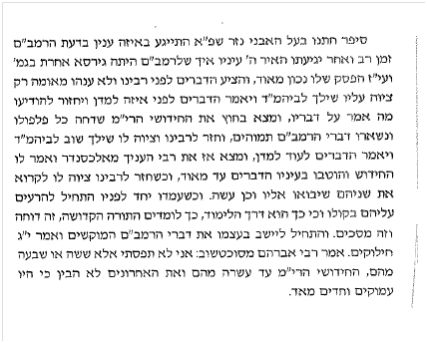
The Chidushai Harim’s Manuscript (told over at Avromi Perl’s Bar Mitzvah)

Translation:

The Chidushai Harim showed the Kotzker Rebbe a manuscript on Torah he wrote on the Choshen Mishpat, (the portion of Jewish law that deals with civil law).  The Kotzker looked at it for a long time and afterwards said – This manuscript is very special, however, I am afraid that if you publish it, people will stop learning  the Shach (a major commentary printed along the side of the Choshen Mishpat text).  The Shach learned Torah for its own sake with major effort and diligence.  The Chedushai Harim left the Kotzker presence and said, even though my manuscript is invaluable, it is a commandment to listen to the words of Torah scholars.  The Chedushai Harim started a fire and burnt his manuscript.

A while later a student came to the  Kotzker and the Rebbe asked the student, what did the Rim  do with the manuscript.  The student answered that the Chedushai Harim burnt it.  The Kotzker Rebbe commented – how wondrous is this great person and the generosity of his sprit, he did a great thing to sublimate his will before mine, and burnt his manuscript that contained precious  and true Torah.  Know that the light of his Torah will begin to shine.  The wisdom of his Torah will enlighten the entire world, and his Torah thoughts will be accepted worldwide.

Lukaver Rebbe’s Yarhziet – 2012

Today, 2/21/12 is my great-grandfather’s Yahrzeit, the 29th of Shevat.  Rabbi Tzvi Hersh Morgenstern.  He was the Lukovar Rebbe, born in 1858 and passed away on the 29th of Shevat 1920, 92 years ago.  I made a Siyum on Mesectas Archin.  Before the Siyum I read about the life of the Lukover Rebbe.  The Sandek at his Bris was the Kotzker Rebbe.   The Lukover Rebbe soaked in the Chassidus of his grandfather, Reb Dovid and then his father, Rabbi Chaim Yisroel, known as the Pilover Rebbe.  After the Pilover Rebbe passed away in 1906, some of the Chassidim followed Reb Tzvi Hersh Morgenstern to Lukav.   I also read about the tragic end of the Lukover Rebbe’s grandson, Reb Menachem Mendel Morgenstern who was Rebbe in Wlodovia.  It was 1942 and the Gestapo rounded up the children in the courtyard of the Shul.  The Rebbe was dressed in his Shabbos clothes and stood among the children telling them stories and giving them comfort.  The gestapo soldier told the Rebbe that the Rebbe can leave.  The Rebbe said no and stayed with the kids as they went on their tragic end to Sorbidor.

Attending the Siyum as Meir Chase, Moshe Roberts, Sholem and Eli Morgenstern, Shabsi S., Ephraim Chase, Ari Pancer, Rabbi Elliot Weinschneider, and Mordy Siegal.  Of course we had herring and crackers.

Kotzker Vort – Parshas Va’erah

Good Erev Shabbas:

It is almost Shabbos and it is snowing here in Chicago.  It gives Shabbos a special look and feel.  I wanted to send everyone the above Bible thought  from the Kotzker Rebbe on this week’s portion.

At the end of last week’s Bible portion and the beginning of this week’s Bible portion,  there is an exchange between Moshe and God.  Moshe challenged God and said that you God, sent me to free the Jewish people, not only did I fail, but their servitude got worse. God has to defend himself and say that indeed I will redeem the Jewish people.

The Medresh Rabbah says on this  exchange:   “God said to Moshe – woe on what we have lost and are not found, that Moshe . . .”  I do not have the full text of the Medresh here at work.

The Kotzker said:

“It is a shame that the forefathers lost their strength at the time that I (God) warned them about the exile of their children.  When I said that your children will be sojourners in a strange land and right afterwards what happened, Avrohom fell into a deep sleep.  If Abraham would have stood his ground with strength and firmly told God (or argue),  no there will not be an exile, then it  is possible that the Jews would not have gone into slavery.”

The Kotzker is saying the God is saying this, lamenting the inability for Avrohom to defend his own children.

This is consistent with the Kotzker.  I spoke to Dr. Ungar and he told me that this is the Chiddush, the mindset, of the school of Pshisca, The Yid Hakodash,  the Rebbe Reb Bunim, and to the Kotzker, to challenge God.  He said that there is a Talmud in Gitten that talks about this very subject, and of our forefathers, only Isaac stands up to God.  The Bardichiver’s approach was to defend Jews to God in a sweet, cajoling manner, C’mon God, be good to  your kids, the Jews are good, do not punish them.

The Kotzker and his teachers, the school of Pshisca, was more brazen, upfront,  and challenging God. This is what Moshe did in our Torah portion.

I quickly wrote this so I apologize for sloppy wording.

Lissa Rov and the Chedushei Harim

From: Mitch Morgenstern
Sent: Sunday, March 27, 2011 1:14 AM
To: Mitch Morgenstern
Subject:

Good Motzai Shabbos:

Today, I saw a great story in a Sefer called the Lukketei HaRim that relates to my feelings of what I have to say.  The Sefer was a gift from Yonatan Glenner.

The Lissa Rav – Yaakov ben Moshe Lorberbaum of Lissa (1760-1832)  (http://en.wikipedia.org/wiki/Yaakov_Lorberbaum)  had a question he could not answer.  The RIM (1787-1866), answered the question.  The Lissa Rav stood for a few moments in deep thought and said – that I answer the question this way and the RIM says another answer.  I can engage in debate with the RIM, however, ultimately I know he is right.  I do not want to engage in debate because through the power of debate and persuasion I may get him to change his answer, and I know he is right.  The truth lies with him.    Understand that the RIM lived from 1799 – 1866, was much younger than the Lissa Rav and was not considered to be at the level of the Lissa Rav.  The Lissa Rav is the Nesivous.

The Lissa Rov learned in the Yeshiva of Rabbi Yosef Hochgelenter in Zamusz, the same yeshiva that the Kotzker Rebbe learned at years later.

I would like to add the WOW to the story with the Lissa Rav.

The point of the story with the Lissa Rav is that when  it comes to Torah, the truth reigns supreme.

The Lissa Rav was one of the great leaders of Jewry in Poland and was at least 60 at the time.  This story took place in the 1820’s. The RIM was in his 20’s and was not a universally recognized Torah scholar.   The Lissa Rav did not let ego get in the way.  He was willing to recognize the truth in what the RIM said.

Not only that,  the RIM was a Chassidic Jew and imagine a Chasid besting one of the greatest Misnagdic scholars at the time.   The Misnagdim were locked into a fight with the Chassidim for the hearts and minds of Jewry.   Misnagidm claimed that Chassdim were ignorant and did not produce Torah scholars.  The RIM disproved this.   The Lissa Rav could have also thought that I have to fight and disprove the RIM simply because we Misnagdim do not like Chassidim and we always have to best them in Torah, even if the Chasid is correct.  Perhaps not consciously,  but subconsciously he could have had this thought, where the Lissa Rav did not even realize that his arguing with the RIM was about not letting a Chasid be correct and  be proven to be a Torah scholar.

Had ego been a factor or a Misnagdic dislike for the Chassid, the Lissa Rav would not have had a clear mind to see the truth in the RIM’s answer and the Lissa Rav could have argued with the RIM and perhaps gotten the RIM to change his mind.  Remember, the Lissa Rav had memorized the entire Shas, Rishonim, and Poskim in his mind.  Had he had an agenda, then he would have fought the RIM.  However, the Lissa Rav was committed to the truth in Torah and publicly admitted that this Chassidic young man is correct.

There are parallels to various arguments among the leaders of Torah Jewry today, however, I will let others make the connections.