Our Posek is Auschwitz, Dachau, and going hungry for 5 days

11 Tamuz: Tonight and tomorrow is my father’s 11th Yahrzeit.

My father’s will states:

Upon donations made with my money the following shall be stated:

“This is a donation from the late Mr. Israel J. Morgenstern, who was continuously hungry since September 1, 1939, when Hitler and his German army with his German Luftwaffe (air power) attacked Poland, until May 7, 1945, when he was liberated from Dachau Concentration Camp by the American Army”

My father’s Posek is Auschwitz, Dachau and going hungry for 5 days.

In 1994, when I visited my father in Los Angles, we walked by a homeless man. I grimaced and my father said that in America, the wealthiest country in the world, it is a shame that we cannot house and feed everyone.

Heaven forbid we should be in need of food and livelihood.

Synagogues from time immemorial were always places of refuge. A Jew could always find comfort, food, and friendship. In 1982 at Kesser Israel in Georgetown, D.C., I was very impressed when, after Shabbos Morning Prayer services, they announced that anyone who needing a place for Shabbos lunch see the Gabbai.

About 5 years ago, I noticed a sign in a Synagogue on Pico Boulevard in LA that people collecting money cannot collect during services. I was outraged. Who are these people to limit when a Jew needing money can collect? Be hungry for 5 days and then tell a person   that he cannot collect during prayer services. A Synagogue is a place of Chesed, not a place where we put restrictions on a Jew who needs money, needs food, and needs sustenance. Do the members believe that their prayers are so holy that they cannot be bothered during davening for charity?  I was so angry that I called their national headquarters in New York and gave the Rabbi in charge of member services an earful. He assured me that the Synagogue in question is charitable. Not a good answer. A few years later I saw a similar sign in Chicago.   I found the right person and a few years later the sign was taken down. I just heard of another Synagogue in Chicago banning collecting money during services.

Two other incidents bothered me. When my nephew wants to irritate me, he has me look at a web site that claims to promote Cheriedai values; however, you can always rely on that website for anti-Zionist views, anti Achdus opinions, and self-righteousness.

Two years ago the web site had a video of a question that two “kids” from Lakewood posed to Rabbi Eliyashuv TZL, a question I considered a question of Eisav Harashah. These two kids are in charge of giving out certificates that allow a person to collect money. They asked can they put in a restriction in the certificates, that money cannot be collected during Krias Shma (reciting of the Shma prayers). I was appalled and thought, what is it their business when people can collect money. Their only job is to make sure the person needing money is worthy. If someone does not want to give during Shma, he can ignore the person, or do what I do, have money ready. These two “kids” had a look and sound of stupidity or as my sister says to me when she feels I am being foolish, “Narashah Lachin”.

These two kids brought down the esteem of Reb Eliyashuv TZL. The web site thought that the video showed the greatness of Rabbi Eliyashuv, when it actually showed him in a poor light. I e-mailed the editors of the web site and had a debate with them. After a series of e-mails they responded to me, we have our Posek, you ask your Posek. My Posek is Auschwitz, Dachau and going hungry for 5 days. The shame is that Lakewood is a city full of Tzedakah.

About two months ago I saw a incident that continues to bother me. A Rabbi from Israel was a guest at this Synagogue for Shabbos in one of its members’ home. He was collecting for his institution in Israel. He was an elderly Jew and had the look of an important Rabbi. Sunday morning this Rabbi was in the Synagogue looking for someone. A Synagogue official went to him and told him to leave the Synagogue, as per the Board of Directors. To my shame and others around me, no one said anything, no one defended this Rabbi. This Rabbi went over to the Gabbai and said, you have acted as they did in Sodom, meaning you have exhibited unnecessary cruelty. I did not know what to do. I went to a Board member and told him about the incident. Here you have a beautiful Synagogue that is full of Torah being soiled by pettiness and Midas Sodom.   I am embarrassed to admit that I said nothing, I froze.

In honor of my father’s Yarhzeit as Jews we have to be kind to one another and that

Our Posek is Auschwitz, Dachau and going hungry for 5 days.

Whirlwind of Simchos

TIME

I had a wonderful May and June. It was a whirlwind of family Simchos and I was able to visit with most of the family. The kids are going to be okay.

I met a number of Rabbonin and people much greater than me, including but not limited to:

Rabbi Jonathan Gross, Rov of Beth Israel Synogague, Omaha, NE and my cousin.

Rabbi Abraham Kelman, Rov of Prospect Park Shul, Brookyn, NY.  Rabbi Kelman inspired me to learn about Kotzker Chassidus and is a cousin via marriage to me.

Rabbi Yitzchok Wasserman, Rosh Hayeshiva of Yeshvia Toras Chaim, Denver, CO.  Rabbi Wasserman is a cousin of Rabbi Avrohom Kelman, who is a cousin to me via marriage.

Rabbi Yisroel Meir Kagan, Rosh Hayeshiva of Yeshvia Toras Chaim, Denver, CO

Rabbi Solomon Maimon, Rov of Sephardic Bikur Holim Congregation, Seattle, WA 

Rabbi Efrem Goldberg, Rov of Boca Raton Synogague, Boca Raton, FL

Rabbi Ben Sugerman, Rov of Boca Raton Synogague, Boca Raton, FL

Rabbi Zev Reichman Rov of the East Hill Synogague, Englewood, NY and RAM in YU.

Rabbi Sholem Baum, Rov of Keter Torah of Teaneck, NJ

Rabbi Stanley Miles, Rabbi of Temple Sholem in Louisville, KY

Rabbi Moshe Peleg and Rabbi Pinchos Levy of Jerusalam of Beera Miriam Seminary located in the Ben Yehuda area, http://www.shorashim-org.co.il/about.html

Chazzan Moshe Kraus of Ungvar, Hungary; Muncaz, Hungary; and Ottawa, CA

Rabbi Elliot Gertel , Rabbi of Rodfei Tedek in Hyde Park, Chicago, IL

Rabbi Moshe Schmuel Rotenberg, Rov of Rotenberg’s Shul on East 28th and Avenue R, Brooklyn, NY

Rabbi Barry Freundel, Rov of Kesser Israel in Georgetown, D.C.  Kesser Israel was the first great Shul across America I attended in 1978 when Rabbi Israel Rabinowitz was Rabbi.

Rabbi Avrohom Yitzchok Levin of Lower Merion, PA, grandson of the holy Rabbi Aryeh Levin.  Rabbi Avrohom Yitzchok Levin was the first child named after Reb Avrohom Yitzchok Kook, after Rabbi Kook passed away.

Rabbi Chaim Dovid Janowski of Coral Springs, FL, RAM in the Lubavitch Yeshiva in Coral Springs, FL and  my nephew.

FAMILY SIMCHOS:

  • May 1-6, 2013 – Boca Raton, FL.  Upsherin of my grandson, Aryeh Moshe Levy
  • May 7, 2013 -Brooklyn, NY.   Being honored by Yeshiva Toras Chaim.  Highlight             was giving Ephraim Chase and Rabbi Yitzchok Wasserman shoes.
  • May 12, 2013 – Philadelphia, PA.   Shoshana Parker’s wedding
  • May 24-26, 2013 – Omaha, NE.    Hosted by Rabbi and Rebbitzen Jonathan Gross
  • May 30, 2013 – Chicago, IL.         Dinner with Chazzan Moshe Kraus and Chazzan Silber
  • June 1, 2013 – Brooklyn, NY.        Amitai Schwartz’s Auf Ruf
  • June 2, 2013 – Closter, NJ.            Amitai Schwartz’s weddingimage001
  • June 9, 2013 – Lakewood, NJ.      Chana Tzipora Saltz’s wedding.
  • June 12, 2103 – Chicago, IL            Had dnner with Rabbi Moshe Peleg and Rabbi Pinchos Levy  both of Jeruslaem,  June 13, 2013 – Chicago, IL.         Dinner with Avi Maza at Milt

DEVAR TORAH ON CHUKAS:

The below Torah though has been percolating in my head for years and this year I am writing about it. Chapter 20, Verse 1 in this week’s Bible portion states:

א  וַיָּבֹאוּ בְנֵי-יִשְׂרָאֵל כָּל-הָעֵדָה מִדְבַּר-צִן, בַּחֹדֶשׁ הָרִאשׁוֹן, וַיֵּשֶׁב הָעָם, בְּקָדֵשׁ; וַתָּמָת שָׁם מִרְיָם, וַתִּקָּבֵר שָׁם. 1 And the children of Israel, even the whole congregation, came into the wilderness of Zin in the first month; and the people abode in Kadesh; and Miriam died there, and was buried there.
What is unique about this Verse?

Observation 1:
The Bible portion before this Verse is about the laws of the Parah Aduma, the Red Heifer. That Bible portion and everything before this verse in B’Midbar (Numbers) took place in the second year of leaving Egypt. The previous verse to Chapter 20, Verse 1 was the final verse of the laws of the Red Heifer. The very next verse, Chapter 20, Verse 1 takes place 38 years later. In one verse 38 years pass, seemingly uneventful. There is zero mention in the Bible as to what happened during these 38 years. People lived their lives, had children, got married, mourned their losses, but nothing eventful happened that the Bible felt it was important to mention.

Observation 2:
Compounding this is the first story in year 40 is the death of Miriam. This makes sense as the Bible is telling us of the passing of the old generation to make way for new leadership. However, Miriam dies and there is no water. Over 3 million people are dying of thirst. The same complaints heard 40 years ago by their parents, are echoed by the children, Why did you take us out of Egypt. This is followed by Moshe hitting the rock and not speaking to it, saying, “listen you rebels” and Moshe being punished. Tough times again. Nothing changed.

To me the simple but unsatisfying answer for the second observation and without looking at the Commentators is that life is tough. Nothing changed. Despite the fact that the Jews had all their needs met in the desert for 40 years, they still had to live life and life is not idyllic. I will say that in our day and age, for many people life has never been this good. However, don’t ever think that you can float by in life. Life will always catch up.

Comment on Observation 1:
I told the below to Rabbi Lopatin and he did not think I was correct. However, the below is my gut feel.

Time passes. Whether we live for 20 years or 80 years, after those 80 years life ceases and your 80 years is no different than that of another person living for 20 years, both are gone. Sometimes a full life is 20 years, sometimes 80 years, and sometimes one day. The quality is the same. We know that someone can acquire merit in the world to come in one hour. This is what the Torah is saying about the Jews in the desert. The years that mattered to the destiny of the Jewish people were up to and including year 2 after leaving Egypt and year 40. The intervening years were unimportant. Year 2 merges with year 40 and that is the continuum of time.

I have a friend who I did not see for 30 years. He moved on to Israel, married, had kids, etc. When I first met with him after the 30 years absence. I was looking for that youthful person I knew from 30 years earlier. I did not see it in him and I could not relate to my friend. I wondered what happened to the young man I met and it bothered me. We were sitting together the last time I was in israel and he sang. He was a Chazzan and only then was I able to see the same person from 30 years earlier. Time merged and the 30 years dropped out of the time continuum.

This coming Wednesday, Tamuz 11, is my father’s Yahrzeit. I did not see my father from 1970 to 1994, for 24 years. I spoke to him on the phone but it was not a relationship. My mother was very angry that I went to visit, but it was something I had to do. On January 17, 1994 when I knocked on his door, and for the next 8 years I went twice a year to visit him we did have a relationship. I was with my father from the date I was born in 1953 to 1970, then from 1994 to his death in 2002. 1970 merged with 1994 and it was a continuous relationship. The distance of time did not matter. It was an entire lifetime. The 24 years just dropped out of the timeline. This is what observation 1 in communicating. At times life truncates, years merge, and intervening years drop out because they do not matter to the relationship. I believe similar to Yaakov our forefather. My years may be off, but he leaves his father at age 58, comes back to his father at age 94, is with his father for 15+- years, goes thorough suffering when his son, Joseph, is gone for 22 years, reunites with Joseph at age 130. It is a great life, the bad times are gone and it is glorious life bound together by the times he spent with his father and with Joseph in peace and harmony.

Korach (and family email)

This is an e-mail sent to my family on 6/29/2008.  A beautiful Vort on this week’s sedra is in the e-mail.

From: Mitch Morgenstern
Sent: Sunday, June 29, 2008 8:35 PM
To: Mitch Morgenstern
Subject: Update

It has been a while.  I hope everyone if fine.  It is a quarter-end at work and I am busy.  But then, I am always busy.

Last Wednesday we had lunch with Kenny and Tzippy who were in Chicago for a wedding.

Shoshana, Danny, Tova Tamara, and Tiferet Tzippora moved to Indianapolis.  They are settling in.

I am trying to get into marathon training.  I ran 6 miles today, not enough.  The weather was perfect at 70 degrees.

Martin– How is your running going.  I am looking forward to December.

Menucha – please send me stories about your father, what he stood for, what he said about his family in Europe.  Why he left Europe, etc. etc.  Write a biography about your parents.  Thanks.


The following is the words of Torah, I developed and spoke out this Shabbos.  I have attached a scan of the sources.

1) In this past Shabbos’s Torah portion – Korach challenged Moshe’s leadership.  Korach initially appears to be motivated by spirituality, however, he aligns himself with bad characters, Dasan and Aviram, the same Dasan and Aviram who were Moshe’s enemies from Egypt.  Who can forget Edward G. Robinson’s great portrayal of Dasan (or Dathan) in the movie, the Ten Commandments.  I read that Edward G. Robinson was the only Jewish actor in the movie.

2)  Moshe sends a messenger to Dasan and Aviram to meet with Moshe and try to make peace.  Dasan and Aviram reject’s Moshe’s olive branch, refuses to meet with Moshe, and sends a verbal assault via the messenger back to Moshe, as conveyed in verses 13 and 14..

image001

image002

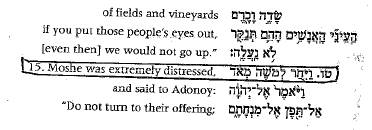
 Verse 15 says

image008

I thought the  word   image009 meant “anger”. I was surprised that Rashi translates it as “distressed” .  Rashi choose to not translate V”Yichar word as anger.  Rashi seems to argue on Targum Onkyls who translates V’Yichar as anger.      Per Rashi, Moshe was distressed, grieved.  Refer to the scanned attachment for Rashi.  It is clear that image009 by itself does not mean anger.  The source of Rashi is the Medresh, as follows:

image010Refer to the explanation in the bottom of the Medresh who explains it, as follows:

 When someone has an argument with another and is able to respond to his antagonist, the person has satisfaction (he is able to answer the verbal assaults).  However, when the person being attacked – the victim, cannot answer his antagonist, the victim  has pain, grief, and aggravation.  Dasan and Aviram challenged Moshe’s leadership.  They did not appear before Moshe with their attack, so that  Moshe could not respond to them.  Moshe tried to make peace, they turned on him, and got the upper hand.  Moshe was publicly humiliated, embarrassed and he was distressed.

This is the meaning of the word – image011

I want to add another meaning of the Medresh.

The Medresh employees the words   image012   image013  .  These words imply personal satisfaction and not answering your enemy or being victorious.

I want to say that the Medresh is telling us a comment on  human psyche.  If we are fighting with someone and we answer that person, we have personal satisfaction and we are at peace with ourselves.  However, if we do not answer a verbal assault on ourselves, then we have pain and anguish.  It eats away at us, with negative, negative results. It can take years to forget the hurt.

A personal story to illustrate.

Years ago,  two distant cousins of mine were talking to one another and the older gentleman tried to humiliate his younger cousin.    He said that he does not see how his cousin is a Kotzker descendant, because his cousin was not sharp.  Neither my cousin nor I, who witnessed this exchange, answered these older gentlemen.     The younger cousin was silent in the face of a verbal assault.  He should have said and could have said that the older gentlemen was at one time the Rabbi of a non-Orthodox  Synagogue, that he is not trustworthy, that his business ethics could be questioned, and that it is doubtful that  he served Kosher food in his business to Jewish residents.

It would have been different if my cousin had a ready answer,  but we both held our tongues.   It was true that my younger cousin  does not have the Kotzker sharpness.   The correct answer is that there are many aspects of Kotzker Chassidus and this individual did not embody at all Kotzker Chassidus.  He did have a quick mind, but otherwise was a boor.   This hurt my younger cousin for years

Medresh

Omaha, Nebraska

photo

This past Shabbos I spent a wondrous weekend in Omaha, Nebraska by my cousins, Rabbi Jonathan Gross and his wife, Miriam, and their three lovely kids.  I left Chicago on Thursday, May 23, 2013 at 6:00 PM and arrived in Omaha at 3:30 AM.  I let myself in their house and went to sleep.

Relationship:

1) Jean Sklar – Morgenstern                         Shirley Sklar-Maza

2)   Mitchell A. Morgenstern                         Zlat (Sandy) Maza-Gross

3)                                                                       Rabbi Jonathan Gross

Continue reading “Omaha, Nebraska”

The Yunge Bubbe’s Yahrzeit and Family News

Today is the Yahrzeit of my mother’s grandmother, (Alta) Chana Henya Sklar , who left this world on the first of Iyar, April 27,  1933.  (Alta) Chana Henya Sklar was the mother of my Zeidi, Reb Sholom Sklar.   She was known as the Yunge Bubbe (young  grandmother).

The Alte Bubbe (older grandmother) was the mother of Archik Tikotsky.  Archik

Alte BubbeTikotsky was married to Beilke, the oldest sister of my Zedie.  She and her husband brought the family to America in the early part of the 20th century, with my Zeide coming last in 1924.  Beilke is buried in the old Krinker cemetery, which I cannot find.    The Alte Bubbe lived by my Zeide because her kids were no longer Orthodox.  My mother told me that she died in my Zeide’s arms. Continue reading “The Yunge Bubbe’s Yahrzeit and Family News”

The Kotzker Rebbe and the Crimean War:

Expressions of love for Jewish soldiers

I saw this Vort from the Kotzker mentioned in Harry Maryles’s Blog, Emes V’emunah, by a commentator named Ephraim.  I have not seen this Vort in  a sefer, but it is true to the Kotzker and keeping with the feeling of his responsibility to the entire nation of Israel. Continue reading “The Kotzker Rebbe and the Crimean War:”

Rabbi Tzvi Hersh Morgenstern, TZL

Rabbi Tzvi Hersh Morgenstern, TZL

1858 –  2/18/1920 – 29 Shevat  5680

ktozk 2This Shabbos was the 83rd Yahrzeit of my great Grandfather, Admor Tzvi Hersh Morgenstern of Lukav.  Rabbi Tzvi Hersh Morgenstern was the great grandson of the Kotzker.  The Kotzker Rebbe was his Sandek. Continue reading “Rabbi Tzvi Hersh Morgenstern, TZL”

Kotzker Rebbe’s Yahrzeit 2011

Family e-mail:

January 26, 2011

It is now 7:44 PM and I have just finished for the day.  I did go to Sidney for Mincha and Maariv.

I gave the Daf Yomi Shiur last week and enjoyed it.  To prepare I used the Daf Yomi shiur on ou.org, the most widely listened to Daf Yomi in the world.  It is given by Rabbi Moshe Elefant.  His 45 minute Shiur turned into a 1.5 hour study session for me.

On 2/1/11, just 6 days from now, registration opens for the 2011 Chicago marathon.  A ray of sunshine in this bleak winter.  Walking the miles and miles of 2010 Chicago Marathon,  I was  in terrible agony, and told myself  that I will never do this again.  However, the sights, sounds, and smell of the marathon keeps beckoning to me and I am going all in.

Tonight and tomorrow is the 152st Yahrzeit of the Kotzker Rebbe.  I like to write something novel or something that I did not know about the Kotzker every year. Continue reading “Kotzker Rebbe’s Yahrzeit 2011”

Yeshiva Week

January 17, 2013 – January 24, 2013

My Week at the Boca Raton Synagogue – BRS

http://www.brsonline.org

BRS Shabbos Bulletin – Parshat Bo

Yeshiva Week – noun.

Celebrated to its fullest in Florida.

You’ve heard of New Year’s break, mid-winter break, and even Spring Break… but what about Yeshiva Week? This is the week when Jewish schools have off and it usually falls around mid-January – this year, it falls around the week of January 19th – January 29th.

Continue reading “Yeshiva Week”

A Man’s Wages

Mr. K_____ is 80+ years old. He lives in a nursing home and attends our Synagogue, Mishna Ugamorah, every Shabbos and Sunday . He is important as we are happy to get 10 men for the Minyan. He comes at 9:30 AM and stays all day. He will eat either at my house or the Rabbi’s house. He worked all the years for Milt Gershowitz on the Montreal pop truck, delivering cases of pop in glass quart bottles, 12 to a case. I first met him when he was still able to live alone. He has since moved to the nursing home. He has only one or two living relatives and is not in contact with them. He talks about politics and only watches Fox news.

This past Shabbos, January 4, 2013, he ate at my house. During the meal he is contemplating his life and says, “I never earned a man’s wages.  As a result I could not get married and have my own kids”. He repeated himself a number times, “I never earned a man’s wages. I never earned a man’s wages. Nothing ever went right for me.”
I spoke to the Rov and what we surmise was that in the 1940s, he was in the Marines. He was issued a general discharge. The Rov was a Chaplain in the US Army and told me that in the 1940s and 1950s, in society a man was judged by his military service and if he was dismissed under a general discharge, it was held against him.  I sense that his entering the Marines was almost by accident and not really what he wanted or a stupid decision. Life often hinges on one act, on decision, one moment.

There was nothing I could say or that could be said.  My response was that we appreciate your effort in coming to our Synagogue and that there is huge merit waiting for him from God.   He is able towards the end of his life to come to pray, be called up to the Torah, participate as one of the guys.  This alone will pay him great dividends in the next world.

I have said this many times in the past.  This is one of the purposes of the Synagogue, to give everyone a place, a sense of belonging.  I love Synagogues that are robust, full of life, people talking, full of Torah.  Rabbi E. once told me that I would love his Synagogue.  He has no rules.  He knows me quite well.   I detest Synagogues with “Hakpodos”, heavy handed rules. 

The movie Back to the Future opens up with Michael J. Fox as Marty McFly with his family. His father lives in fear of his boss, they have a very modest home, and are losers in life. At the end of the movie after Marty McFly goes Back to the Future, history has changed, and his family now lives an upper middle class life in a gorgeous home and are winners in life. What changed? In the movie there was a pivotal scene which changed his father’s life. His future boss was the school bully. Originally, in the pivotal moment, his father does not stand up to the school bully and as a result lived his entire life in fear, downtrodden. When Marty McFly goes back to the future, he changes that moment of truth. His father stands up to the bully. His father now sees himself differently, as a winner, and his entire future changes.

Mr. K____ ‘s moment of truth did not turn out well for him. As a result a Man’s Wages . . . a Man’s Wages . . .