Reb Shmuel (Shiku) Smilovic – Sam Smiley February 1928 – 11/27/2015

November 27, 2015 – 14 Kislev 5776

Reb Shmuel (Shiku) Smilovic – Sam Smiley  February 1928 – 11/27/2015

Today I received news of the passing of Reb Shmuel Smilovic.  I met Reb Shmuel about 5 years ago.  His wife was a fifth cousin of mine.    I felt instant kinship with Reb Shmuel and cherished my visits with him.  I had a lunch with him along with his daughter, Fern, and son,  Dr. Mark Smiley.  The following is my feelings on his passing.

Picture1

Please click on this link for his history, – http://www.museumoffamilyhistory.com/wims-smilovic-prewar.htm

Dear Fern and Mark:

I join with you in your sense of loss on the passing of your father.  My connection with your father while short left a deep impression on me.  The grace, the sense of history, the joy of family is what I remember and I cherish.  Thank you for introducing me to your father.

On Shabbos at the Sholosh Suedas meal, I dedicated my speech to your father and spoke about your father.  It was at my sister’s house as she has a Minyan every Shabbos and hosts the Shalosh Suedas meal.  Here are my words and I have added to them.

I regret to inform everyone of the passing of our relative in Toronto, Reb Shmuel-Sam Smilovic-Smiley.  His wife was a descendent of Rabbi Yechiel Moshe Greenwald.   Despite his wife being a sixth (fifth) cousin to us, I felt a close bond to Reb Shmuel.

Reb Shmuel grew up in Munkatch Hungary and was in the city choir with his best friend Jack Reiss.   He had a happy childhood.  It changed in 1943 – 1944.  Reb Shmuel wrote about his experiences in Hungary and in the concentration camps.  I tried to read through his memoir on those years.  I have a difficult time reading first person accounts of the holocaust and will just quickly scan through an account because of the horror.  The one thing I remember is Reb Shmuel writing about being in the train to Buchenwald, looking out of the window, seeing the soccer fields that he played soccer with his friends.  It was a nice day.   The kids on the field had life and he and his fellows Jews were on their way to death.

He was freed from Buchenwald with Jack Reiss.  Both wanted to start a new life.  Reb Shmuel ended up in Toronto.

Reb Shmuel lived in an Assisted Living Facility on Sheppard.  It was there that I met his kids, Fern Smiley and Dr. Mark Smiley.

I remember him introducing me to his friends in the assisted living facility.  Everyone had a nickname for where they were from in Europe.

As I think back to my visiting him, what stood out most is when I sat with him is his apartment.  I looked around his apartment and tried to absorb everything in the room.

  • I saw the picture on the wall of Reb Shmuel at a grandson’s Bar Mitzva (wedding?). He was in the center, surrounded by his beautiful family.  I only wish that God gives me the same feeling of joy and Nachas that Reb Shmuel felt on that sunny day at his Ainilkol’s Bar Mitzvah.
  • I looked at his coffee table to see what books he was reading and what gave him comfort.  There were three books:
  • A cantorial book.  Reb Shmuel loved Chazzonus.  As I am writing out my speech on Sunday morning, I recall Reb Shmuel breaking out in Chazzonus.
  • A book by Elie Weisel.  Reb Shmuel met and was honored by Elie Weisel.   He also met and felt honored by his friendship with the former Chief Rabbi of Israel, Rabbi Yisroel Meir Lau.
  • A book of Rabbi Shlomo Carlbach’s stories.  The incomparable Reb Shlomo.

I looked through his son’s, Dr. Mark Smiley’s, wedding album.  Beautiful.  I was able to see his family.  As I turned the pages I saw one of my mentors, Rabbi Avrohom Kelman, Rabbi of Prospect Park, where my sister’s family davened.    The next day I called Rabbi Kelman and gave him a “Gruss” from his Mechutin.  Rabbi Kelman is elderly and appreciated my call.   Reb Shmuel was able to reach out and touch Rabbi Avrohom Kelman.  One year later my nephew’s Aufruf was in Prospect Park and Rabbi Kelman in his 90’s was as strong as ever.  I Febrenged with him.

I then said over a Dvar Torah that his wife’s ancestor, Rabbi Yechiel Moshe Greenwald, wrote that he heard from his Uncle, Admor Dovid Morgenstern on this week’s Bible portion.  Admor Dovid was married to Chaya Toibe, a brother to Reb Yechiel Moshe’ father.  Rabbi Yechiel Moshe Greenwald saw the Kotzker as a boy. learned by the Kotzker’s son, Admor Dovid.  Rabbi Yechiel Moshe Greenwald is the only one who wrote Torah from Admor Dovid, and because of his efforts we have Torah from the Kotzker’s son.  Rabbi Yechiel Moshe Greenwald lived roughly from 1830 to 1920.  He fathered kids into his 80’s.  Rabbi Yechiel Moshe Greenwald has a grandson in Toronto.  Imagine, we have a grandson of a man who saw the Kotzker.

The first Verse in this week’s Torah portion, says.  “And Yaakov sent Malochim “before him”, to Eisav his brother, to the land a Seir, the field of Edom.”  The Hebrew word Malochim can be translated as angels or messengers.

The Medresh Rabbah 75:4 brings down a dispute:

“These Malochim are human messengers.  The Rabbis said Malochim Mammosh – actual angels.”

Rashi mentions only the Rabbi’s position and says “Malochim Mamosh “ – angels.  The Sifsei Chachomin says the basis for this positon is that there is an extra word in the Verse,  “The word “L’phnov – before him”.   This word is clearly  extra as it can be read without this word, without losing any meaning.   This word  teaches us that Yaakov sent the angels that were before him, two verses prior says that as Yaakov entered Israel he met the angels of God.  These are the angels that were sent.

What does the first opinion that Yaakov sent humans do with the extra work of L’phnov – before him.

You can answer it by a Torah thought written down by Rabbi Yechiel Moshe Greenwald from his uncle, Admor Dovid Morgenstern on this Verse.   Admor Dovid said that the extra work of “L-phnov” means that he sent them away from before him. He sent them away as he did not want their help, because God can help without angels, and without any intermediary.  Yaakov wants his prayers to God and his own efforts to help and guide him, and not reliance on  intermediaries  Similar to  Exodus 33:15 where  Moshe did not want angels leading the children of Israel but God himself.

Reb Shmuel combined both aspects of the Medresh.  He was a human being with the qualities of an angel.

I know that his Neshama is in Toronto and he may not be able to hear me, I ask him forgiveness for not visiting more, not calling.  May his life be a source of comfort to his family and be a Melitz Yosher for his family.

—–Original Message—–
From: fernsmile [mailto:fernsmile@gmail.com]
Sent: Friday, November 27, 2015 8:36 AM
To: Mitch Morgenstern
Subject: Re: Jack Reiss

My father, Sam Smilovic passed away this morning. Funeral Sunday through Steeles memorial, Fern

On Oct 19, 2014, at 9:01 AM, Mitch Morgenstern <MMorgenstern@mbfinancial.com> wrote:

Jack Reiss passed away and his funeral is this morning.


SMILOVIC (Smiley), Sam
Within the loving embrace of his family, Sam Smilovic (Smiley) passed away early Friday morning. Sam always found a way to overcome his difficult past by holding true to his values and traditions, while moving forward with his beloved Annette z”l with hope, humour, and contributions to the community. Sam is lovingly remembered by his children, Fern Smiley, Rabbi Mark Smilovic Smiley (Aviva Silverman) and Neil Smiley (Jordana), by his grandchildren, Jessica, Daniel, David, Yael (Gabe), Dov, Benjamin, Jared and Erin, by many nieces and nephews in Canada, U.S., and Israel, as well as by a multitude of friends from each stage of his life.* He will be greatly missed and forever remembered. Sam’s published Holocaust memoir can be found at http:/ /migs.concordia.ca/memoirs/smilovic/ smilovic.html. Funeral service will be held on Sunday, November 29, 2015 at 11:00 a.m. at Shaarei Tefillah Synagogue, 3600 Bathurst St., Toronto. Interment to follow at Mount Sinai Cemetery, Shaarei Tefillah section. Memorial donations may be made to The Sam and Annette Smilovic Fund, c/o Associated Hebrew Schools (416) 494-7666.

Sam Smilovic (Smiley) ז״ל

We regret to announce the passing of our member:

Sam Smilovic (Smiley) z”l
on
Friday November 27, 2015
15 Kislev 5776

Father of:

Fern Smiley

Rabbi Mark Smilovic Smiley (Aviva Silverman)

Neil Smiley (Jordana) our members

Grandfather of:

Jessica, Daniel, David, Yael (Gabe), Dov, Benjamin, Jared and Erin

Funeral:

November 29, 2015, 11:00 am

Shaarei Tefillah Congregation, 3600 Bathurst Street, Toronto

Interment:

Mount Sinai Memorial Park, Toronto – Shaarei Tefilah Synagogue Section

Shiva:

566 Castlefield Avenue, Toronto

Private family time between 6:00 pm and 7:00 pm

Services:

Morning Services at 7:30 am

Evening Services at 4:30 pm


Parshas Ki Tavo – Jewish Soldiers

From: Mitch Morgenstern <MMorgenstern@mbfinancial.com>
Date: Sunday, August 30, 2015 at 9:54 AM
To: Rabbi Efrem Goldberg
Subject: Update

Rabbi Goldberg:

I hope everything is well.  I like your weekly Chumash Shiur.  I listened to your Shiur from Tuesday on Ki Teitzei.   I used your Torah as a springboard,  went through the Rishonim myself, expanded for myself your approach, added to it, and spoke on Shabbos in two places.

I went through the Meshcech Chocma who added greatly.  I find the Meshech Chocma refreshing and the few times I have seen the Meshech Cochma, it seems  that his Torah is very Litvish, very practical.  To me he is part of the Rov’s world, part of Rabbi Kook is his approach. I admit I have seen only a few of his Divrei Torah.  My daughter got me a Cooperman Meshech Chochma  this past June (she was in Michlala this past year, unfortunately did not get me a signed copy) and without Cooperman, it is almost impossible for me to learn the Meshcech Chochma.

I also ended my speech with reading directly from the Abarbanal who beautifully recapped  your approach.

I spoke at Shalosh Suedes and told over your IDF Golani story along with another story I heard.  The crowd is more Yeshvish and I am the only one who will bring up Israel, the IDF, Rav Kook so I thank you for your approach and your stories.  It is not that they do not agree with me, but they do not hear these stories, will never hear a Torah Vort from Rav Kook, how to look positively at the State of Israel and the IDF.

I wish that the BRS classes would be broadcast live and that they be recorded as audio classes.

Wishing you continued success.


From: Mitch Morgenstern
Sent: Tuesday, September 01, 2015 9:44 PM
To: Rabbi Efrem Goldberg
Subject: Update

Rabbi Goldberg:

I know you will be giving a Shiur tomorrow on Ki Tavo, however, I wanted to add something from your Shiur last week.

The attached Medresh Tanchumah translates “M’Kol Dvar Ra” as there should not be an “Lazunus” – frivolity,  so that you do not come to guilt.

The Medresh is not like any of the other explanations.

I think the Medresh is saying that when you go into the army, a soldier may feel that everything is permitted.  Halacha is that certain things are permitted in times of war,  and since a soldier is in a  situation of Pikuach Nefesh, he will have a laxity in his attitude, Mitzvos, and actions.

The Medresh Tanchuma is saying that a soldier should not have this sense of Lazunus, translated more as laxity.   The YU Kollel Torah M’Tzion had a program where two Kollel members, Rabbis’ Liss and Berman, spoke about why they served in the IDF.  Rabbi Liss was a Yeshiva Hakotel student and Yeshiva Hakotel goes to the army (as I recall) after Purim as a Chevra.  These guys go in with a sense of purpose, with seriousness, and a sense of  responsibility to the entire Jewish nation.  These Bochrim do not go in with Lazunus.

The Medresh Tanchuma is saying be like these Hesder boys, who go in for the right reasons.    Rabbi Liss and Rabbi Berman were riveting and after there speeches, all one can say is Boruch Hashem  we have boys like this.   I sit in one of Rabbi Liss’s classes and I looked at him totally different after his talk.  I  am not on his level.

Rabbi Liss has terrible asthma and during basic training had a serious attack.  He was told that he could get a desk job, yet he refused, and completed basic training.  They made him a tank driver which is not as hard.  When he left after his 14 months in the Hesder program, he had a sense that was deserting his friends who serve for three years.    Rabbi Berman was equally compelling.

Rabbi Liss said they had 20 minutes for Mincha, which only took 10 minutes.  They spent the extra 10 minutes learning


SHABBOS CHAZON – JULY 25, 2015


SHABBOS CHAZON – PARSHAS DEVORIM – JULY 25, 2015 – 9 AV 5775

LEADERSHIP II

Moshe FeIglin – https://en.wikipedia.org/wiki/Moshe_Feiglin

Moshe Feiglin spoke at 5:00 PM at KJBS and I went to hear him and his ideas for Israel. It was very informative. I walked him home with others to his host after the speech. I told him what he said in his speech is what Rabbi Samson Raphael Hirsh said on the Haftora for Shabbos Chazon. Moshe Feigln wants both religious and secular Jews in Israel to go back to their purpose which is to be a light to the nations. This is why Moshe Feiglin moved his political center to Tel Aviv. He wants to bring a universal message to all Jews, that we are to be a beacon of light to the world, whether secular or Dati.

Rabbi Samson Raphael Hirsh said the first temple was destroyed because the Jewish people were no longer the light to the world. They did not bring morality and spirituality to the entire world, so God destroyed the temple and sent the Jewish people into exile.

On Tisha BAv, I heard the Consulate General Roey Gilad.  He said that depsite all of the problems in Israel, he trusts the Jewish people and that God will not let us down.  Moshe Feiglin said the same thing.

I only wish I was a Talmud Chochem so I would give a Shiur with Moshe Feiglin and Roey Gilad and with Torah we can unite all Jews together.  They can argue but they would leave the Shiur as friends and can work together.


This Shabbos I focused on the following verses.

כדאי לעצמו:
9 And I said to you at that time, saying, ‘I cannot carry you alone. ט וָאֹמַר אֲלֵכֶם בָּעֵת הַהִוא לֵאמֹר לֹא אוּכַל לְבַדִּי שְׂאֵת אֶתְכֶם:

Rashi comments –  “What is the meaning of   לֵאמֹר   ?” (This is an extra word as the Verse makes sense without this word.)    “Moshe said to them, “not by my own accord do I speak to you, but by the command of the Holy One, blessed is He.”

The next Rashi on the words “I cannot carry you alone” explains why God did not let Moshe carry the burden of the Jewish people alone. Rashi says:

Rather Moshe said to the Jewish people – The Lord, your God has multiplied you: – meaning – He has made you superior and elevated you higher than your judges. He took the punishment away from you and imposed it upon the judges.

Rashi seems to be saying that there is too much responsibility for one man, even as great as Moshe. I feel that God is also saying to rule and judge, one man cannot do it alone; especially a court system. Honest judges and a fair court system are the cornerstones of a normal society, a just world.

Verse 12 says:

כאשר דבר לכם:
12 How can I bear your trouble, your burden, and your strife all by myself? יב אֵיכָה אֶשָּׂא לְבַדִּי טָרְחֲכֶם וּמַשַּׂאֲכֶם וְרִיבְכֶם

Why does Moshe essentially repeat himself? In verse 9 he already said that he cannot do it alone. Although the plain meaning of the text does not seem to criticize the Jewish people, as Moshe on a plain meaning is saying how can I alone put on my shoulders the trouble, burdens, and strife of my people Every leader put on his shoulders the responsibility of his people.   Moshe is saying I need help doing it. However, here Rashi is saying that Moshe is criticizing the Jewish people saying they are 1) troublesome  2) burdensome – they were heretics, and 3) they are contentious.  This is very difficult because the Rashi on verse 9 said that God told Moshe that God is not allowing Moshe to be the sole leader because God made the Jewish people superior and elevated them higher than the judges.

Another question is that the first Rashi on Verse 12 says, Even if I were to say, “I will do so in order to receive a reward,” I cannot do so. This is what I have already said to you, “Not by my own decision do I tell you [that I am unable to bear your trouble], but by the command of God.

What does it mean, even if I were to say, I will do so in order to receive a reward, why would Moshe want a reward, leaders do not ask for a reward, they want to do the right thing, they are leaders.

The Gur Aryeh on this Verse asks this question and another one, and explains Rashi

Final questions on Verse 15, Rashi says what does it mean “So I took the heads of your tribes, . . .” – “I attracted them through fine words: “How fortunate you are! Over whom are you to be appointed? Over he children of Abraham, Isaac, and Jacob – over the children of people who are called brothers and friends, God’s portion and inheritance and every term of endearment.

In verse 12 Rashi says that Moshe severely criticized the people, saying they fight, are heretics, and are burdensome and to attract the judges he says the people are great.

There is a beautiful Mesh Chochma, on Verse 9 which is in line with the Gur Aryeh. The Meshech Chocma is Rabbi Meir Simcha of Dvinsk (1843 -1926), https://en.wikipedia.org/wiki/Meir_Simcha_of_Dvinsk. My daughter was in Michlala and she bought me the Meshech Chocma edition with Rabbi Cooperman’s footnotes. The Meshech Chocma is a difficult Sefer to understand and Rabbi Cooperman opened up the Sefer with his footnotes.

Reb Meir Simcha says:

Verse 9 is can be explained in the following manner: A person who is blessed with wealth and children. He has problems raising his kids, from his business. He says, how great are these problems from you. God should give you, my children and grandchildren the same problems.   This is what Moshe the faithful servant said , God increased you and made you like the stars of the heaven, in numbers and greatness almost as if by miracles.  So should all leaders say about you and complain how difficult it is because that is their job. They are not complaining, but saying thank you Hashem for giving me this opportunity to lead the Jewish people.

As Rabbi Cooperman says, Moshe is really blessing the Jewish people. There are always problems and only because of the problems can we be leaders.

Rabbi Samson Raphael says on Verse 12 that these three negative attributes are not specific to the Jews in the desert, but to all nations, like the Gur Aryeh and the Meshech Chocma.

Dr. Ungar added the following:

http://www.jyungar.com/theological-essays/2012/4/27/the-space-upon-which-the-torah-hinges.html

Submitted on 2015/07/26 at 6:15 PM

Rashi has a different definition of apikorus…

“troubles” meaning litigious and using the legal system to further business aims…
“burdensome” means apikoris (like the targum)..here it means alsways questioning the leader’s motives….ie the definition of true heresy…

Heresy is any provocative belief or theory that is strongly at variance with established beliefs or customs. A heretic is a proponent of such claims or beliefs. Heresy is distinct from both apostasy, which is the explicit renunciation of one’s religion, principles or cause, and blasphemy, which is irreverence toward religion.

However the Rambam made apikorsus into apostasy.

has anyone done a study on the difference between the French and Spanish Jewish theologies?
( I would argue that being exposed to Arabic philosophy the JEws of Spain were more inclined to arguing about doctrine.)

How can I bear…all by myself?: [Even] if I were to say, “I will do so in order to receive a reward,” I cannot do so. This is what I have already said to you, “Not by my own decision do I tell you [that I am unable to bear your trouble], but by the command of the Holy One, blessed is He.”

איכה אשא לבדי: אם אומר לקבל שכר לא אוכל, זו היא שאמרתי לכם לא מעצמי אני אומר לכם, אלא מפי הקדוש ברוך הוא:
your trouble: This teaches us that the Israelites were troublesome [people]; if one saw his opponent in a lawsuit about to win, he would say, “I have [other] witnesses to bring, [more] evidence to introduce, I [will exercise my right to] add judges to you [in your tribunal]”.

טרחכם: מלמד שהיו ישראל טרחנין. היה אחד מהם רואה את בעל דינו נוצח בדין, אומר יש לי עדים להביא, יש לי ראיות להביא, מוסיף אני עליכם דיינין:
and your burden: This teaches that they [the Israelites] were heretics: If Moses was early leaving his tent they would say, “Why does the son of Amram leave so early? Perhaps he is not at ease inside his house?” If he left late, they would say, “Why does the son of Amram not leave? What do you think? He is [probably] sitting and devising evil schemes against you, and is thinking up plots against you. [Other editions of Rashi have”commandments and reckonings.”]

ומשאכם: מלמד שהיו אפיקורסין. הקדים משה לצאת, אמרו, מה ראה בן עמרם לצאת, שמא אינו שפוי בתוך ביתו. איחר לצאת, אמרו, מה ראה בן עמרם שלא לצאת, מה אתם סבורים, יושב ויועץ עליכם עצות רעות וחושב עליכם מחשבות:
and your strife: This teaches that they [the Israelites] were contentious (Sifrei).

LEADERSHIP

SHABBOS – PARSHAS PINCHOS – 24 TAMMUZ 5775 – July 11, 2015:

LEADERSHIP:

20 Tammuz – 5664 – July 3, 1904 – Yahrzietof Binyomin Tzvi Ben Yaakov – Theodore Herzl

22 Tammuz- 5666 – July 17, 1873 – Yahrzeit of Admor Dovid Morgenstern. Second Kotzker Rebbe.

29 Tammuz – 5700 – August 4, 1940 – Yahrzeit of Ze’ev Jabotinsky

Parshas Pinchos Chapter 27, Verses 15-23 talks about leadership. Parshas Pinchos is blanketed by the Yahrzeits of Herzl and Jabotinsky, with my Zedi’s Yahrzeit in the middle. Herzl and Jabotinsky were secular and not accepted by many in the Torah world. Yet they were great people whose mission was to save Jews. The tragedy is that many in the Torah world refused to understand them. Others understood their message.   My Zedi and all the Kotzker children understood leadership, the responsibilities, and worked for the betterment of all the Jews. Reb Dovid’s son in 1885 tried to go to Israel and change everything to save the Jews in Europe. He understood the right things to do because he had Shimosh from his grandfather, the Kotzker Rebbe, and his father, Admor Dovid Morgenstern.

These three people should be MiLeitz Yosher for all Jews.

This Shabbos I went through the first half of Parsha Pinchos and tried to get a foothold in the parsha. I focused on Chapter 27, Verses 15-23. The storyline is that Moshe and Eliezer counted the nation of Israel and said these 601,730 men over 20 years old will inherit the land of Israel.   The five daughters of Zlaphchad go to Moshe and say , “why should our father’s name be eliminated from his family because he has no sons, give us an inheritance.” The next storyline is that God tells Moshe “go up to the mountain of Averim and look at the land. You will die and you are not going into Israel.” After Moshe is told you are not going to Israel, he asks for God to appoint a successor. When you read these nine verses, it is a beautiful story. One leader passed the leadership to the next generation’s leader. However, Hebrew words have nuances and there are Midrashim that give color.

15Moses spoke to the Lord, saying:

16“Let the Lord, the God of spirits of all flesh, appoint a man over the congregation,

17who will go forth before them and come before them, who will lead them out and bring them in, so that the congregation of the Lord will not be like sheep without a shepherd.”
18The Lord said to Moses, “Take for yourself Joshua the son of Nun, a man of spirit, and you shall lay your hand upon him.

19And you shall present him before Eleazar the Kohen and before the entire congregation, and you shall command him in their presence.

20You shall bestow some of your majesty upon him so that all the congregation of the children of Israel will take heed

21He shall stand before Eleazar the Kohen and seek [counsel from] him through the judgment of the Urim before the Lord. By his word they shall go, and by his word they shall come; he and all Israel with him, and the entire congregation.”

22Moses did as the Lord had commanded him, and he took Joshua and presented him before Eleazar the Kohen and before the entire congregation.

23He laid his hands upon him and commanded him, in accordance with what the Lord had spoken to Moses

Rashi on Verse 15 speaks in praise of Moshe and says.:

Moses spoke to the Lord…: This [verse comes] to let us know the virtues of the righteous, for when they are about to depart from the world, they disregard their own needs and occupy themselves with the needs of the community. — [Sifrei Pinchas 23] וידבר משה אל ה’ וגו’: להודיע שבחן של צדיקים שכשנפטרין מן העולם מניחין צרכן ועוסקין בצרכי צבור:
saying: He said to Him, “Answer me whether You are appointing a leader for them or not.” – [Sifrei Pinchas 23] לאמר: אמר לו השיבני אם אתה ממנה להם פרנס אם לאו:

Moshe wants an answer from God. Moshe didn’t merely ask, but said in a harsher tone, I want an answer. The Orach Chaim Hakodosh speaks about this and really does not answer.  Chazal say that there were 4 times that Moshe asked something from God and wanted an answer. All were when the nation of Israel was in trouble.

I can understand why Moshe talked harshly saying, I demand an answer. Leadership is critical. Throughout our history leaders have failed. After King Solomon dies, the Jewish people had a series of bad leaders leading to disastrous results. In our own day and age, the great leaders after the Holocaust rebuild Jewry.  Unfortunately there were those who despite their greatness felt a need to disparage other leaders.   Pre WW II, when Europe was burning there were those leaders who understood that the salvation for Jewry was Eretz Yisroel. In the 1880s Admor Dovid Morgenstern’s son, Reb Chaim Yisroel M’Pilav understood this and tried to change the dynamic. The Meshech Chocmoh understood this and while not directly agreeing with Rabbi Avraham Yitzchok Kook, agreed in principal with him. In secular Jewry, Herzl changed everything and in the heavens they were praying that Herzl would succeed. Jabotinsky also got it. Many, many Gedolim understood it, but could not make the necessary changes. The Agudah got it in 1937.

Rashi on Verse 16 seems to contradict the above and that Moshe was asking for selfish reasons.

Artscroll put the two together and says that Moshe desired a successor and he truly felt that he son could be that person. It was a benign request of God. However, the language used by the Medresh Tanchuma Sefrei is harsh, as if Rashi is saying time for me to take care of my own. After all, the opening Rashi on Verse 15 is also harsh.

 Verse 16:

Let the Lord… appoint: When Moses heard that the Omnipresent told him to give Zelophehad’s inheritance to his daughters, he said, “It is time to ask for my own needs-that my son should inherit my high position.” The Holy One, blessed is He, said to him, That is not My intention, for Joshua deserves to be rewarded for his service, for he “would not depart from the tent” (Exod. 33:11). This is what Solomon meant when he said, “He who guards the fig tree eats its fruit” (Prov. 27:18). – [Mid. Tanchuma Pinchas 11],

Another question on Rashi – You would think that Moshe would have thought to ask for his sons to succeed him would have happened after Moshe heard that he is going to die. Perhaps Rashi means both.

Another question – Rashi says that Joshua was rewarded for his service. Does this mean that Joshua was a worthy leader, or with  Moshe by laying his hands on Joshua thereby passing the mantle of leadership, and this instilled in Joshua a leadership force.  (The magic wand). The Ksav Sofer says that Joshua was a capable leader. A person to become a leader must have “Shimosh”. He must learn and observe from a teacher, a leader and once he absorbed all that he saw, how his teacher treated people, how people asked questions, then he can succeed him. Joshua observed all this. Not only that we know that Joshua led the fight against Amalek, Exodus 17, Verses 9 and 10. Joshua was this person through his dedication to Moshe.

 Verse 17:

Verse 17 repeats itself. The leader is to take the people out and lead them back in twice. What does it mean “and back in”.

The final Verse that can be questioned:

 Verse 19:

יט  וְהַעֲמַדְתָּ אֹתוֹ לִפְנֵי אֶלְעָזָר הַכֹּהֵן וְלִפְנֵי כָּל הָעֵדָה וְצִוִּיתָה אֹתוֹ לְעֵינֵיהֶם:

19And you shall present him before Eleazar the kohen and before the entire congregation, and you shall command him in their presence.

Rashi says:

And you shall command him: Concerning Israel; be aware that they are troublesome and obstinate. [You accept office] on condition that you take upon yourself [all this]. – [See Sifrei Beha’alothecha 42]

This command was said in their presence”. In front of the entire congregation Moshe told Joshua they are troublesome and obstinate. We have a beautiful moment and the people of Israel are criticized. Why say anything negative at this time. Joshua saw everything that Moshe went through and knows all this. If you want to criticize, put a positive spin on it. Why not say, yes that are troublesome, but they are a holy nation, well worth the sacrifice. They are a great people. Maybe that is what was actually said.

It appears that this Rashi is his own explanation.   My initial reaction is that Rashi is focusing on the words        לְעֵינֵיהֶם   “in their presence”, even though it is not part of the Divrei Hamaschil of Rashi.    This word is extra because the Verse already said that Joshua is standing before the entire congregation.

On initial glance Rashi appears to be rebuking the Jewish people. The Ranban asks this question on Rashi and says that these words of rebuke were not said in front of the people. But rather privately to Joshua.   We still have to understand Rashi.

I was looking in Rabbi Munk’s Sefer and I noticed something. The same word,   לְעֵינֵיהֶם is used five Verses earlier when God told Moshe the reason why Moshe will not be going into Israel with the Jewish people , “ because Moshe did not  to sanctify Me through the water before their eyes   “לְעֵינֵיהֶם“.

I believe that Rashi agrees with the Ranban,  but Rashi is telling us that God told Moshe to command Joshua about the “לְעֵינֵיהֶם “. Remember what happened to me, how I let my anger get the better of me and was punished, do not let this happen to you.   This was not done publicly, but privately.   This verse is explained both ways.   Pashut Pshat like the Ranban, but the deeper explanation is that privately Moshe told Joshua, this is serious business. You will be provoked, etc.


Admor Dovid Morgenstern

Yesterday, July 9, 2015 – 22 Tammuz – was the 142nd Yahrzeit of Admor Dovid Morgenstern, Dovid ben Menachem Mendel, known by Kotzker Chassidim in Europe as the Mittler (Middle) Rebbe.  He was born in 1809. Refer to my post from last year.

I did not really do anything. I did say a Kal Maalah (prayer for the departed) for him; however, I only said it for myself, as Chazzan Silber told me we do not say Kal Maalah for old ancestors because they are already bound up with God.

I left work late and walked to the mail box on Lincoln to mail out a protest to a parking ticket I received, through almost no fault of my own. I bumped in Rabbi Yitzchok Kalish, a Breslever Chosid from Israel and a third cousin to me. I was happy to see him as he has not been in Chicago for years.    We made up a time to meet. I drove him to Great Chicago and of couse, if you read my post about my father’s Yahrzeit, I paid for his dinner.

On this day 152 years ago: The Battle of Gettysburg

JULY 3, 1863 – GETTYSBURG, PA – 152 Years ago

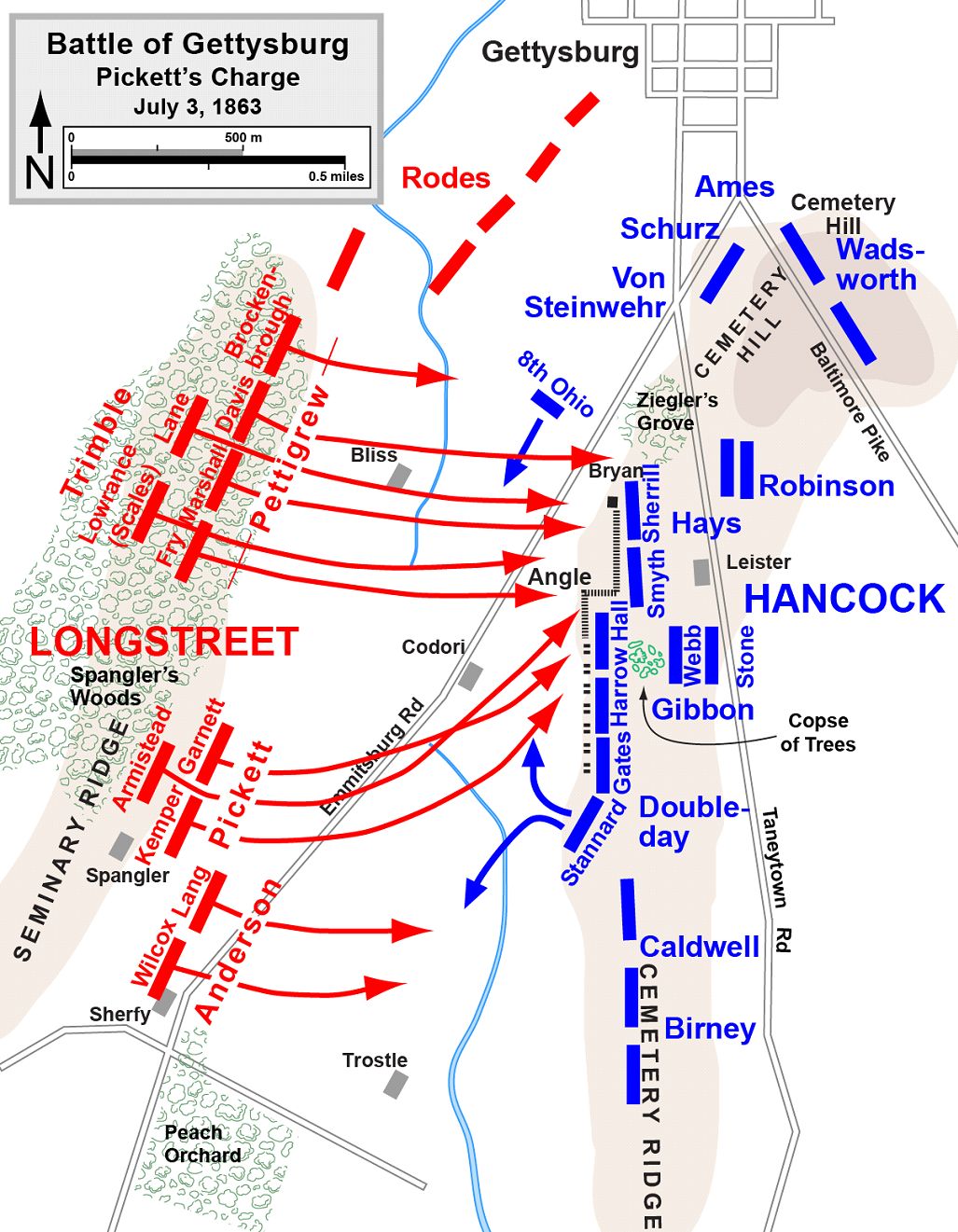
The Battle of Gettysburg was fought from July 1 – July 3, 1863. At 1:00 PM on July 3, 1863 Colonel E. P. Alexander, commander of the Confederate artillery on that day, gave the order and 150 Confederate guns open up against the Union line located approximately 1 mile away along Cemetery Ridge. The plan was to soften the Union defenses and then charge through the Union line and rout the Army of the Potomac.

This is a 6 minute portion from the movie, Gettysburg, which shows General James Longstreet discusisng the plans with his field General.s

http://www.bing.com/videos/search?q=gettysburg%2c+youtube+movie&FORM=VIRE16#view=detail&mid=E36C5D461F9D8BCABAE3E36C5D461F9D8BCABAE3

This is a 4 minitue snipet from the movie showing Picketts charge:

http://www.bing.com/videos/search?q=gettysburg%2c+youtube+movie&FORM=VIRE16#view=detail&mid=073B339C01E63C2FBE9D073B339C01E63C2FBE9D

This is another 4 minute snippet showing General Armistad ralling the troops.  He shouts,  “Give them the cold steel boys” and they go over the top.

http://www.bing.com/videos/search?q=gettysburg%2c+youtube+movie&FORM=VIRE16#view=detail&mid=073B339C01E63C2FBE9D073B339C01E63C2FBE9D

At about 1:30 PM, the order is given and 12,500 Confederate soldiers emerge from the woods behind Seminary Ridge. They line up in formation about 1 mile across, bayonets fixed and glistening in the bright July sun. It was an amazing sight.
At about 2:00 PM, General Pickett gallops on his horse to General James LongstreLet, commander of Lee’s First Corp . Pickett asked Longstreet, “General, shall I advance?” Longstreet’s memoir recalled: “The effort to speak the order failed, and I could only indicate it by an affirmative bow.”[x] General Longstreet felt the charge was doomed and could not verbalize the order to charge. He nods and General Pickett gives the order to march forward towards the Union line. The charge is known in history as Pickett’s Charge. Watch the movie Gettysburg for a vivid view of the Battle of Gettysburg, Pickett’s Charge and see all the entire battle unfolding before your eyes.

gettysberg
James_LongstreetRobert_Edward_Lee
Lieutenant General James Longstreet                General Robert E. Lee

I visited Gettysburg one item in my life and that was the day after Nachum and Alyssa Caplan’s wedding in Baltimore. I wandered onto the battlefield with no clue what I was looking at. I asked someone walking by for information. He told me that he is of the Southern persuasion and comes often. He showed me the high water mark, the bloody angle, and gave me an outline of Pickett’s charge . He told me that it has been debated for years as to why General Lee ordered the attack, when they were going p against a dug in and fortified Union line. This Southern gentleman explained that General Lee was suffering from dysentery and his mind was not clear. The wisdom and failure of Pickett’s charge has been debated every since the war. Who was to blame? Who let General down? Was General Longstreet a traitor ? Years later, when asked why his charge at Gettysburg failed, General Pickett replied: “I’ve always thought the Yankees had something to do with it.”
William Faulkner commented on this moment before the charge of the possibilities, when all the hopes and dreams of the Confederacy can come true. Read it with a Southern drawl.

For every Southern boy fourteen years old, not once but whenever he wants it, there is the instant when it’s still not yet two o’clock on that July afternoon in 1863, the brigades are in position behind the rail fence, the guns are laid and ready in the woods and the furled flags are already loosened to break out and Pickett himself with his long oiled ringlets and his hat in one hand probably and his sword in the other looking up the hill waiting for Longstreet to give the word and it’s all in the balance, it hasn’t happened yet, it hasn’t even begun yet, it not only hasn’t begun yet but there is still time for it not to begin against that position and those circumstances which made more men than Garnett and Kemper and Armistead and Wilcox look grave yet it’s going to begin, we all know that, we have come to far with too much at stake and that moment doesn’t need even a fourteen-year-old boy to think This time. Maybe this time with all this much to lose than all this much to gain: Pennsylvania, Maryland, the world, the golden dome of Washington itself to crown with desperate and unbelievable victory the desperate gamble, the cast made two years ago.
– William Faulkner, novelist

I read this fascinating account of the battle by Colonel C. E. Alexander written by him in 1877.

E. P. Alexander at Gettysburg

Letter From General E. P. Alexander, Late Chief Of Artillery, First Corps., A. N. V.

Southern Historical Society Papers, Vol. IV. Richmond, Virginia, September, 1877. No. 3.

Montgomery, Alabama. March 17th 1877.
Reverend J. William Jones, Secretary:

EdwardPAlexander

Edward Porter Alexander (Library of Congress)

Dear Sir — I have your favor of the 27th ult., enclosing copy of letter from , giving an outline of his views of the campaign and Battle of Gettysburg, and inviting my comments thereon. I take great pleasure in giving them in the same frank spirit in which they are asked, and asking no one to accept them to whom they do not commend themselves, and not pretending to know every thing about it.
My rank and position during that campaign was colonel of artillery, commanding a battalion of six batteries attached as reserve to Longstreet’s corps; and on the field of Gettysburg I was placed by General Longstreet in command of all of his artillery on the field as chief of artillery for the action. As I had belonged to the United States Engineer Corps before the war, and as General Longstreet at that time had no engineer officers on his staff, I was frequently called on, also, during the campaign, as an engineer officer. I mention these facts only that you may form an idea of my personal opportunities of observation and information.

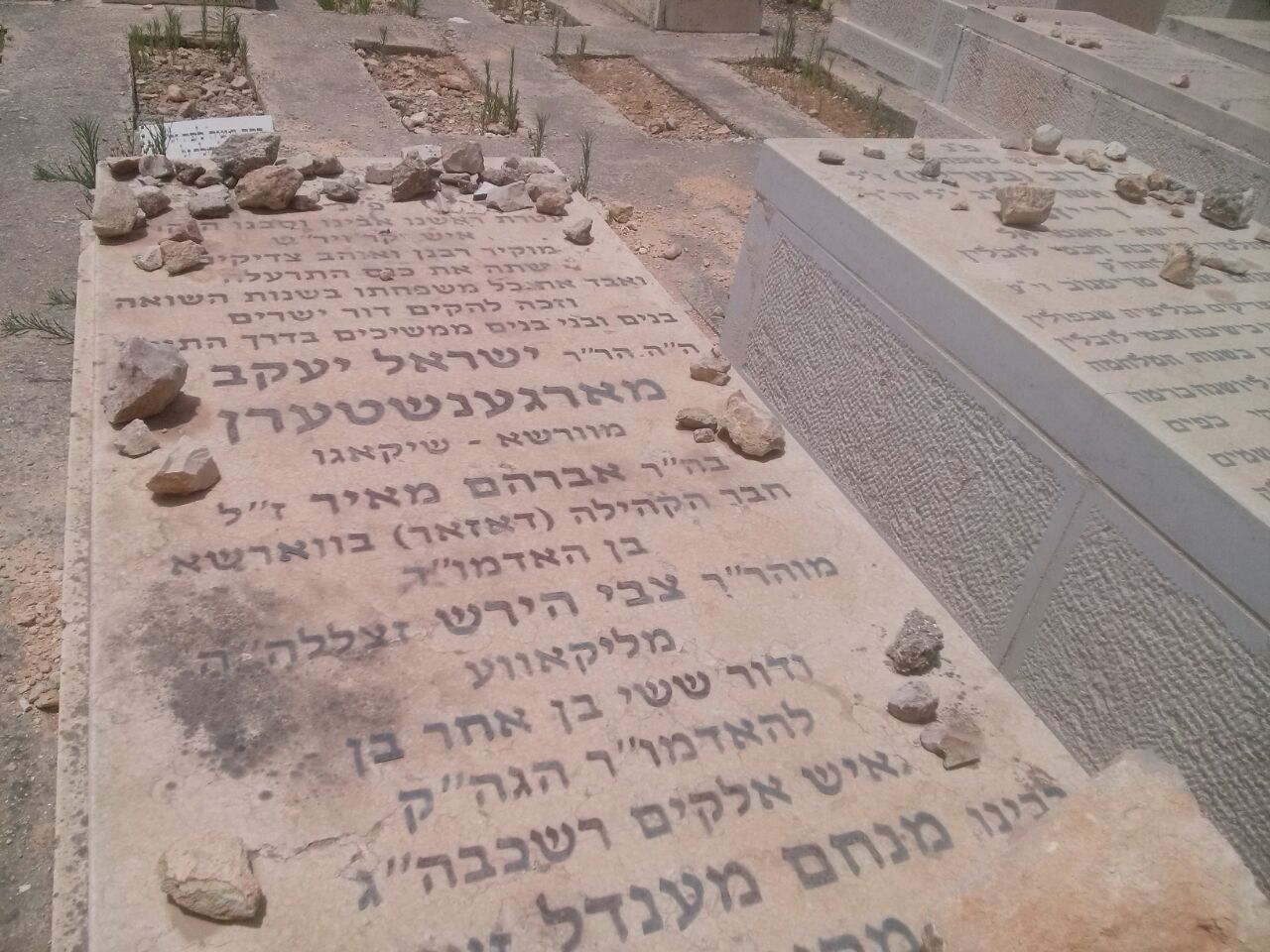
Today, 11 Tammuz 5715 – June 28th is the Yahrzeit of my father, Yisroel Yaakov ben Avrohom Meir, ZL.

Today, 11 Tammuz 5715 – June 28th is the Yahrzeit of my father, Yisroel Yaakov ben Avrohom Meir, ZL.

My nephew, Michoel Glenner, went to my father’s buriel site on Har Hamuchos to and took these pictures.

IMG-20150628-WA0000 IMG-20150628-WA0001

Part One:

My father’s will states:

“This is a donation from the late Mr. Israel J. Morgenstern, who was continuously hungry since September 1, 1939, when Hitler and his German army with his German Luftwaffe (air power) attacked Poland, until May 7, 1945, when he was liberated from Dachau Concentration Camp by the American Army”.

Growing up my father never spoke about his life, his parents and his family in Europe. My grandfather who I am named after, was not real to me. He was not part of my psyche. I did not identify with him, did not feel him within my soul. Despite my father being a holocaust survivor, I did not feel the holocaust within me. I mourned the holocaust as part of the Jewish people, not of my family’s loss. I have gotten older, delved into my family history, understood more of life, backfilled my knowledge about my grandfather, and now can mourn my grandparents and family. Tonight we are mourning not only my father but our family who we lost in the holocaust.

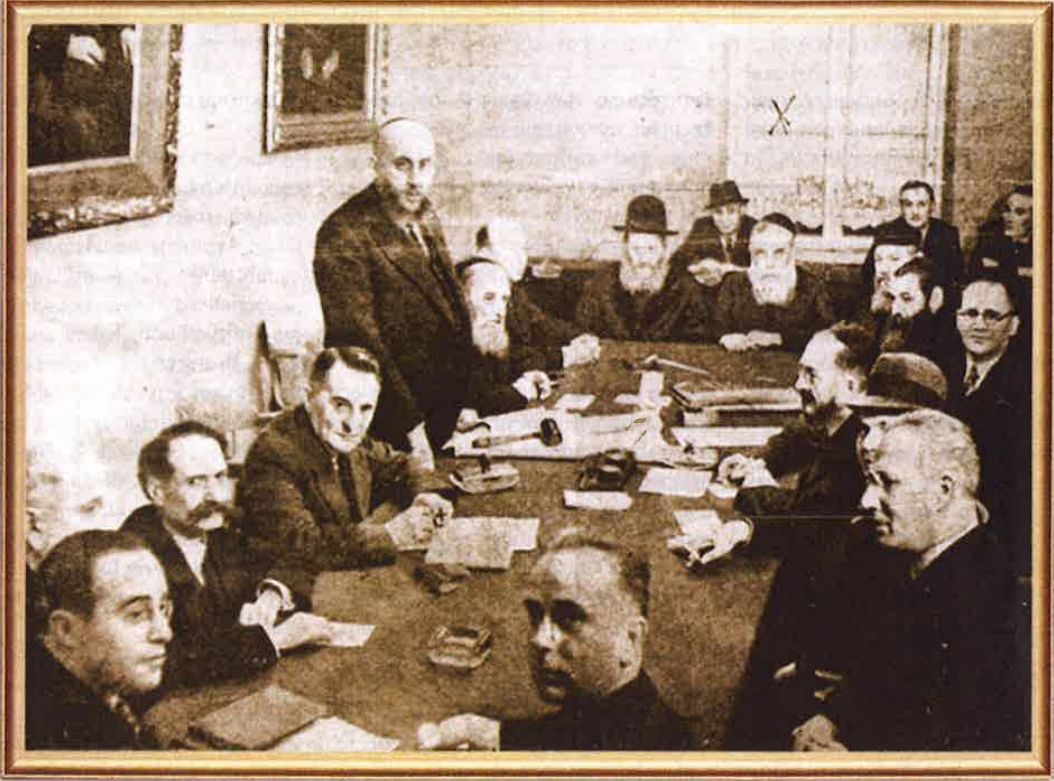
 The below picture is from a meeting of the Warsaw Community Council.  It is a tragic picture because they did not know what the Nazi beast had planned for them.

My grandfather, Reb Avrohom Meir Morgenstern, HYD is sitting in the back right, partially obsucred by I believe Reb Zushe Friedman, author of the Maynah Shel Torah.  Sitting on my zedi’s right is Rabbi Tzvi Yechizkal Michelson, HYD.  For many years I did not know what happened to the holy Rabbi Tzvi Yechizkal Michelson until I read in Dr. Hillel Zeidman, Warsaw Ghetto Diaries, who describered the last days of this Tzaddik.   The Nazi’ s YS’Z,  sent Rabbi Tzvi Yechizkal Michelson to Treblinka.  Also in the picture according to Historian Esther Farbstein who sent this picture into the Hamodia Magazine is –  Reb Eliyahu Mazor, ZL standing; Dr. Yitzchok Schiffer, HYD to his right.

warsaw

Polish Jewry was destroyed from 1939 to 1943. The liquation of the Warsaw ghetto began on July 23, 1942. Dr. Hillel Zeidman in his Warsaw Ghetto Diaries, recorded the summer and fall of 1942 along with the winter and spring of 1943 documenting the destruction of the Warsaw ghetto and the final total destruction of Polish Jewry.

It started on July 23, 1942. The head of the Judenrat was Adam Czerniakow.  Dr. Hillel Zeidman writes that Adam Czerniakow was secular, but always believed that the Jews would outlast the Nazis.  He felt that they must follow the dictates of the Nazis as terrible as they were.  Eventually the Germans would be defeated and the Jews would remain intact as a community.  On July 23, 1942, he was visited by two SS Officers. They leave and Adam Czerniakow asks his assistant for a glass of water. The assistant gives Adam Czerniakow the water, leaves, and closes the door.  After a few minutes, the assistant knocks on the door and there is no response. After a few more minutes he walks in and finds Adam Czerniakow slumped over his desk.   They called doctors, but to no avail.  He committed suicide.  Adam Czerniakow did not leave a note or a will. They opened his appointment / note book and saw the number 7,000 on it. They understood that Adam Czerniakow was told to deliver 7,000 Jews to the Umschlagplatz, the train station which would take the Jews to Treblinka.   Adam Czerniakow realized that the Jews in Poland as a community would not outlast the Germans, devastating.   His obedience to the Germans would have aided the Nazis in their pursuit of the destruction of the Jews.  How does on live with oneself?  He did not want to further the Nazi’s goals by being their pawn, by delivering the Jews to the Umschlagplatz, to help destroy Polish Jewry.  He committed suicide.

Czerniakow

My grandparents Avorhom Meir and Ester (Blass) Morgenstern lived before the war in Warsaw and were trapped in the ghetto. We have a partial picture of my grandfather. It is uncanny that he looks like by mother’s father, Reb Sholem Sklar. They could be brothers.

My father who had a wife and child in Kielce, went to be with his parents in the Warsaw ghetto.  My father kept his parents alive by providing food for them. They were elderly and could not survive on their own. His father, Reb Avrohom Meir. turns to my father one day and say, “my son, you have fulfilled the command of Honor Your Father and Mother, just like it says in the Torah.” My grandparents were taken to the Umschlagplatz, put on a train, and sent to Treblinka as part of the 7,000. Their number came up.

Michael Savage on his radio program read a first person account of what it was like for a person, such as my grandparents and hundreds of relatives to have the train doors open and you are at Treblinka.   It described the horrors of the last hour of life for these holy souls. I listened to it, with one hand by the dial to shut the radio if it got too gruesome. They you Michael Savage.

This day was Tisha B’Av 1942 – the ninth day Av.

The End of the Warsaw Ghetto and Polish Jewry:

downloadThe Warsaw ghetto and Polish Jewry was fully destroyed during Pesach 1943.  Dr. Hillel Zeidman records a meeting between the remaining Rabbis and leaders in the ghetto to discuss the Warsaw Ghetto uprising. Rabbi Menachem Ziemba speaks last and says, we should have resisted passively. We should not have gone willingly to the Umschlagplatz.  Rabbi Menachem Ziemba says that there is no Kiddush Hashem to die, but to fight.  He places the Warsaw Ghetto uprising as a fight for the sake of God. Every person who fought was an agent of God, part of the Jewish army, in the legacy of Dovid Hamelech. They all had the kiss and love of the Gadol Hador, the Rabbinic leader of the generation. They were surrounded with his love. A few days later Rabbi Menachem Ziemba is martyred and Polish Jewry is destroyed.

Please read the following article which expresses these sentiments:

http://www.jpost.com/Opinion/Op-Ed-Contributors/The-last-rabbi-in-the-Warsaw-Ghetto-Zionist-311637

Please also read this article:

http://www.haaretz.com/news/features/this-day-in-jewish-history/this-day-in-jewish-history-the-warsaw-ghetto-uprising-begins-in-the-mind-1.493880#!

* * * * * * * * * * * * * * * * * * * * * * * * * * * * * * * * * * * * * * * * * * * * * * * *

What is the lesson. On a communal level it is Torah, Israel, a strong Army, moral clarity, Achdus, loyal Jews, and wealthy Jews to donate money for the community.  What does this mean and what is my father’s legacy on an individual basis. What could Mitch Morgenstern do?   I am not wealthy, I am a middle of the road Jew. Just remembering the holocaust means nothing without something tangible. I did not fight for the IDF, I am not a Torah scholar.

My Speech Continued:

It is about the Chulent:

My father’s hunger led to the following story:

I learn with a study partner. The Shul serves Chulent Thursday nights as a treat. This one Thursday a Mshulach wanders in and asks if he can have some Chulent. One of the members said, No! The Chulent is for the people learning. I was aghast. The poor guy wants some Chulent. There is always extra. I was flabbergasted but could not say anything. I have since gotten to know the person and he is not bad, he just did not have the sensitivity.  He has to be educated.

The next day on Friday, I left work at 6:00 PM.   As I am passing the corner of Devon and Lincoln, I see this Meshculach at the stoplight.  I made a U-Turn and picked him up. He was with a friend. As he got into my car, I said, aren’t you the person last night who asked for Chulent. He said, I think so. I apologized for the person for his lack of sensitivity, the Shul, and the city of Chicago. I told him that while he is in Chicago, he can go to Tel Aviv Pizza, give them my card and I will pay. He left the following Monday and only used it once. The bonus is that his friend’s grandfather was a Kotzker Chossid.

I do not remember his name.  I think his friend was Rotman.

No Pain, No Gain – A heartfelt Brocha

Rabbi Naftoli G.

No Pain, No Gain – A heartfelt Brocha

June 24, 2015

This coming Sunday the 11 day of Tammuz is my father’s 13th Yahrzeit. I offer the following incident L’Chovod my father.

I am in pain and went to visit the Doctor. I need an MRI and probably some minor surgery. I finished with the Doctor at 7:10 PM and ran over to Chicago Center for Mincha. I usually daven at Reb Moshe’s Shul or Kins, rarely at the Chicago Center. Davened Mincha and said Kaddish for my Mechutan, Moshe ben Yosef, Halevi.   As I walked out I saw an older gentlemen who I thought I recognized but being in pain shuffled past him.   I admit that had I made eye contact, I was afraid that he would ask me donate to his charity, but being in pain, I was not in a charitable mood.

B’H he followed me and gave me an envelope, did not ask for money.   I recognized these older gentlemen and told him we met a few weeks earlier at a different Shul.  He is Rabbi Naftoli G. I reminded him of what he told me at that time. This Rabbi is a Talmud of Rabbi Tzvi Yehuda, TZL. His father was a Talmud of Rabbi Avrohom Yitzchok Kook, TZL. Wow. I met someone who was a Talmud and saw Rabbi Tzvi Yehuda and Rabbi Avrohom Yitzchok Kook.   He said they were Kiddoshi Elyon, lofty souls.   I gave him a copy of my Zedi’s Sefer, Sholem Yerushalim that was reprinted by Rabbi Zini, Shlita, and a Rosh Yeshiva in Haifa of Yeshivas Ohr Vishua. Rabbi Naftoli G. knows Rabbi Zini well and will visit him to give him my regards. I never met Rabbi Zini, but feel a close bond to him. Unfortunately, I was in Israel in late January and to my loss I did not visit Rabbi Zini or his Yeshiva. I pray to Hashem that in the near future we have a family Simcha in Israel and I can visit.

I asked Rabbi Naftoli G. to give a speech on Rabbi Tzvi Yehuda, TZL. He mentioned that many places would not appreciate the Gadlus of Reb Tzvi Yehuda and Rabbi Avrohom Yitzchok Kook. I told him that I would find him the appropriate venue. Rabbi Naftoli G. is leaving Chicago tonight, but I told him next time to let me know when he will be in Chicago.

I insisted that Rabbi Naftoli G. give me a Brocha for my pain and for Shidduchim.

Perhaps my week of pain was a Kapara for me, and to allow me the Zichus to give regards to Rabbi Zini.

Three Shabbosim – Three Cities – Three Great People

May 30th – June 6th – June 13th
Nasah – Behaloscha – Shelach

Shabbos – June 6, 2015 – 19 Sivan 5775 Parshas Behaloscha

Rabbi Shlomo Riskin -Shlita

In my never ending quest to meet great people, I went to hear Rabbi Shlomo Riskin speak at KJBS.   Rabbi Riskin is the founder of Efrat in Israel.

Entering the Shul, I saw Hart Hasten.  He is one of the sponsors of the Shabbos.  He called me the Kotzker.  I reminded him of the story in 1967 when the IDF captured the Kotel and Menachem Begin had called  Prime  Minister  Levi Eshkol  at 4:00 AM that the IDF must enter the old city immediately and Menachem Begin’s prayer at the Kotel.  He said that he has more stories to write another book which is what his wife wants him to do.  He should as he is living history.

Rabbi Riskin spoke at 7:00 PM.  He wore a black Kapote with subtle gold sprinkles.  He had a big white Kippah Sruga.     His theme was about the duty of the Jewish people to bring moral conscience to the world.  When we fail in our mission we are punished.  He spoke about the rainbow the God showed to Noah that He will not destroy the world.   The circle would have been a better choice, but a rainbow was used because God will not destroy the world, but man can.   Western society is based on the Greeks and Romans whose society was based on might is right, to the victors the spoils.   Anyone who imposes their views on someone is someone who is a Roman.

Rabbi Riskin spoke again at the Shlosh Suedas meal.  He told over how the city of Efrat was created with the confluence of events with The Rov – Rabbi Yosef Dov Halevy Solovechik; the Rebbe, Rabbi Menachem Mendel Schneerson, the Lubavitcher Rebbe; and Menachem Begin.

In 1977, Menachem Begin was elected Prime Minister of Israel.  His first trip was to America and he went to visit the Rov, the Rebbe, and Rabbi Moshe Feinstein.   Rabbi Moshe Feinstein was the leader of the generation in Halacha – Jewish law.  The Rov, the leader of the generation in Lomdos – Torah learning. The Rebbe the leader of the generation in his concern for every Jew and the world.

1)  The Rov

kotzk

The Rav and the Prime Minister: Memories of Brisk from Rabbi Shlomo Riskin’s Listening to God:

Some years later, when I was teaching at Yeshiva University, I would generally request a meeting with the Rav on Thursday afternoons to ask my “questions of the week.” He would usually give me from two minutes to an exceedingly rare, two hours, depending upon the pressures of his day. During one particular meeting, while the Rav was in the midst of showing me a passage from the Guide for the Perplexed, a telephone call came announcing that Menachem Begin, newly elected prime minister of Israel, would be arriving shortly. The prime minister of Israel is generally considered to be the prime minister of world Jewry, and this first traditional prime minister announced that during his first official visit to the United States, he wished an audience with the three religious Jewish leaders of the generation: the Lubavitcher Rebbe, Rav Moshe Feinstein and Rav Soloveitchik. Now that the revered head of state was about to enter the Rav’s New York apartment, I knew that good manners dictated that I excuse myself; my curiosity, however, got the better of my gentility, and I opted to remain until I was specifically asked to leave.

When Menachem Begin walked through the door, the Rav quickly jumped up to meet him. As they embraced, the Rav seemed especially moved, with what appeared to me to be tears welling up in his eyes. These two Jewish world leaders, the foremost statesmen in the political arena and the foremost rabbi in the religio-philosophical realm, both shared a common “Brisker” (Brest-Litovsk, Lithuania) connection.

Rav Joseph Dov’s illustrious grandfather, Rav Chayyim Soloveitchik (who pioneered a new conceptual methodology for the study of Talmud), was the rabbi of the main synagogue in Brisk and therefore of the entire city; indeed, he was known worldwide as the “Brisker Rav.” Menachem Begin’s father, Binyamin Begin – an avid Zionist, a devotee of the Revisionist Movement’s founder, Ze’ev Jabotinsky, and in his own right a riveting orator – was the gabbai (lay leader) of that same synagogue in Brisk. And just to add some spices to the cholent, one of the three judges (dayanim) of that synagogue community was Rav Moshe Chazan, the father of Yaakov Chazan, founder and leader of Mapam and the initiator of the secular Shomer HaTza’ir kibbutzim in Israel – and the midwife who “birthed” all of the babies was the grandmother of Ariel Sharon. Menachem Begin had been born and raised in Brisk, and Rav J.B. Soloveitchik had spent significant Sabbaths there with his grandfather, including that of his bar mitzvah.

After their initial embrace of greeting, both men stood looking at each other, respectfully, admiringly, nostalgically. The Rav seemed to burst out, “Mr. Prime Minister, you are so short, and your father was so tall.” Menachem Begin responded, “Kavod HaRav, I will say two things. Firstly, you remember how my father looked when you were a small child, and all adults seem taller than they actually are, to children. But the real point is that my father was always a much taller and greater man than I.”

And there they sat at the table and began to reminisce together, the one entering into the words of the other and finishing the other’s thoughts and sentences. Clearly they felt transported to their childhood in Brisk, as their Yiddish words and gesticulations evoked that world. A world in which either the rabbi or the gabbai held the keys to the synagogue, and Binyamin Begin had gladly given up his keys to the illustrious Reb Chayyim when the latter accepted the rabbinical position. A place where a bar mitzvah who was preparing to spend his biblical portion in Brisk, couldn’t sleep a week beforehand because his revered grandfather insisted that every cantillation had to be exactly accurate or the entire verse would have to be repeated; an ideological climate in which Zionist leaders were either revered as forerunners of the Messiah, or reviled as rebels against God’s rule over the cosmos.

And then they both recounted an incident together, the one dispute they remembered that had taken place between the gabbai and the rabbi, between Binyamin Begin and Rav Chayyim Soloveitchik. Theodore Herzl, the legendary father of modern Zionism, died, and Binyamin Begin planned to eulogize him in the main synagogue of Brisk. Reb Chayyim was an anti-Zionist who certainly did not believe it proper to eulogize a non-observant Jew who probably ate on Yom Kippur, in an Orthodox synagogue. Since it was the rabbi who had the keys, without any kind of discussion or debate, Reb Chayyim locked the synagogue door on the morning of the scheduled eulogy. Binyamin Begin, a powerful person in his own right, broke the lock, opened the synagogue doors wide, and gave his eulogy. He then purchased new keys and a lock, and left them on the doorstep of Reb Chayyim’s home with a letter of apology and a promise that he would never do such a thing again.

Both men agreed to the facts of this. But the Rav added a fascinating postscript. He had heard of this incident from his father, Rav Moshe, who was a rabbi of a smaller town a considerable distance from Brisk. Rav Moshe asked his father, Reb Chayyim, how he had reacted to the gabbai’s defiance. Reb Chayyim, who was generally a lion in defense of what he considered proper Torah values, told his son that he decided not to react, that he inquired how many people had attended the eulogy, and found out that the shul was filled to the rafters with a large overflow outside, many more congregants than for Ne’ila on Yom Kippur. Reb Chayyim explained that “a rav muz vissen ven tzu reden, un a rav muz vissen ven tzu shreigen, a rabbi must know when to speak out, and a rabbi must know when to remain silent.”

“Mr. Prime Minister, you apparently learned to be a principled Zionist from your father,” said Rav Soloveitchik. “Kavod HaRav, you apparently learned to be a sage religious leader from your grandfather,” said Menachem Begin.

At that point, the Rav suddenly took notice of my presence, made a very quick introduction, and gestured in a way that told me that my appointment had long since ended. I left the apartment happily, not at all guilty that I had overstayed my welcome. After all, this too was Torah, and I was glad that I had been in the right place to have learned it.

2)  The Rebbe

The year is 1981.  Rabbi Riskin moved forward to create  Efrat, just seven miles from Jerusalem.  He was in America and had to travel to Israel for the groundbreaking and laying  the cornerstone for the city of Efrat.  The groundbreaking for Efrat was to be on a Monday.  The Thursday before, Rabbi Riskin was at a wedding and afterwards went to the Lubavitcher Rebbe’s Fabrengen.   He came after the Rov left and was seated in the Rov’s seat.  When the Rebbe finished he walked towards the exit and passed by Rabbi Riskin.  The Rebbe stopped and told Rabbi Riskin that Rabbi Riskin is always in the Rebbe’s prayers.  Rabbi Riskin said he wanted a Bracha for his project in Efrat.  The Rebbe responded, God should make your plans successful.  The Rebbe took a few steps towards the exit, turned around and went back to Rabbi Riskin and said again, God should make your efforts successful.  (I was told that Rabbi Riskin on many occasions spoke to the Rebbe about Efrat.)

3)  Menachem Begin

Rabbi Riskin lands in Israel on Sunday and his partner calls frantically.  There was a terrorist attack on the west bank and the Israeli government froze all settlement activity.  Rabbi Riskin asks who can override this policy.  His partner told him, only the Prime Minister, Menachem Begin.  They call a Knesset member, a Rabbi, who was recovering from heart surgery.  The Rabbbi despite his illness, called Begin on behalf of Riskin.   Riskin was told to show up at the prime minister’s office the following Monday.

Rabbi Riskin goes to the Prime Ministers office.  Begin asks what you want?  Rabbi Riskin told him the problem.  Menachem Begin calls over Yechiel Kadishai and asks to bring  Herzl’s The Jewish State (Der Judenstaat).  In it, Menachem Begin finds a paragraph that says that when the Jewish State is formed; there will be groups and groups of Jews going to the land (I cannot find the exact quote).

Menachem Begins tells Rabbi Riskin that you can have the groundbreaking ceremony, but only one Knesset member and no publicity.  Despite no publicity, 6,000 people showed up.

Begin then turns to Riskin and says that they met at the Rov’s house back in 1977.  They talked for another few moments.

Boca Raton – Three Shabbosim – December 2014 – January 2015 – February 2015

I have meant to blog, however, did not have the time. Since the first of the year, we were in Boca three times and I met and met great and interesting people.

1) Professor Mordechai Kedar
2) Mort Klein
3) Borough Park
 4) The four Weisses
5) Rabbi Michael Steinberg

Professor Mordechai Kedar, http://mordechaikedar.com/ and Mort Klein, http://en.wikipedia.org/wiki/Morton_Klein

In December 2014, BRS brought in Professor Mordechai Kedar as a scholar in residence. I heard him three times; right after morning prayer services, one hour before Mincha, and after Sholosh Suddos.

Professor Mordechai Kedar is a PHD and professor at Bar Ilan University. He was with IDF intelligence for 25 years. The professor’s speech before Mincha was excellent. He spoke about nation building in the Mideast. The countries in the Mideast were arbitrarily formed in the early part of the 20th century by putting lines on a map, disregarding religion, families, clans, and villages. As a result, there are many failed countries as the ethnic, family, and religious makeups are in friction with one another. Despite great oil wealth the countries are in turmoil. Wealth does not bring stability, but rather stability brings wealth.

After the Sholsoh Suddos meal, most people were headed to the Shul for the evening services. Professor Mordechai Kedar and Mort Klein were arguing about policy. Mort Klein did not let up. I stood near them, listening to these great men talking.

Borough Park:
After Professor Mordechai Kedar’s lecture, my friend and his wife were walking by me and I said hello. My friend is from Borough Park and would never sit in a Shul next to his wife, would never go to a lecture by an Israeli Intellectual even if he is Frum, yet in Boca he does. This is the magic of Boca Raton Synagogue.

The Four Weisses:
I met four Weisses during these three times in chronological order:

1) Steven I Weiss – http://steveniweiss.com/about/
Steven I Weiss is an investigative journalist, whose work appears on NPR, JTV. He was sitting in the hallway, with his daughter in a stroller and I struck up a conversation. He was reading a book written about torture and he was to interview the author in a few weeks. We spoke about a few issues. He said that he broke the story about YU’s $100MM of investment losses.

2) Farley Weiss – http://www.youngisrael.org/board-members.html
I was privileged to meet Farley Weiss, President of Young Israel. He has moved to the Boca Raton community. His zeal to help the Jewish people is refreshing. I wish him well. I told him the Vort of Reb Moshe Soloveichik. Reb Moshe said that Young Israel saved Orthodoxy in New York. Young Israel was the transition during the first half of the 20th century and into the 1960s, when it was hard to be Orthodox and today. Although the young Jewish families did not have strong connection to Orthodoxy, they belonged to the Young Israel Shuls and stayed within Orthodoxy. Their kids became more Orthodox, and filled the yeshiva and day schools. In Chicago, where the Traditional movement was strong, these same types of Jews belonged to Traditional Shuls did not remain Orthodox. Traditional Shuls do not have , and are not within the world of Orthodoxy. Their members ended up not keeping Shabbos or Kashrus. Their kids moved further away from Orthodoxy.

3) Rabbi Avi Weiss – http://en.wikipedia.org/wiki/Avi_Weiss
The Shabbos before Purim, Rabbi Avi Weiss and his wife came to Boca Raton Synagogue for a Bar Mitzvah. Rabbi Efrem Goldberg welcomed Rabbi Avi Weiss to Boca Raton. I spoke for a few minutes to him and told Rabbi Weiss that I love Rabbis Lopatin and Rabbi Wolkenfeld. I told him that I walk 5.5 miles just to be at Anshe Sholem to listen to both Rabbis. The Jewish people owe Rabbi Avi Weiss a thank you for his activism for Russian Jewry when it was not popular.

4) Joseph Weiss
At the Shabbos before Purim, I also saw Joseph Weiss. Joseph Weiss is from Chicago and he retired to Boca Raton Synagogue a few months ago. He has a daughter who lives in Boca Raton Synagogue, and his son-in-law is the head of NCSY in Boca. He is doing an excellent job. I am sad to report that on Purim, Joseph Weiss collapsed and was Niftar. He was able to retire to Boca Raton Synagogue; a place of Torah, Shiurum, Yiddishkiet, great personalities, and his time a BRS was cut short. May your family know no more sorrow.

Looking for Rabbi Michael Steinberg:
I have been looking for Rabbi Michael Steinberg  for years. Michael Stein was my classmate at Arie Crown. The last time I saw him was in 1968 -1969, playing basketball.    He was taller and a better basketball player than myself.  Michael was shirtless and not wearing a Yarmulke. Over the years, I heard that he went to Israel, became a student of Rabbi Gustman, and became a great Torah scholar. He was in Rabbi Gustman’s Yeshiva in Rechavia, called Nezach Yisroel. During my recent trip to Israel, I walked into Netzech Israel and found out the Rabbi Gustman’s Yeshiva fell apart after his death.  Michael Steinberg is a Rosh Kollel, and has a place near the central bus station. I never did find Michael Steinberg. I was watching my grandkids in BRS’s playground and sat next to David Steinber, Michael Steinberg’s nephew. Wow. David grew up in Skokie and I remember his father. The Steinbergs were the only family in our school from Logan Square, located about 7 miles from school. The boys had to take two buses every morning to get to school. Amazingly, at BRS I was sitting next to his nephew, David. David filled my in on Michael’s life. Michael Steinberg has a large family. The only “disappointing” thing is that none of Rabbi Michael Steinberg’s kids served in the IDF. I felt that with Michael growing up in Chicago, going to the Ida Crown Jewish Academy, he could be that Rosh Kollel who bridges the Bnei Brak world, the IDF, and the Dati Leumi world. Maybe he has.

Update –  March 17,2015:

I just met another relative of Rabbi Michal Steinberg.   This relative has kids in the IDF and works for Klal Yisroel.   I would only hope that the kids go to Rabbi Michael Steinberg before entering the IDF for a blessing, Rabbi  Michael Steinberg is there to say Divrei Brachah when his nephew’s unit graduates.  I have to believe that Rabbi Michael Steinberg learns with his nephews.  Michael Stein’s kids and their IDF cousins are united “B’Lev Eichod”.  Rabbi Michael Steinberg goes to give Shiur to the boys in the army base and has his nephew with his platoon spend a Shabbos, Yom Tuv, hear a Chabura in the Kollel.   Anything less would disappointing.


Update – July 21, 2015

I found on Rabbi Dov Lipman’s blog a moving tribute to Max Steinberg, a lone soldier from LA, who was killed in Gaza one year ago defending Israel. I watched the Kiddush Hashem of Max Steinberg,  the clips from his funeral and that over 30,000 people attended.   I expected to see Rabbi Michael Steinberg giving a eulogy, giving a Shiur on his Yahrzeit. Perhaps Max is a relative of Rabbi Michael, however, if not related the similar name should bring closeness. Max Steinberg’s sacrifice should energize the Rabbi Michael Steinberg family, especially, a family of Torah.

http://blogs.timesofisrael.com/remembering-max-steinberg/