Toras Shemos 2013: Moshe – Leadership, Identification, and Responsibility

11. Now it came to pass in those days that Moses grew up and went out to his brothers and looked at their burdens, and he saw an Egyptian man striking a Hebrew man of his brothers.

יא. וַיְהִי | בַּיָּמִים הָהֵם וַיִּגְדַּל משֶׁה וַיֵּצֵא אֶל אֶחָיו וַיַּרְא בְּסִבְלֹתָם וַיַּרְא אִישׁ מִצְרִי מַכֶּה אִישׁ עִבְרִי מֵאֶחָיו:

  1. Rashi says on “Moses grew up”; was it not already written the child grew up.  Rabbi Judah the son of Rabbi Illai says:  The first one (was Moses growth) in height, and the second one (was his growth) in greatness, because Pharaoh appointed him over his house,

  2. Rashi says on “and looked at their burdens” He directed his eyes and his heart to be distressed over them.  Berashis Rabbah 1:27.

RAMBAN:

The Ramban argues on the first  Rashi on “Moses Grew Up” and says that Moshe grew up and became a man.  He matured.   The Ramban agrees with the second Rashi of  וַיַּרְא בְּסִבְלֹתָם – Moshe was told that he was a Jew, and he desired to see them because they were his brothers.  And he says their burden and work, and could not handle (their hardship), and therefore he killed the Egyptian hitting the oppressed (Jew).

The Ramban in Hebrew:

(יא): ויגדל משה ויצא אל אחיו –
שגדל והיה לאיש. כי מתחלה אמר ויגדל הילד (לעיל פסוק י), שגדל עד שלא היה צריך לגמלה אותו, ואז הביאתהו לבת פרעה ויהי לה לבן כי לפני מלכים יתייצב, ואחרי כן גדל ויהי לאיש דעת:

וטעם ויצא אל אחיו –
כי הגידו לו אשר הוא יהודי, והיה חפץ לראותם בעבור שהם אחיו. והנה נסתכל בסבלותם ועמלם ולא יכול לסבול ולכן הרג המצרי המכה הנלחץ:

The Seferno agrees with Rashi and the Ramban, as follows:

וַיַּרְא בְּסִבְלתָם. נָתַן לִבּו לִרְאות בָּעֳנִי אֶחָיו.

וַיַּרְא אִישׁ מִצְרִי מַכֶּה אִישׁ עִבְרִי מֵאֶחָיו. וּמִצַּד הָאַחֲוָה הִתְעורֵר לְהִנָּקֵם.

Rashi, the Ramban, and Seferno are based on the Medresh Rabbah, see attached for a beautiful Medresh.  See attachment #2 at the end of this post.

IBN EZRA:

Along comes the Ibn Ezra and says something that seems incomprehensible:

Translated in English – 11. “And he went out to his brothers.” The Egyptians“, because he (Moshe) was in the palace of the king.  And the reason for “from his brothers (the second time the Passuk says from his brothers) is that after the Passuk mentions, a Jew from his family, (the word “his brothers” in this Passuk is to mean the same as when Abraham spoke to Lot) like we are men who are relatives – brothers.

What does the Ibn Ezra mean – he went out to see “the Egyptians”?  All Reshonim and the Medresh say he went out to see his brothers, the Jews.  The Netter Mikros Gedolos has an explanation on the Ibn Ezra who explains the words “the Egyptians” are referring to the Jews, since they were living in Egypt, the Ibn Ezra referred to them as Egyptians.  Very difficult as the Ibn Ezra should have said that Moshe went out to see the Jews.

Comes along the Holy Klausinberger Rebbi and explains the Ibn Ezra magnificently.  The Klausingberger explains that the Ibn Ezra understands וַיִּגְדַּל משֶׁה  in  Passuk 11 the same as Rashi that Moshe was appointed a leader of Egypt.  He was appointed to oversee the land of Egypt.  What was Moshe’s first act when he was now in charge; he wants to understand his job and determine what he has to do; to meet with all his brothers – the government officials, the engineers, the workers.  This is the meaning of  וַיַּרְא בְּסִבְלֹתָם  to see the public works of Egypt.    ַבְּסִבְלֹתָם  here means the work needed in the land of Egypt (and not like Rashi and the Ramban who says this means the burdens of the Jews.)   The Klausingberger adds that these government officials were his brothers.  He identifies with them as an Egyptian.  He sees them “in the palace of the king” as moral, thoughtful, and decent men.  However, what happens.  Moshe sees cruelty. He sees these seemingly refined individuals behave with ultimately cruelty and everything changes.  Moshe is smacked in the face and he now identifies with the slave, the Jew, and now the Jew is his brother, and not the Egyptian.

Beautiful.  Unfortunately, I do not have the Klausingberger in front of me because I think he says it slightly differently and more gloriously.

I saw in the book, Margolios Hatorah. – the Gems of the Torah, that Rabbi Chaim Finkelstein says in his Sefer that Passuk 11 is telling us what Moshe gave to all future generations, the strength and innate ability to reject comfort, honor, and recognition, in the greater dominant and successful society to remain a faithful Jew.    Moshe  had the opportunity to live a life of Egyptian nobility, to be the cream of society, yet he  went out to his brothers to save them, to identify with their pain and suffering.  The result was that he was on the run, thrown out of Egypt, and his comfortable life a memory.   Rabbi  Finklestien says that from here we learn proper behavior, not like those who once they become promoted to a high position and become successful, they flee from their brothers and feel superior to them.  The actions of our forefathers are a sign to (baked into) their children.  Moshe could have remained as an Egyptian, turned a blind eye to the Jews, as he was raised as a prince of Egypt.  Yet, he rejected the recognition of greatness in the dominant society  that could have been his in Egyptian society  and identified and cast  his lot with the downtrodden Jews.

We know of many Jews who once they become successful and respected in the general society gave up their religion and identify with the greater society, completely cutting themselves off from the Jewish people and all of the issues we Jews have with being a nation alone.  Look at what the State of Israel has to suffer and many Jews have no trouble abandoning Israel to fit into society.  

This ability of rejecting acceptance in the greater society and identifying with the Jew,  is not only with Orthodox Jews who are unmistakable Jewish, but it also is baked into secular Jews who can easily melt into society and turn their back on the Jews.  During the 1800’s when the ghetto walls came down,  many Jews converted to gain acceptance into the greater society and forgot their Jewish roots.  Look at the Rothschild family.  

We have the example in Orthodoxy by the Abarbanel, who was offered to stay in Spain, yet chose exile with his community.  

We also have the example in secular society with Theodore Herzl.  Herzl was an assimilated Jew.  He was wealthy, successful, and identified himself as an Austrian, not as a Jew.  He was so assimilated that when he thought about the plight of the Jews, he approached with Archbishop of Vienna, with a plan to convert the Jews.  The Archbishop laughed at Theodore Herzl. Herzl went from being an Austrian to identifying with the Jews, returning to his religion, and trying to save them.  As my cousin, Martin Brody writes the following vignette about Theodore Herzl.

Leadership, Repentance and Going Home.

At last!

Teshuva literally means return. But return to what? There are several word for sin in Hebrew, the most well known perhaps being “Chet” which is used dozens of times in the Yom Kippur liturgy for example. With Judaism so concerned with self elevation, that this word for sin means missing the mark, as if one was not in the right place. The English word transgress is similar, meaning moving outside the border, away from one’s home. So Teshuva means returning home at least in a spiritual sense, and Judah introduced the concept, later to be repeated and amplified with Joseph, to whom he and his brothers had caused so much distress. This step alone earned him the right of leadership and the progenitor of kings and the future Messiah.

A young Austrian, thoroughly assimilated Jewish writer had invited the Chief Rabbi of Vienna over to his house one December evening to discuss a wild and crazy idea. On entering the home, the writer asked the Rabbi if he would like to join them for the lighting. As it was Chanukah, the Rabbi was delighted to attend, but on entering the family room was shocked to see the writer and his family about to light the Christmas tree. It was Christmas Eve! The Rabbi took the writer aside and had a long discussion about his Judaism, and convinced the writer to perhaps light a Menorah instead.


This young Austrian writer was none other than the great Theodor Herzl. This little known vignette with the Rabbi was to have a tremendous impact on his life. The wild and crazy idea, of course, was Zionism, the return of Jews after nineteen hundred years to sovereignty in their homeland. A movement to go home. This was spurred on by the horrific Dreyfus trial to which he was a reporter. So alienated from his religion he previously thought the answer to anti-Semitism was conversion to Christianity, but that was jettisoned by the events at the trial. But after the meeting with the Rabbi there was a new ingredient to the mix. Religious observance. He was repenting, returning. So much so, that in 1897 he publicly declared that there could be no return to Zion without a return to Judaism. How much he moved in the direction of observance is not our business, but move he did. And he did not physically return home to Israel, but through his genius, courage and leadership, millions did and will in the future.

So much was his importance that Rabbi Abraham Isaac Kook, the Chief Rabbi of pre- State Palestine and the leader of the religious Zionist faction declared that Theodor Herzl could have been Messiah Ben Joseph, the precursor of Messiah Ben Yehuda.


The eight day festival of Chanuka begins this Friday night. Below I have reproduced the magnificent essay, Menorah, penned by Herzl shortly after that momentous meeting with the Chief Rabbi of Vienna..

 Shabbat Shalom and have a great Chanukah

Martin Brody

 Read Theodore Herzl’s essay titled, The Menorah:

THE MENORAH

 Deep in his soul he began to feel the need of being a Jew. His circumstances were not unsatisfactory, he enjoyed an ample income and a profession that permitted him to do whatever his heart desired for he was an artist. His Jewish origin and the faith of his fathers had long since ceased to trouble him, when suddenly the old hatred came to the surface again in a new mob-cry. With many others he believed that this flood would shortly subside. But there was no change for the better, and every blow, even though not directed at him, struck him with fresh pain till little by little his soul become one bleeding wound. These sorrows,  buried deep in his heart and silenced there, evoked thoughts of their origin and of his Judaism and now he did something he could not perhaps have done in the old days, he began to love his Judaism with an intense fervour. Although in his own eyes he could not, at first, clearly justify this new yearning, it became so powerful at length that it crystallized from vague emotions into a definite idea which he must need express. It was the conviction that there was only one solution for this moral misery and that was a return to Judaism.

 “The Jew of to-day had lost the poise which was his father’s very being. This generation, having grown up under the influence of alien cultures, was no longer capable of that return which he had perceived to be their redemption. But the new generation would be capable of it, if it were only given the right direction early enough. He resolved, therefore that his own children, at least, should be shown the proper path. They should be trained as Jews in their own home.

“Hitherto he had permitted to pass by unobserved the holiday which the wonderful apparition of the Maccabees had illumined for thousands of years with the glow of miniature lights. Now, however, he made this holiday an opportunity to prepare something beautiful which should be forever commemorated in the minds of his children. In their young souls should be implanted early, a steadfast devotion to their ancient people. He bought a Menorah, and when he held this nine-branched candlestick in his hands for the first time a strange mood came over him. In his father’s house also the lights had once burned in his youth, now far away, and the recollection gave him a sad and tender feeling for home. The tradition was neither cold nor dead, thus it had passed through the ages, one light kindling another. Moreover, the ancient form of the Menorah had excited his interest. Clearly the design was suggested by the tree, in the centre the sturdy trunk, on right and left four branches, one below the other, in one place, and all of equal height. A later symbolism brought with it the short ninth branch, which projects in front and functions as a servant. What mystery had the generations which followed one another read into this form of art, at once so simple and natural! And our artist wondered to himself if it were not possible to animate again the withered form of the Menorah, to water its roots, as one would a tree. The mere sound of the name, which he now pronounced every evening to his children, gave him great pleasure. There was a loveable ring to the word when it came from the lips of little children.

“On the first night the candle was lit and the origin of the holiday explained. The wonderful incident of the lights that strangely remained burning so long, the story of the return from the Babylonian exile, the second Temple, the Maccabees, our friend told his children all he knew. It as not very much, to be sure, but it served. When the second candle was lit, they repeated  what he had told them and though it had all been learnt from him, it seemed to him quite new and beautiful. In the days that followed he waited keenly- for the evenings, which became ever brighter. Candle after candle stood in the Menorah, and the father mused on the little candles with his children till at length his reflections became too deep to be uttered before them.

“Then came the eighth day, when the whole row burns, even the faithful ninth, the servant , which on other nights is used only for the lighting of the others. A great splendour streamed from the Menorah. The children’s eyes glistened. But for our friend all this was the symbol of the enkindling of a nation. When there is but one light all is still dark, and the solitary light looks melancholy. Soon it finds one companion, then another, and another. The darkness must retreat. The light comes first to the young and the poor, then others join those who love Justice, Truth, Liberty, Progress, Humanity, and Beauty. When all the candles burn, then we must all stand and rejoice over the achievement. And no office can be more blessed than that of a Servant of the Light.”

Theodor Herzl

(Trans. B. L. Pouzzner.)

January 25, 1904: Herzl Finally Meets the Pope, but the meeting did not go well for him!

Herzl wrote in his diary that the Pope received him standing, and held out his hand, but Herzl refused to kiss it. Herzl also wrote in his diary that the go-between Lippay had told him in advance that he must kiss the Pope’s hand, but Herzl said he wouldn’t do it. “I believe that this spoiled my chances with him, for everyone who visits him kneels and at least kisses his hand. This hand kiss had worried me a great deal and I was glad when it was out of the way”.

Herzl begun the meeting with the Pope by thanking him for the opportunity. Herzl put forth the request that brought him to seek audience with the Pope. But the Pope replied by saying:

“We are unable to favor this movement. We cannot prevent the Jews from going to Jerusalem – but we could never sanction it. The ground of Jerusalem, if it were not always sacred, has been sanctified by the life of Jesus Christ. As the head of the Church, I cannot answer you otherwise. The Jews have not recognized our Lord, therefore we cannot recognize the Jewish people. Jerusalem cannot be placed in Jewish hands.”

Herzl then asked the Pope if he had any problem with the Holy land being under the control of the Muslims? The Pope relied:

“I know it is disagreeable to see the Turks in possession of our Holy Places. But we simply have to put up with it. But to sanction the Jewish wish to occupy these sites, that we cannot do.”

However, Herzl attributed the Pope’s answer due to Herzl’s refusal to kiss the Pope’s hand.
 

1

2

Parshas VaYishlach

Chapter 34, Verse 1:

1. Dinah, the daughter of Leah, whom she had borne to Jacob, went out to look about among the daughters of the land.

וַתֵּצֵא  דִינָה  בַּת  לֵאָה  אֲשֶׁר  יָלְדָה  לְיַעֲקֹב  לִרְאוֹת  בִּבְנוֹת  הָאָרֶץ:

  Rashi says on this Passuk:

 And not the daughter of Yaakov.  However, because of her going out she was called the daughter of Leah, since she {Leah} too was in the habit of going out, as it says, in Ve’Yetzi, Chapter 30, verse 16 –” and she came forth to meet him” from Tanchuma Vayishlach 7 (And concerning  her, they  devise the proverb : Like mother like daughter).   From Midrash Rabbah 80:1

Question:

When you read Rashi, there really is no criticism of Leah.  It is benign.  “Going out” could be good or bad.

Artscroll  writes the generally held view that spins Rashi negatively, Dinah was immodest and Leah was excessively outgoing.  What!   We are now criticising Leah.    Leah  was one of the “Eimohos” –  founding mothers of the Jewish nation, the one who cried until her eyelashes fell out not to marry Eisav.

In fact, I would say the opposite of Artscroll.  Rashi seems to be saying – in case you think  that the Passuk speaks harshly of Dinah,  because the Passuk says that Dinah went out to see the daughters of the land, Rashi says, this is not true.  Just as Leah was a righteous person and her going out was done out of holiness, so too was Dinah going out for holiness.    What does Rashi gain by criticising Leah, one of the founders of the Jewish people.      Has Rashi turned into a Bible critic?   impossible.

Artscroll’s interpretation  seems to be based on Midrash Rabbah, Chapter 80, Section 1, copy attached.  In fact, all the Chumashim add that the source of Rashi is from this Midrash Rabbah.   The Midrash actually says that the end of Section 1, that Dina and Leah were dressed as Zona’s (harlots).    How can an Amorah, who lived in the second generation after the destruction of the Second Temple say this interpretation.   Can you imagine if this was said today?   Impossible!

I said an explanation a few years ago and my brother-in-law showed me that I was in line with the explanation of the Lubavitcher Rebbe  This year I saw it in the Gutnick Chumash, in the portion that says Toras Menacham,  copy attached.

I want to say the Rashi actually means the Lubavitcher Rebbe’s explanation.  Rashi is not being critical of Leah and Dinah, but rather he is praising them.

The Rebbe writes that Dinah had a tremendous ability to bring spirituality to the world.  In a sense, she was the first Lubavitcher Shiliach.  She went out into the world to positively impact the “daughters of Shechem”.  Leah had the same  ability, the ability to go out to the world and bring people closer to God.  After all, Dinah was a descendant of Avrohom.  Proof of this is that Yaakov was criticized for hiding Dinah from Eisav.  Only if Dinah had this tremendous ability to bring people to Hashem and had it within her to positively influence the evil Eisav, is Yaakov criticised.

Rabbi Lichtman this morning at our Daf Yomi Shiur added to my explanation.  There is a Midresh  that says the Yosef’s wife was Dinah.  If so, this is beautiful.  Yosef is the epitome of the Jew who is involved in the general world, maintained his Jewish soul, and had a positive impact on the world.  It is fitting that Dinah should marry Yosef.

I will add another indication, similar to Rabbi Lichtman.  Dinah, per the Midrash was initially a boy;  however, Leah, prayed to Hashem to make the fetus into a female.  I saw somewhere that Dinah had the Neshama of Yosef.  If so, just like Yosef had the ability to intermingle with the world, Dinah had the same ability, and bring people closer to Hashem.

The question is, how you explain the Midrash because clearly the Midrash appears to be critical of Leah.  Is the Lubavitcher Rebbe and the Abarbanal arguing on the Midrash.

The answer is no, no, no.  The source of Rashi is not the Midrash.  Rashi is positive and not negative.  The people who printed the Chumash who added that the source of Rashi is the Midrash Rabbah 80:1 were wrong.   I have proof of this.  Look at Rashi again.  Notice, the words in Rashi (And concerning  her, they  those that say parables, say: Like mother like daughter)  is in parentheses. These words are very similar to the Midrash and this is what seems to anchor Rashi to the Midrash.  However, we  do not read parenthesis.  Per Reb Tzvi Hersh Weinreb, words in Rashi that have parentheses around them, are words that were not in Rashi’s manuscripts.   They were added later by others.    The answer is that Rashi is not based on the Midrash, so parentheses were used on these words, to tell us not to read these words because that there is no connection between Rashi and the Midrash.  These words were put into Rashi in later generations who got it wrong.

How to understand the Midrash:

Look at the Midrash, pages 5-7 of the attached.  Although the Midrash at the end says that Leah and Dinah were dressed as harlots, Reb Yosi said this only in the context of a response to Reb Yehuda Nesia.  It was not said as the explanation of the Passuk.   The story in the Midresh is that Reb Yosi publicly insulted the house of the Nasia saying that they are unethical.  Finally at the end, Reb Yosi insults Reb Yehuda Nesai to his face via insinuation, allusion, and intimation.  Reb Yehuda Nesia did not realize he was being insulted.  Reb Yosi was in fact alluding to the Reb Yehuda Nesia and the house of the Nasi, saying that they sold themselves for money and they are animals.  .As the cliché goes, “the Empower has no Clothes”  Meaning, we cannot use a story to say the actual Pshat in the Pasuk.

Post Script:

A few years later I told this Torah to Rabbi Meir Pilchik.  I farbrenged with him one late December Friday night.  He  responded to me with a Torah from the Dhizicover Rebbe who said a Pshat in a Rashi.  Rashi then appeared to him that night and Rashi thanked him for interpreting a Rashi that on the surface seems to be critical of Chanoch, into a positive.  Rashi told him that before your Pshat whenever I passed Chanoch we did not look at each other, however, once you said your Pshat we talk to one another.   I saw the same Torah in a Kotzker, who lived before the Dhizicover.  I was overjoyed.   Look up on Kotzk.com on my January/February2020 Yahrzeit  Shiur on the Kotzker.
Post Script December 12, 2022:
Rabbi Meir Yehuda Lichtman added to my Torah that Yoseph married Osnas, who was the daughter of Dina. It is fitting that the daughter of Dina and grand-daughter of Leah, both of whom were יַצְאָנִית to teach Torah and bring people closer to G-d married Yospeh who also was a יַצְאָנִית.
On December 12, 2022 I found the source that states that Osnas was the daughter of Dina.  It is a beautiful Perkei R’Rabbi  Eliezer 38:1 and 38:2:

Artscroll

VeYatzah Dinah

Parsha Vayeitzei

Notes for Chumash Shiur to be given at Anshe Sholom on 11/7/13 at 4:50 PM and hopefully at the Bais Ment at the Glenners.

Thanks to Rabbi David Wolkenfeld for giving me the time to give a Chumash Shiur.  I plan to speak on four Verses:

Torah Thought #1:

Chapter 28, Verse 19:

Source:  Beautiful Dvar Torah heard from Rabbi Abner Weiss, Rabbi of the Village Shul in Westwood, LA, Martin Brody’s Shul.

יט. וַיִּקְרָא אֶת שֵׁם הַמָּקוֹם הַהוּא בֵּית אֵל וְאוּלָם לוּז שֵׁם הָעִיר לָרִאשֹׁנָה:

19. And he named the place Beth El, but Luz was originally the name of the city

Question – What is the significance that Luz was the original name?

Answer:   Luz is mentioned in Sotah 46b as a place where people lived forever and when the old men became tired of life,  they go outside the wall and then die.

Luz represents stagnation, lack of growth.    Yaakov brought the concept of growth, that we must all grow in our service to God, in spirituality, and in life.  This is behind the name change.  Yaakov taught the world the we must became   a   בֵּית אֵל – a house of God, always growing in our connection to God, our learning, and our helping others and in spirituality.

Torah Thought #2:

Chapter 29, Verses 10 and 11:

Source:   Mitch Morgenstern in LA at Aunt Florence’s house after a beautiful Friday night Shabbos meal at Madeline and Martin’s house.

י  וַיְהִי כַּאֲשֶׁר רָאָה יַעֲקֹב אֶת-רָחֵל, בַּת-לָבָן אֲחִי אִמּוֹ, וְאֶת-צֹאן לָבָן, אֲחִי אִמּוֹ; וַיִּגַּשׁ יַעֲקֹב, וַיָּגֶל אֶת-הָאֶבֶן מֵעַל פִּי הַבְּאֵר, וַיַּשְׁקְ, אֶת-צֹאן לָבָן אֲחִי אִמּוֹ.

10 And it came to pass, when Jacob saw Rachel the daughter of Laban his mother’s brother, and the sheep of Laban his mother’s brother, that Jacob went near, and rolled the stone from the well’s mouth, and watered the flock of Laban his mother’s brother.

יא  וַיִּשַּׁק יַעֲקֹב, לְרָחֵל; וַיִּשָּׂא אֶת-קֹלוֹ, וַיֵּבְךְּ.

11 And Jacob kissed Rachel, and lifted up his voice, and wept.

Question:      Why did Yaakov give water to sheep before he kissed Rochel?

Observation:   The Hebrew words for “watered” and “kissed” are the same letters.

Answer:  When Yaakov saw Rochel for the first time, he was bubbling with emotion.  Yaakov sees Rochel and knows that this is the person he is to marry; this was why he was in Choren.  Yet while seeing Rochel, he also takes note of the sheep.  He understands that he cannot take care of his own needs (introducing himself to Rochel) until the sheep are watered.  They are innocent animals that rely on their shepherd to take care of them.    So, he rolls the stone from the well, waters the sheep, and only then does he let his emotions flow, he kisses Rochel.   This is what a righteous person does, and this is what is expected from every Jew.

The Hebrew word for watering is       וַיַּשְׁקְ       and the Hebrew word for “kiss” is  וַיִּשַּׁק   ,  Both are the same letters, albeit with different punctuation.  Yaakov’s love for Rochel was, what can I do for Rochel.  It is not about me, it is about my future wife, Rochel.

Perhaps this is why the Torah used the word    וַיִּשַּׁק – and he kissed.  The question is asked did Yaakov actually kiss Yaakov.  If you do not want to say that Yaakov actually kissed Rochel, perhaps you can answer that the Torah uses the word kissed to mean, that he loved Rochel, with a love that she was the center of his universe.  They were together to start a family life and start the nation of Israel.

It is the same idea noted by Rabbi David Wolkenfeld in last’s week Sedra and in my post from last week.  Yitzchok prayed for his wife to have children because she was barren.   It was not about him, it was about his suffering wife.

Torah Thought #3:

Chapter 29, Verse 17:

 Source – Mitch Morgenstern explains the meaning of the word  רַכּוֹת ;  and the Kotzker Rebbe.

Chapter 29, Verse 17 says the following:

 יז  וְעֵינֵי לֵאָה, רַכּוֹת; וְרָחֵל, הָיְתָה, יְפַת-תֹּאַר, וִיפַת מַרְאֶה

17 And Leah’s eyes were weak; but Rachel was of beautiful form and fair to look upon.

Observation – Onkalys and Rasbam seems to argue with Rashi.

Onkalys and Rasbam  explain the word       רַכּוֹת;     to mean “nice”.    She has beautiful eyes and eyes are the window of the soul.

Rashi  understands the word  רַכּוֹת;   to mean just the opposite based on the Gemorah in Baba Basra 123a.  The Gemorah says that     רַכּוֹת;    means “weak” or “cried out”. The Gemorah says that her eyelashes fell out due to her crying and she was not pretty.  The Gemorah later on seems to say that her prettiness was that she was worried about her spiritual future and did not want to marry an evil person.  This is her beauty.

Kotzker Vort – on Rashi

 Page 14 of the attached Notes for Chumash Shiur .  It is worthwhile to read the Kotzker Vort in Hebrew.  The Kotzker said:

“One should always take note of what people are saying, proof of this because of this Passuk and Rashi.  “Leah’s eyes are weak, because she cried, she heard that people were saying the she would  marry Eisav.  Who was saying this, Lavan and friends, so why should she cry about this” (meaning, why cry because someone says something.  They were just pointing out something that may happen because Lavan’s mother married Yitzchak and maybe theirs sons will marry Lavan’s children, Leah and Rochel, not that this would necessarily happen.  The Kotzker concludes, “but you have to be aware of what people are saying”, especially someone who has control.

The Kotzker is saying listen and observe what people are talking about to protect yourself, to be prepared to have a response when that thing happens and you do not want it to happen to you.     You have to control your life; do not let others dictate to you.  They may or may not be acting for your benefit.  Only you can decide.

Torah Thought #4:

Chapter 31, Verses 36 – 43:

 Source:    Mayer Chase was given a copy of a speech by his seatmate on a flight approximately 10 years ago.  She found it in her seat pocket and said to Meir, you would be interested in this speech.   It was a Shabbos Drasha from Rabbi Jack Riemer.   I  called him at the time and thanked him for his beautiful speech.  I just called Rabbi Riemer again to thank him for his powerful speech.

 Observation – Yaakov explodes at Lavan, verses 36 – 42,  and notice Lavan’s unrepentant response in Verse 43.

Read the power of the words in Verses 36 through 42.  It is powerful.  For 20 years Yaakov has said nothing to Lavan.  He took and took and took the abuse.  Finally after suffering the indignity of being powerless in front of his family, as Lavan ransacks through Yaakovs belongings, Yaakov explodes in anger.  He  has held it in for 20 long, hard-suffering years, and 20 years of abuse comes out of Yaakov:

36. And Jacob was angry (livid), and he quarreled with Laban, and he said to Laban, “What is my transgression? What is my sin, that you have pursued me?
37. For you have felt about all my things. What have you found of all the utensils of your house? Put it here, in the presence of my kinsmen and your kinsmen, and let them decide between the two of us
38. Already twenty years have I been with you, and your ewes and she goats have not miscarried, neither have I eaten the rams of your flocks.
39. I have not brought home to you anything torn [by other animals]; I would suffer its loss; from my hand you would demand it, what was stolen by day and what was stolen at night.
40. I was [in the field] by day when the heat consumed me, and the frost at night, and my sleep wandered from my eyes.
41. This is twenty years that I have spent in your house. I served you fourteen years for your two daughters and six years for your animals, and you changed my wages ten times ten times.
42. Had not the God of my father, the God of Abraham and the Fear of Isaac, been for me, you would now have sent me away empty handed. God has seen my affliction and the toil of my hands, and He reproved [you] last night.”

After Yaakov finally confronts Lavan, Lavan responds:

43. And Laban answered and said to Jacob, “The daughters are my daughters, and the sons are my sons, and the animals are my animals, and all that you see is mine. Now, what would I do to these daughters of mine today, or to their children, whom they have borne?

Lavan has zero empathy for Yaakov; and says to his son-in-law,  nothing is yours, not your wife, not your kids, not your money.  It is all mine.  Lavan does not have the humility to acknowledge Yaakov; he only lashes back with the arrogance of a man who is corrupt through and through, without a shred of decency.

Rabbi Jack Riemer looked around his congregation and said.  How many people here have lived the life of Yaakov, where we work for years for a boss who has no appreciation for his employees,  does not compensate properly, makes us work long hours and on our days off.   We work for these people for years negatively affecting our health, or self-worth, our family lives.

לו  וַיִּחַר לְיַעֲקֹב, וַיָּרֶב בְּלָבָן; וַיַּעַן יַעֲקֹב, וַיֹּאמֶר לְלָבָן, מַה-פִּשְׁעִי מַה חַטָּאתִי, כִּי דָלַקְתָּ אַחֲרָי.

36. And Jacob was angry (livid), and he quarreled with Laban, and he said to Laban, “What is my transgression? What is my sin, that you have pursued me?

לז  כִּי-מִשַּׁשְׁתָּ אֶת-כָּל-כֵּלַי, מַה-מָּצָאתָ מִכֹּל כְּלֵי-בֵיתֶךָ–שִׂים כֹּה, נֶגֶד אַחַי וְאַחֶיךָ; וְיוֹכִיחוּ, בֵּין שְׁנֵינוּ.

37. For you have felt about all my things. What have you found of all the utensils of your house? Put it here, in the presence of my kinsmen and your kinsmen, and let them decide between the two of us

לח  זֶה עֶשְׂרִים שָׁנָה אָנֹכִי עִמָּךְ, רְחֵלֶיךָ וְעִזֶּיךָ לֹא שִׁכֵּלוּ; וְאֵילֵי צֹאנְךָ, לֹא אָכָלְתִּי.

38. Already twenty years have I been with you, and your ewes and she goats have not miscarried, neither have I eaten the rams of your flocks.

לט  טְרֵפָה, לֹא-הֵבֵאתִי אֵלֶיךָ–אָנֹכִי אֲחַטֶּנָּה, מִיָּדִי תְּבַקְשֶׁנָּה; גְּנֻבְתִי יוֹם, וּגְנֻבְתִי לָיְלָה.

39. I have not brought home to you anything torn [by other animals]; I would suffer its loss; from my hand you would demand it, what was stolen by day and what was stolen at night.

מ  הָיִיתִי בַיּוֹם אֲכָלַנִי חֹרֶב, וְקֶרַח בַּלָּיְלָה; וַתִּדַּד שְׁנָתִי, מֵעֵינָי.

40. I was [in the field] by day when the heat consumed me, and the frost at night, and my sleep wandered from my eyes.

מא  זֶה-לִּי עֶשְׂרִים שָׁנָה, בְּבֵיתֶךָ, עֲבַדְתִּיךָ אַרְבַּע-עֶשְׂרֵה שָׁנָה בִּשְׁתֵּי בְנֹתֶיךָ, וְשֵׁשׁ שָׁנִים בְּצֹאנֶךָ; וַתַּחֲלֵף אֶת-מַשְׂכֻּרְתִּי, עֲשֶׂרֶת מֹנִים.

41. This is twenty years that I have spent in your house. I served you fourteen years for your two daughters and six years for your animals, and you changed my wages ten times ten times.

מב  לוּלֵי אֱלֹהֵי אָבִי אֱלֹהֵי אַבְרָהָם וּפַחַד יִצְחָק, הָיָה לִי–כִּי עַתָּה, רֵיקָם שִׁלַּחְתָּנִי; אֶת-עָנְיִי וְאֶת-יְגִיעַ כַּפַּי, רָאָה אֱלֹהִים–וַיּוֹכַח אָמֶשׁ.

42. Had not the God of my father, the God of Abraham and the Fear of Isaac, been for me, you would now have sent me away empty handed. God has seen my affliction and the toil of my hands, and He reproved [you] last night.”

מג  וַיַּעַן לָבָן וַיֹּאמֶר אֶל-יַעֲקֹב, הַבָּנוֹת בְּנֹתַי וְהַבָּנִים בָּנַי וְהַצֹּאן צֹאנִי, וְכֹל אֲשֶׁר-אַתָּה רֹאֶה, לִי-הוּא; וְלִבְנֹתַי מָה-אֶעֱשֶׂה לָאֵלֶּה, הַיּוֹם, אוֹ לִבְנֵיהֶן, אֲשֶׁר יָלָדוּ.

43. And Laban answered and said to Jacob, “The daughters are my daughters, and the sons are my sons, and the animals are my animals, and all that you see is mine. Now, what would I do to these daughters of mine today, or to their children, whom they have borne?

Toras Chaya Sorah

During the week, no words of Torah hit me on this week’s Torah portion of Chaya Sorah.  However, Shabbos morning, I needed a walk, and decided to walk to Anshe Sholem for health reasons and hear the Torah of the Synagogue.  I ended up walking 4 miles and decided to go to my regular Synagogue to make sure we had a Minyan.  I was able to think about the Torah portion and the following six items is  the result.

1)      Chapter 23, Verse3:

Abraham in addressing the people of Ches said:

ד  גֵּר-וְתוֹשָׁב אָנֹכִי, עִמָּכֶם; תְּנוּ לִי אֲחֻזַּת-קֶבֶר עִמָּכֶם, וְאֶקְבְּרָה מֵתִי מִלְּפָנָי.

4 ‘I am a stranger and an inhabitant with you: give me a possession of a burying-place with you, that I may bury my dead out of my sight.’

גר ותושב אנכי עמכם: גר מארץ אחרת ונתישבתי עמכם. ומדרש אגדה אם תרצו הריני גר, ואם לאו אהיה תושב ואטלנה מן הדין שאמר לי הקב”ה (לעיל יב ז) לזרעך אתן את הארץ הזאת:

I am a stranger and an inhabitant with you: [I am] a stranger from another land, and I have settled among you. [Consequently, I have no ancestral burial plot here (Rashbam, Sforno).] And the Midrash Aggadah (Gen. Rabbah 58:6) [states]: If you are willing [to sell me burial property], I am a stranger, but if not, I will be as an inhabitant and will take it legally, for the Holy One, blessed be He, said to me, “To your seed I will give this land” (above 12:7).

Rashi explains the words, “I am a stranger and an inhabitant”.    The first explanation is the simple meaning of text.  However, in explanation two Rashi brings in a Medresh Rabbah that is very difficult to comprehend.  Is this a threat?  Did Abraham actually say this to the inhabitants of Ches that if you do not  agree, I will take the cave of Hamachpelah by force?  This Medresh is inconsistent with the entire dialogue with the inhabitants of Ches in which Abraham treats them with personal humility.

I have no answer for this Medresh, however I would like to suggest  that this Medresh is a   very Zionistic Medresh.  Of course, Abraham never threatened the Bnei Ches.  The Medresh is saying to the world,  especially to Jews, that Israel belongs to the Jews, now and  forever – even when we are not in the land.   When Binyamin Ze’ev – Theodore Herzl told world Jewry that Europe is burning, community upon community should have been set up in Israel, as my Zedi wanted, based on this Verse.

2)  Every year when I read the words “I am a stranger and an inhabitant”; I always think that this is a message to the children of Israel in the diaspora over the last 2,000 years.   Jews always become inhabitants of the land.  We grow up in the culture of society around us, we identify with it, we will join the army; however, we must always realize that at the same time we are strangers.  We have to be loyal to the Torah, set up Yeshiva’s and Kolleleim, we have to understand that we have to be, collectively, a light to the nations.  However, we better have one foot in Israel.  We have to understand that nations change, events change, leaders change, and there may come a time when we have to leave.  Watch again the last 15 minutes of Fiddler on the Roof.   This took place in the 1880s+.  It got worse under communism in 1917.  I repeat. when Binyamin Ze’ev – Theodore Herzl told world Jewry that Europe is burning, community upon community should have been set up in Israel, as my Zedi wanted.

2)      Verses 5 -16:

Verse 9 states: 

That he may give me the Machpelah (double) Cave, which belongs to him, which is at the end of his field; for a full price let him give it to me in your midst for burial property.”


Abraham handled the negotiations skillfully.  He was humble; he never said I want to purchase the land.  He always called it a gift to appeal to the local’s sense of generosity, meaning it  is more than a purchase.  Abraham is saying, it is a favor to me, and in return I want to give you a gift of money.   Abraham also described  the land in verse 9,  “ which is in the end of his field” – meaning it really has no use and it does not break up Ephron’s land.  The Hebrew word is “Ketz” which implies something of no value. He is telling the people of Ches that they are not giving up anything, it cannot be developed, etc.

3)   Chapter 24, Verse 15:

“Now the maiden was very pretty”.  Although we believe that the proper  beauty is  inner beauty – one who has proper manners,  kindness, generosity, and has a Neshamah; however, never forget that physical beauty is important.    As we know beauty is in the eye of the beholder, so everyone has the ability to make themselves physically beautiful.

4)  Chapter 24, Verse 30:

The verse describes Lavan approaching Eliezer and states:

וַיְהִ֣י ׀ כִּרְאֹ֣ת אֶת־הַנֶּ֗זֶם     –  23:30.

30. And it came to pass, when he (Lavan) saw the nose ring and the bracelets on his sister’s hands, and when he heard the words of his sister Rebecca, saying, “So did the man speak to me, ” that he came to the man, and behold, he was standing over the camels at the fountain.

Notice, the Torah Trop right after the word, V’Yehi, is a Yisef P’sik, which is a stop.  What is this doing here,  as the proper reading for the first line of this verse is one thought. The V’yehi goes along with the next word and it should be read as “and it was when he saw”.

I think the answer is that the word “V’yehi” in usage by the Bible means something bad is happening or going to happen.  I think the Yisef P’sik is telling you and when Lavan saw the wealth of Abraham, it was not good.  V’Yehi – it was bad.  There was jealousy.  A person should not openly display riches.  Evil, jealous, nasty people set their eyes on the wealth and they want to take it away from  you.  Even not an evil person, it can be interpreted as you are trying to show someone up.

5)  Eliezer does a masterful job relating to Rivkah’s family the events and at the end of his narration, both Bethual and Lavan, who are say, this is from God.  However, in Chapter 24, Verse 53 it says:

53. And the servant took out silver articles and golden articles and garments, and he gave [them] to Rebecca, and he gave delicacies to her brother and to her mother.

Rivka gets gold and silver and Lavan gets as Rashi says, fruits of Israel.  What is Eliezer doing.  Lavan gets a few grapes from Israel?  It could be that the fruits of Israel have curative powers and were very valuable, however, it seems that Eliezer blew it.  In fact I believe the Alshiach says that when Bethual saw that Eliezer was giving them these fruits, he wanted to renege on Rivka marrying Yitzchok and  was killed.

The answer as suggested by Rabbi Montel from Sefas that after Eliezer got the agreement from Rivkah’s family and made the Shiddach, Eliezer was rebuking Lavan, trying to impart to him the lesson that it is always not about gold and silver, it is about appreciating life, spirituality, tasting delicious fruits of Israel, things that appeal to the soul.

6)  Rashi on Chapter 25, Verse 6 brings down a Medresh to  explain the gifts that Abraham gave to the children of Ketura was the gift of Tumah, of uncleanliness, of demons.  Abraham, who represented decency to the world and spread the morality of God is giving them uncleanliness.  What is the explanation.  This I have no answer for this question.

The Torah of Boca Raton Synagogue is refreshing and truly Toras Hashem

I was in Boca Raton helping take care of my grandkids for the last week and a half. It was very nice. I was there for Parshas Noah and Parshas Lech Lacha. I had a bad cold for Noah so my Shabbos was muted. Lech Lecha I was back on my game and Boca Raton Synagogue had some great speakers.

The following is Torah I learned at BRS.

Friday Night, October 10, 2013:

Arrived in Shul for Mincha and Kabalas Shabbos.  I picked up the BRS weekly and loved what I saw.  Rabbi Rabinovici is in Boca to teach Torah and there is a scholar in residence.

Boca Raton Synagogue Weekly

Went home for a delicious Shabbos meal with the kids.  

Shiur 1:

9:15 PM – Went to Rabbi Moscowitz’s house for a Shiur by Rabbi Shmuel Rabinovici. It was a Shiur on adding the prayer for rain in the Shmoei Esra – V-Sain Tal U’matur Levracha -which in Israel begins on the 7th of Marchesvan and in the Diaspora begins on December 4th, which is supposed to be 60 days after the fall equinox. However, we add 10 days due to the adjustment of the Gregorian colander in the late 1500’s. I am not sure why it is the night of December 4th, which is 73 days after the fall equinox. Rabbi Rabinovici mentioned the Rosh who asks, the 60 days after the fall equinox was for Babylonia, and why in other parts of the world isn’t it at different time based on when rain is needed, such as south of the equator. The Rosh said that although the date for the start of praying for rain should be different for different parts of the world, the custom is to do it for all of the diaspora on December 4th. The Shiur was excellent.

Shabbos morning, October 11, 2013:

Shiur 2:

Made it to the 7:25 AM Haskama Minyan at 7:55 AM, during the end of Chazaros Hashatz. Typical for me as I am always late. Rabbi Efrem Goldberg, Rabbi of BRS, spoke beautifully. He quoted Newton’s first law of motion – “ . . .an object either is at rest or moves at a constant velocity, unless acted upon by an external force.[2][3]

Chapter 11, Verse 31 states:

And Terach took Abram, his son and Lot the son of Haran, his grandson, and Sarai his daughter in law, the wife of Abram his son and they went forth with them from Ur of the Chaldees to go to the land of Canaan, and they came as far as Charan and settled there.

Chapter 12, verse 5 states that Abram left to go to the land of Canaan, and he came to the land of Canaan. 

It is interesting that Terach also left his land to go to Canaan, just like Abram. The difference is that Terach stopped in Charan and settled there. Terach also wanted to go to Canaan, a land of a higher spiritual level. However, Terach got distracted and settled in Charan. He was enticed by the bright lights of Charan. Abram on the other hand was not distracted from his mission and made it to the land of Canaan. Rabbi Goldberg continued, we all have the power and ability to achieve spirituality and/or greatness. Many of us get distracted from our mission. We have to be like Abram and actually make it to the promised land, achieve higher spirituality, and fully achieve our mission in life.

Listened to the Torah reading

Shiur 3:

During the Torah reading, I noticed a Targum Onkalys who seems to disagree with Rashi. Chapter 16, verse 12 is the conversation between the angel and Hagar, Sarah’s maidservant.

יב.      וְהוּא יִהְיֶה פֶּרֶא אָדָם יָדוֹ בַכֹּל וְיַד כֹּל בּוֹ וְעַל פְּנֵי כָל אֶחָיו יִשְׁכֹּן

12. And he will be a wild donkey of a man; his hand will be upon all, and everyone’s hand upon him, and before all his brothers he will dwell.”

Rashi translates the Verse as follows:

And he shall be an “outdoorsman who loves hunt”, his hand shall be against every man, “a robber”, and every man’s hand against him, “everyone will hate him and contend with him”; and he shall dwell in the face of all his brethren. This is very harsh.

Onkalys translates it is follows:

And he shall be a rebellious person, he will need everyone and everyone will need him, and he shall dwell in the face of all his brethren.

I was puzzled on how to fully understand Onkalys, and asked Rabbi Tzvi Yehuda and Rabbi Rabinovici for their opinion.

Rabbi Tzvi Yehuda said that Onkalys was more of an open person and explained Onkayls that while the nature of Yismael is to be rebellious, he is an integral part of the world. (This is how I understood Rabbi Tzvi Yehuda)

Rabbi Rabinovici said differently. Yismael will be rebellious and you will want to avoid him, just as we avoid difficult people. However the Torah tells us, you will not be able to avoid him because he will need everyone and everyone will need him

Shuir 4:

I listened to the reading of the Torah and while the Haskama Minyan davened Mussaf, I davened Shachris, and caught Tefilah B’zibbur. Rabbi Moshe Soloveichik confirmed that according to Rabbi Chaim Brisker, I fulfilled Tefilah B’zibbur.   Rabbi Moshe Solevichik’s grandfather, who has the same name and was Rosh HaYeshiva of YU, as a student once was in Shul, and while the congregation was at Mussef, he was at the Shachris prayer.  Rabbi Moshe Soloveichik, TZL, davened the Mussaf prayer with the congregation and afterwards said the Shacharis prayer.   Reb Moshe, TZL, asked his father, Reb Chaim Brisker,  if it was proper to first say the Mussaf prayer and then the Shachris prayer.  Reb Chaim Brisker answered his son that had his son said the Shachris prayer while the congregation was saying the Mussaf prayer, then it would have been Tefilah B’Tzibbur and proper.

After davening took a small bowl of Cholent to the Board room to attend Rabbi Tzvi Yehuda’s Shiur.  Reb Theo was there to provide the Diet Coke.

Rabbi Tzvi Yehuda said two amazing Torah insights:

1) In the first test and the tenth test,  the Torah uses the same type of descriptive terminology.   The Torah is telling  us that there is a commonality between the two.

First test was for Abram to leave his home and go to Canaan:

Chapter 12, Verse 1:

וַיֹּאמֶר יְהֹוָה אֶל אַבְרָם לֶךְ לְךָ מֵאַרְצְךָוּמִמּוֹלַדְתְּךָ וּמִבֵּית אָבִיךָ אֶל הָאָרֶץ אֲשֶׁר אַרְאֶךָּ

:1. And the Lord said to Abram, “Go forth from your land and from your birthplace and from your father’s house, to the land that I will show you.

The tenth test of Abraham was the Akeidah – Chapter 22, Verse 2

The Torah uses to the same type of expression: :

ב.וַיֹּאמֶר קַח נָא אֶתבִּנְךָ אֶת יְחִידְךָ אֲשֶׁר אָהַבְתָּ אֶת יִצְחָק וְלֶךְ לְךָ אֶל אֶרֶץ הַמֹּרִיָּה וְהַעֲלֵהוּ שָׁם לְעֹלָה עַל אַחַד הֶהָרִים אֲשֶׁר אֹמַר אֵלֶיךָ:

2. And He said, “Please take your son, your only one, whom you love, yea, Isaac, and go away to the land of Moriah and bring him up there for a burnt offering on one of the mountains, of which I will tell you.”

Rabbi Tzvi Yehuda said beautifully.   In both places the Torah increases the intensity of the moment, emphasizing that what is asked of Abram is difficult, something of great importance, and meaning.   By asking Abram to leave  his home, God was asking Abram  to give up his past;  and at the Akediah, God was asking Abraham to give up his future.

2)  Rabbi Tzvi  introduced his next piece of Torah by reading this Rashi on Chapter 22, Versa 12.  I can still  hear in my mind how beautifully Rabbi Tzvi Yehuda read the below Rashi in his scholarly voice:

כי עתה ידעתי: אמר רבי אבא אמר לו אברהם אפרש לפניך את שיחתי, אתמול אמרת לי (לעיל כא יב) כי ביצחק יקרא לך זרע, וחזרת ואמרת (שם כב ב) קח נא את בנך, עכשיו אתה אומר לי אל תשלח ידך אל הנער. אמר לו הקב”ה (תהלים פט לה) לא אחלל בריתי ומוצא שפתי לא אשנה, כשאמרתי לך קח מוצא שפתי לא אשנה, לא אמרתי לך שחטהו אלא העלהו, אסקתיה אחתיה

12. for now I know: Said Rabbi Abba: Abraham said to Him,“ I will explain my complaint before You. Yesterday, You said to me (above 21:12): ‘for in Isaac will be called your seed,’ and You retracted and said (above verse 2): ‘ Take now your son.’ Now You say to me, ‘ Do not stretch forth your hand to the lad.’” The Holy One, blessed be He, said to him (Ps. 89:35): “I shall not profane My covenant, neither shall I alter the utterance of My lips.” When I said to you,“ Take,” I was not altering the utterance of My lips. I did not say to you,“ Slaughter him,” but,“ Bring him up.” You have brought him up; [now] take him down. — [from Gen. Rabbah 56:8]

Rabbi Tzvi Yehuda also said that when it comes to an animal,  וְהַעֲלֵהוּ , uplifting spiritually always means a Sacrifice to God. However, when it comes to people הַעֲלֵהו always means that when we uplift someone to God, we uplift them by teaching them knowledge, and educating them.

Shiur 5:

Went into the main Shul to Daven Mussaf.  After services the scholar-in-residence, Rabbi Shmuel Bowman spoke. He spoke emotionally about what he does. He is the Executive Director of Operation Lifeshield,  a not-for-profit organization that provides above ground air raid shelters. He said that he went to Israel as an educator and found his calling running this important organization. He said that in 2006 Israel decided that they could not build underground shelters. Israel cannot be a country living underground and that it was too much a reminder of the Holocaust. He spoke about what it means to Israeli’s who are in harm’s way from rockets to have these shelters.

Nachum Caplan:

I took my granddaughter, Tiferet, to visit Nachum Caplan by his in-laws house in Captiva. His mother-in-law is from South Africa and I met some of the BRS South African contingent at her house. His cousin was there. His cousin’s wife is a granddaughter of Rabbi Walkin, who was a Dayan in Pinsk. My Bubby was from Pinsk and I spent a Shabbos in 2005 in Pinsk.

Shiur 6:

Shabbos afternoon – Rabbi Shmuel Bowman spoke before Mincha.

Rabbi Shmuel Bowman talked about his disagreement with the book, The Giving Tree.  I never read this kid’s book, however, my niece, Chanie, read the book as a kid in Texas.   In the book, a kid over his lifetime tells the tree that he is unhappy and would like various things.    The tree constantly gives and gives the kid part of herself to try to make the kid happy.   The tree is cut down piece by piece,  until years later, the tree is only a stump.  Even after all these years of the kid getting what he wants, and now he is an older man, he is not happy, and the tree even as a stump offers the kid her stump for him to rest.  

Rabbi Bowman’s disagreement with The Giving Tree is self evident.

Rabbi Bowman then talked about a Gemorah is Shabbos in which a Tanna walks into the study hall and  silences the learning.  The Tanna tells the entire study hall, I have just heard a beautiful saying from a child.  Imagine walking into the Bais Medresh and stopping learning for a kids poem.  

The Tanna said he heard a child say that the entire Hebrew alphabet teaches  life and moral lessons.  

Aleph – Beis.   Aleph Bina – The primary thing to knowledge.

גּ  –  ד stands for Gomel Dalim – translated as being generous to people in need.  The Tanna is amazed that even the form of the Hebrew letters have great insight.  We can see this lesson in the form of the letters גּ  –  ד .   The Daled – person in need – cannot see the Gimel – the  person who gives.  The top of the Gimal arches over as he is giving to the Daled.  The top right of the Daled has a little piece that extends back towards the Gimal. This symbolizes that the person in need puts his hand behind him to receive the largess from the Gomel.

Shiur 7:

At the third Sabbath meal, Rabbi Bowman spoke about Christian Evangelicals and their support for Israel. He has asked them why they support Israel.  He was told that Christian Evangelicals believe in the Torah; and what is said in Chapter 12, Verse 3, is to be taken  literally.

Chapter 12, Verse 3 states:

וַאֲבָרְכָה מְבָרֲכֶיךָ וּמְקַלֶּלְךָ אָאֹר וְנִבְרְכוּ בְךָ כֹּל מִשְׁפְּחֹת הָאֲדָמָה

And I will bless those who bless you, and the one who curses you I will curse, and all the families of the earth shall be blessed in you.”

Rabbi Bowman spoke of being at the Christian United for Israel (CUFI) convention.  Two years ago, Rabbi Lopatin spoke from the pulpit about being at the same CUFI convention. 

Rabbi Bowman also mentioned that the Christian Evangelicals have a new slogan, popping up at conventions.  It is Esther 4:14. 

 Esther 4:14 states:

14. For if you remain silent at this time, relief and rescue will arise for the Jews from elsewhere, and you and your father’s household will perish; and who knows whether you attained the kingdom at this time just to save the Jews.”

When Rabbi Shmuel Bowman takes Christian Evangelical ministers to show them the need for shelters, he tells them Esther 4:14.  He tells them that God will provide us with money for shelters, even without your money, however, “who knows whether you attained the kingdom at this time just to save the Jews.”

Shiur 8:

Sunday morning Daf Yomi with Rabbi Ben Sugerman.

Operation Lifeshield

Whirlwind of Simchos

TIME

I had a wonderful May and June. It was a whirlwind of family Simchos and I was able to visit with most of the family. The kids are going to be okay.

I met a number of Rabbonin and people much greater than me, including but not limited to:

Rabbi Jonathan Gross, Rov of Beth Israel Synogague, Omaha, NE and my cousin.

Rabbi Abraham Kelman, Rov of Prospect Park Shul, Brookyn, NY.  Rabbi Kelman inspired me to learn about Kotzker Chassidus and is a cousin via marriage to me.

Rabbi Yitzchok Wasserman, Rosh Hayeshiva of Yeshvia Toras Chaim, Denver, CO.  Rabbi Wasserman is a cousin of Rabbi Avrohom Kelman, who is a cousin to me via marriage.

Rabbi Yisroel Meir Kagan, Rosh Hayeshiva of Yeshvia Toras Chaim, Denver, CO

Rabbi Solomon Maimon, Rov of Sephardic Bikur Holim Congregation, Seattle, WA 

Rabbi Efrem Goldberg, Rov of Boca Raton Synogague, Boca Raton, FL

Rabbi Ben Sugerman, Rov of Boca Raton Synogague, Boca Raton, FL

Rabbi Zev Reichman Rov of the East Hill Synogague, Englewood, NY and RAM in YU.

Rabbi Sholem Baum, Rov of Keter Torah of Teaneck, NJ

Rabbi Stanley Miles, Rabbi of Temple Sholem in Louisville, KY

Rabbi Moshe Peleg and Rabbi Pinchos Levy of Jerusalam of Beera Miriam Seminary located in the Ben Yehuda area, http://www.shorashim-org.co.il/about.html

Chazzan Moshe Kraus of Ungvar, Hungary; Muncaz, Hungary; and Ottawa, CA

Rabbi Elliot Gertel , Rabbi of Rodfei Tedek in Hyde Park, Chicago, IL

Rabbi Moshe Schmuel Rotenberg, Rov of Rotenberg’s Shul on East 28th and Avenue R, Brooklyn, NY

Rabbi Barry Freundel, Rov of Kesser Israel in Georgetown, D.C.  Kesser Israel was the first great Shul across America I attended in 1978 when Rabbi Israel Rabinowitz was Rabbi.

Rabbi Avrohom Yitzchok Levin of Lower Merion, PA, grandson of the holy Rabbi Aryeh Levin.  Rabbi Avrohom Yitzchok Levin was the first child named after Reb Avrohom Yitzchok Kook, after Rabbi Kook passed away.

Rabbi Chaim Dovid Janowski of Coral Springs, FL, RAM in the Lubavitch Yeshiva in Coral Springs, FL and  my nephew.

FAMILY SIMCHOS:

  • May 1-6, 2013 – Boca Raton, FL.  Upsherin of my grandson, Aryeh Moshe Levy
  • May 7, 2013 -Brooklyn, NY.   Being honored by Yeshiva Toras Chaim.  Highlight             was giving Ephraim Chase and Rabbi Yitzchok Wasserman shoes.
  • May 12, 2013 – Philadelphia, PA.   Shoshana Parker’s wedding
  • May 24-26, 2013 – Omaha, NE.    Hosted by Rabbi and Rebbitzen Jonathan Gross
  • May 30, 2013 – Chicago, IL.         Dinner with Chazzan Moshe Kraus and Chazzan Silber
  • June 1, 2013 – Brooklyn, NY.        Amitai Schwartz’s Auf Ruf
  • June 2, 2013 – Closter, NJ.            Amitai Schwartz’s weddingimage001
  • June 9, 2013 – Lakewood, NJ.      Chana Tzipora Saltz’s wedding.
  • June 12, 2103 – Chicago, IL            Had dnner with Rabbi Moshe Peleg and Rabbi Pinchos Levy  both of Jeruslaem,  June 13, 2013 – Chicago, IL.         Dinner with Avi Maza at Milt

DEVAR TORAH ON CHUKAS:

The below Torah though has been percolating in my head for years and this year I am writing about it. Chapter 20, Verse 1 in this week’s Bible portion states:

א  וַיָּבֹאוּ בְנֵי-יִשְׂרָאֵל כָּל-הָעֵדָה מִדְבַּר-צִן, בַּחֹדֶשׁ הָרִאשׁוֹן, וַיֵּשֶׁב הָעָם, בְּקָדֵשׁ; וַתָּמָת שָׁם מִרְיָם, וַתִּקָּבֵר שָׁם. 1 And the children of Israel, even the whole congregation, came into the wilderness of Zin in the first month; and the people abode in Kadesh; and Miriam died there, and was buried there.
What is unique about this Verse?

Observation 1:
The Bible portion before this Verse is about the laws of the Parah Aduma, the Red Heifer. That Bible portion and everything before this verse in B’Midbar (Numbers) took place in the second year of leaving Egypt. The previous verse to Chapter 20, Verse 1 was the final verse of the laws of the Red Heifer. The very next verse, Chapter 20, Verse 1 takes place 38 years later. In one verse 38 years pass, seemingly uneventful. There is zero mention in the Bible as to what happened during these 38 years. People lived their lives, had children, got married, mourned their losses, but nothing eventful happened that the Bible felt it was important to mention.

Observation 2:
Compounding this is the first story in year 40 is the death of Miriam. This makes sense as the Bible is telling us of the passing of the old generation to make way for new leadership. However, Miriam dies and there is no water. Over 3 million people are dying of thirst. The same complaints heard 40 years ago by their parents, are echoed by the children, Why did you take us out of Egypt. This is followed by Moshe hitting the rock and not speaking to it, saying, “listen you rebels” and Moshe being punished. Tough times again. Nothing changed.

To me the simple but unsatisfying answer for the second observation and without looking at the Commentators is that life is tough. Nothing changed. Despite the fact that the Jews had all their needs met in the desert for 40 years, they still had to live life and life is not idyllic. I will say that in our day and age, for many people life has never been this good. However, don’t ever think that you can float by in life. Life will always catch up.

Comment on Observation 1:
I told the below to Rabbi Lopatin and he did not think I was correct. However, the below is my gut feel.

Time passes. Whether we live for 20 years or 80 years, after those 80 years life ceases and your 80 years is no different than that of another person living for 20 years, both are gone. Sometimes a full life is 20 years, sometimes 80 years, and sometimes one day. The quality is the same. We know that someone can acquire merit in the world to come in one hour. This is what the Torah is saying about the Jews in the desert. The years that mattered to the destiny of the Jewish people were up to and including year 2 after leaving Egypt and year 40. The intervening years were unimportant. Year 2 merges with year 40 and that is the continuum of time.

I have a friend who I did not see for 30 years. He moved on to Israel, married, had kids, etc. When I first met with him after the 30 years absence. I was looking for that youthful person I knew from 30 years earlier. I did not see it in him and I could not relate to my friend. I wondered what happened to the young man I met and it bothered me. We were sitting together the last time I was in israel and he sang. He was a Chazzan and only then was I able to see the same person from 30 years earlier. Time merged and the 30 years dropped out of the time continuum.

This coming Wednesday, Tamuz 11, is my father’s Yahrzeit. I did not see my father from 1970 to 1994, for 24 years. I spoke to him on the phone but it was not a relationship. My mother was very angry that I went to visit, but it was something I had to do. On January 17, 1994 when I knocked on his door, and for the next 8 years I went twice a year to visit him we did have a relationship. I was with my father from the date I was born in 1953 to 1970, then from 1994 to his death in 2002. 1970 merged with 1994 and it was a continuous relationship. The distance of time did not matter. It was an entire lifetime. The 24 years just dropped out of the timeline. This is what observation 1 in communicating. At times life truncates, years merge, and intervening years drop out because they do not matter to the relationship. I believe similar to Yaakov our forefather. My years may be off, but he leaves his father at age 58, comes back to his father at age 94, is with his father for 15+- years, goes thorough suffering when his son, Joseph, is gone for 22 years, reunites with Joseph at age 130. It is a great life, the bad times are gone and it is glorious life bound together by the times he spent with his father and with Joseph in peace and harmony.

Korach (and family email)

This is an e-mail sent to my family on 6/29/2008.  A beautiful Vort on this week’s sedra is in the e-mail.

From: Mitch Morgenstern
Sent: Sunday, June 29, 2008 8:35 PM
To: Mitch Morgenstern
Subject: Update

It has been a while.  I hope everyone if fine.  It is a quarter-end at work and I am busy.  But then, I am always busy.

Last Wednesday we had lunch with Kenny and Tzippy who were in Chicago for a wedding.

Shoshana, Danny, Tova Tamara, and Tiferet Tzippora moved to Indianapolis.  They are settling in.

I am trying to get into marathon training.  I ran 6 miles today, not enough.  The weather was perfect at 70 degrees.

Martin– How is your running going.  I am looking forward to December.

Menucha – please send me stories about your father, what he stood for, what he said about his family in Europe.  Why he left Europe, etc. etc.  Write a biography about your parents.  Thanks.


The following is the words of Torah, I developed and spoke out this Shabbos.  I have attached a scan of the sources.

1) In this past Shabbos’s Torah portion – Korach challenged Moshe’s leadership.  Korach initially appears to be motivated by spirituality, however, he aligns himself with bad characters, Dasan and Aviram, the same Dasan and Aviram who were Moshe’s enemies from Egypt.  Who can forget Edward G. Robinson’s great portrayal of Dasan (or Dathan) in the movie, the Ten Commandments.  I read that Edward G. Robinson was the only Jewish actor in the movie.

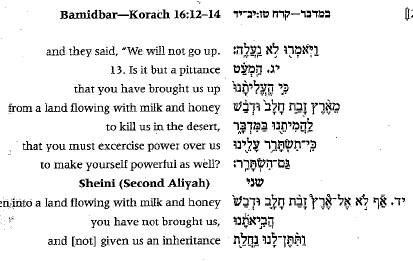
2)  Moshe sends a messenger to Dasan and Aviram to meet with Moshe and try to make peace.  Dasan and Aviram reject’s Moshe’s olive branch, refuses to meet with Moshe, and sends a verbal assault via the messenger back to Moshe, as conveyed in verses 13 and 14..

image001

image002

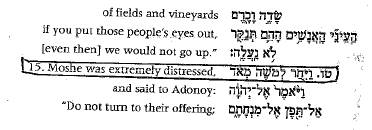
 Verse 15 says

image008

I thought the  word   image009 meant “anger”. I was surprised that Rashi translates it as “distressed” .  Rashi choose to not translate V”Yichar word as anger.  Rashi seems to argue on Targum Onkyls who translates V’Yichar as anger.      Per Rashi, Moshe was distressed, grieved.  Refer to the scanned attachment for Rashi.  It is clear that image009 by itself does not mean anger.  The source of Rashi is the Medresh, as follows:

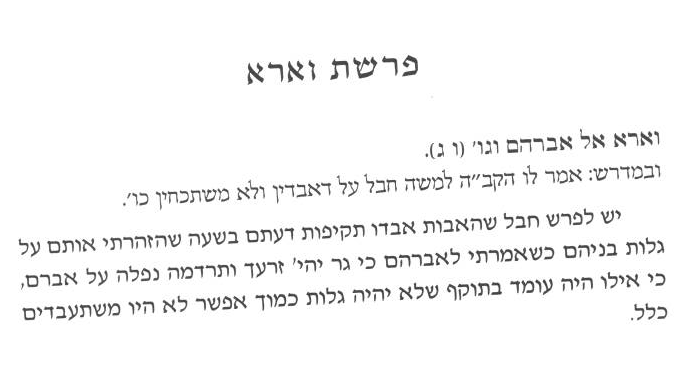
image010Refer to the explanation in the bottom of the Medresh who explains it, as follows:

 When someone has an argument with another and is able to respond to his antagonist, the person has satisfaction (he is able to answer the verbal assaults).  However, when the person being attacked – the victim, cannot answer his antagonist, the victim  has pain, grief, and aggravation.  Dasan and Aviram challenged Moshe’s leadership.  They did not appear before Moshe with their attack, so that  Moshe could not respond to them.  Moshe tried to make peace, they turned on him, and got the upper hand.  Moshe was publicly humiliated, embarrassed and he was distressed.

This is the meaning of the word – image011

I want to add another meaning of the Medresh.

The Medresh employees the words   image012   image013  .  These words imply personal satisfaction and not answering your enemy or being victorious.

I want to say that the Medresh is telling us a comment on  human psyche.  If we are fighting with someone and we answer that person, we have personal satisfaction and we are at peace with ourselves.  However, if we do not answer a verbal assault on ourselves, then we have pain and anguish.  It eats away at us, with negative, negative results. It can take years to forget the hurt.

A personal story to illustrate.

Years ago,  two distant cousins of mine were talking to one another and the older gentleman tried to humiliate his younger cousin.    He said that he does not see how his cousin is a Kotzker descendant, because his cousin was not sharp.  Neither my cousin nor I, who witnessed this exchange, answered these older gentlemen.     The younger cousin was silent in the face of a verbal assault.  He should have said and could have said that the older gentlemen was at one time the Rabbi of a non-Orthodox  Synagogue, that he is not trustworthy, that his business ethics could be questioned, and that it is doubtful that  he served Kosher food in his business to Jewish residents.

It would have been different if my cousin had a ready answer,  but we both held our tongues.   It was true that my younger cousin  does not have the Kotzker sharpness.   The correct answer is that there are many aspects of Kotzker Chassidus and this individual did not embody at all Kotzker Chassidus.  He did have a quick mind, but otherwise was a boor.   This hurt my younger cousin for years

Medresh

Pesach 2013

I would like to wish everyone a holiday that is joyous, festive, and inspiring.   Mazel Tov to Daniel and Chayala Glenner of the birth of a son, and to Menachem Mendel and Shoshana Janowski on the birth of a son.  Daniel and Chayla named thier baby Yehoshua Nissan, after Chayala’s great – grandfather and a great-great grandfather.  Menacham Mendel and Shoshana’s baby’s Circumcision should, God willing, take place on Shabbos, 3/24/13.

(Mazel Tov – the baby’s name is Itamer Yaakov.  This is indeed a great Simcha and the name Itamer Yaakov is after my father-in-law, Itamer Yaakov Janowski.)

Mazel Tov to Yossi and Elisheva Chase on the birth of a daughter, this past Tuesday.  The baby naming and Kiddush is this Shabbos at Bais Chaim Dovid East, Rabbi Menachem Fine.

Continue reading “Pesach 2013”

The Kotzker Rebbe and the Crimean War:

Expressions of love for Jewish soldiers

I saw this Vort from the Kotzker mentioned in Harry Maryles’s Blog, Emes V’emunah, by a commentator named Ephraim.  I have not seen this Vort in  a sefer, but it is true to the Kotzker and keeping with the feeling of his responsibility to the entire nation of Israel. Continue reading “The Kotzker Rebbe and the Crimean War:”

Kotzker Vort – Parshas Va’erah

Good Erev Shabbas:

It is almost Shabbos and it is snowing here in Chicago.  It gives Shabbos a special look and feel.  I wanted to send everyone the above Bible thought  from the Kotzker Rebbe on this week’s portion.

At the end of last week’s Bible portion and the beginning of this week’s Bible portion,  there is an exchange between Moshe and God.  Moshe challenged God and said that you God, sent me to free the Jewish people, not only did I fail, but their servitude got worse. God has to defend himself and say that indeed I will redeem the Jewish people.

The Medresh Rabbah says on this  exchange:   “God said to Moshe – woe on what we have lost and are not found, that Moshe . . .”  I do not have the full text of the Medresh here at work.

The Kotzker said:

“It is a shame that the forefathers lost their strength at the time that I (God) warned them about the exile of their children.  When I said that your children will be sojourners in a strange land and right afterwards what happened, Avrohom fell into a deep sleep.  If Abraham would have stood his ground with strength and firmly told God (or argue),  no there will not be an exile, then it  is possible that the Jews would not have gone into slavery.”

The Kotzker is saying the God is saying this, lamenting the inability for Avrohom to defend his own children.

This is consistent with the Kotzker.  I spoke to Dr. Ungar and he told me that this is the Chiddush, the mindset, of the school of Pshisca, The Yid Hakodash,  the Rebbe Reb Bunim, and to the Kotzker, to challenge God.  He said that there is a Talmud in Gitten that talks about this very subject, and of our forefathers, only Isaac stands up to God.  The Bardichiver’s approach was to defend Jews to God in a sweet, cajoling manner, C’mon God, be good to  your kids, the Jews are good, do not punish them.

The Kotzker and his teachers, the school of Pshisca, was more brazen, upfront,  and challenging God. This is what Moshe did in our Torah portion.

I quickly wrote this so I apologize for sloppy wording.