Kotzker Vort – Parshas Va’erah

Good Erev Shabbas:

It is almost Shabbos and it is snowing here in Chicago.  It gives Shabbos a special look and feel.  I wanted to send everyone the above Bible thought  from the Kotzker Rebbe on this week’s portion.

At the end of last week’s Bible portion and the beginning of this week’s Bible portion,  there is an exchange between Moshe and God.  Moshe challenged God and said that you God, sent me to free the Jewish people, not only did I fail, but their servitude got worse. God has to defend himself and say that indeed I will redeem the Jewish people.

The Medresh Rabbah says on this  exchange:   “God said to Moshe – woe on what we have lost and are not found, that Moshe . . .”  I do not have the full text of the Medresh here at work.

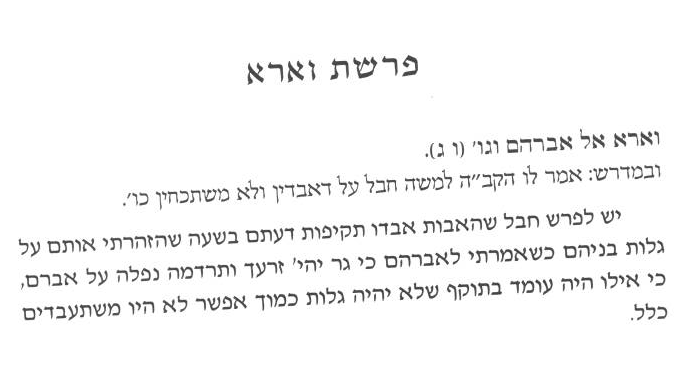
The Kotzker said:

“It is a shame that the forefathers lost their strength at the time that I (God) warned them about the exile of their children.  When I said that your children will be sojourners in a strange land and right afterwards what happened, Avrohom fell into a deep sleep.  If Abraham would have stood his ground with strength and firmly told God (or argue),  no there will not be an exile, then it  is possible that the Jews would not have gone into slavery.”

The Kotzker is saying the God is saying this, lamenting the inability for Avrohom to defend his own children.

This is consistent with the Kotzker.  I spoke to Dr. Ungar and he told me that this is the Chiddush, the mindset, of the school of Pshisca, The Yid Hakodash,  the Rebbe Reb Bunim, and to the Kotzker, to challenge God.  He said that there is a Talmud in Gitten that talks about this very subject, and of our forefathers, only Isaac stands up to God.  The Bardichiver’s approach was to defend Jews to God in a sweet, cajoling manner, C’mon God, be good to  your kids, the Jews are good, do not punish them.

The Kotzker and his teachers, the school of Pshisca, was more brazen, upfront,  and challenging God. This is what Moshe did in our Torah portion.

I quickly wrote this so I apologize for sloppy wording.

Lissa Rov and the Chedushei Harim

From: Mitch Morgenstern
Sent: Sunday, March 27, 2011 1:14 AM
To: Mitch Morgenstern
Subject:

Good Motzai Shabbos:

Today, I saw a great story in a Sefer called the Lukketei HaRim that relates to my feelings of what I have to say.  The Sefer was a gift from Yonatan Glenner.

The Lissa Rav – Yaakov ben Moshe Lorberbaum of Lissa (1760-1832)  (http://en.wikipedia.org/wiki/Yaakov_Lorberbaum)  had a question he could not answer.  The RIM (1787-1866), answered the question.  The Lissa Rav stood for a few moments in deep thought and said – that I answer the question this way and the RIM says another answer.  I can engage in debate with the RIM, however, ultimately I know he is right.  I do not want to engage in debate because through the power of debate and persuasion I may get him to change his answer, and I know he is right.  The truth lies with him.    Understand that the RIM lived from 1799 – 1866, was much younger than the Lissa Rav and was not considered to be at the level of the Lissa Rav.  The Lissa Rav is the Nesivous.

The Lissa Rov learned in the Yeshiva of Rabbi Yosef Hochgelenter in Zamusz, the same yeshiva that the Kotzker Rebbe learned at years later.

I would like to add the WOW to the story with the Lissa Rav.

The point of the story with the Lissa Rav is that when  it comes to Torah, the truth reigns supreme.

The Lissa Rav was one of the great leaders of Jewry in Poland and was at least 60 at the time.  This story took place in the 1820’s. The RIM was in his 20’s and was not a universally recognized Torah scholar.   The Lissa Rav did not let ego get in the way.  He was willing to recognize the truth in what the RIM said.

Not only that,  the RIM was a Chassidic Jew and imagine a Chasid besting one of the greatest Misnagdic scholars at the time.   The Misnagdim were locked into a fight with the Chassidim for the hearts and minds of Jewry.   Misnagidm claimed that Chassdim were ignorant and did not produce Torah scholars.  The RIM disproved this.   The Lissa Rav could have also thought that I have to fight and disprove the RIM simply because we Misnagdim do not like Chassidim and we always have to best them in Torah, even if the Chasid is correct.  Perhaps not consciously,  but subconsciously he could have had this thought, where the Lissa Rav did not even realize that his arguing with the RIM was about not letting a Chasid be correct and  be proven to be a Torah scholar.

Had ego been a factor or a Misnagdic dislike for the Chassid, the Lissa Rav would not have had a clear mind to see the truth in the RIM’s answer and the Lissa Rav could have argued with the RIM and perhaps gotten the RIM to change his mind.  Remember, the Lissa Rav had memorized the entire Shas, Rishonim, and Poskim in his mind.  Had he had an agenda, then he would have fought the RIM.  However, the Lissa Rav was committed to the truth in Torah and publicly admitted that this Chassidic young man is correct.

There are parallels to various arguments among the leaders of Torah Jewry today, however, I will let others make the connections.