
Shabbos Chanukah – December 9, 2023
On Shabbos January 14, 2024 I finished reading the book, The Jewish Confederates, by Robert N. Rosen. https://en.wikipedia.org/wiki/The_Jewish_Confederates
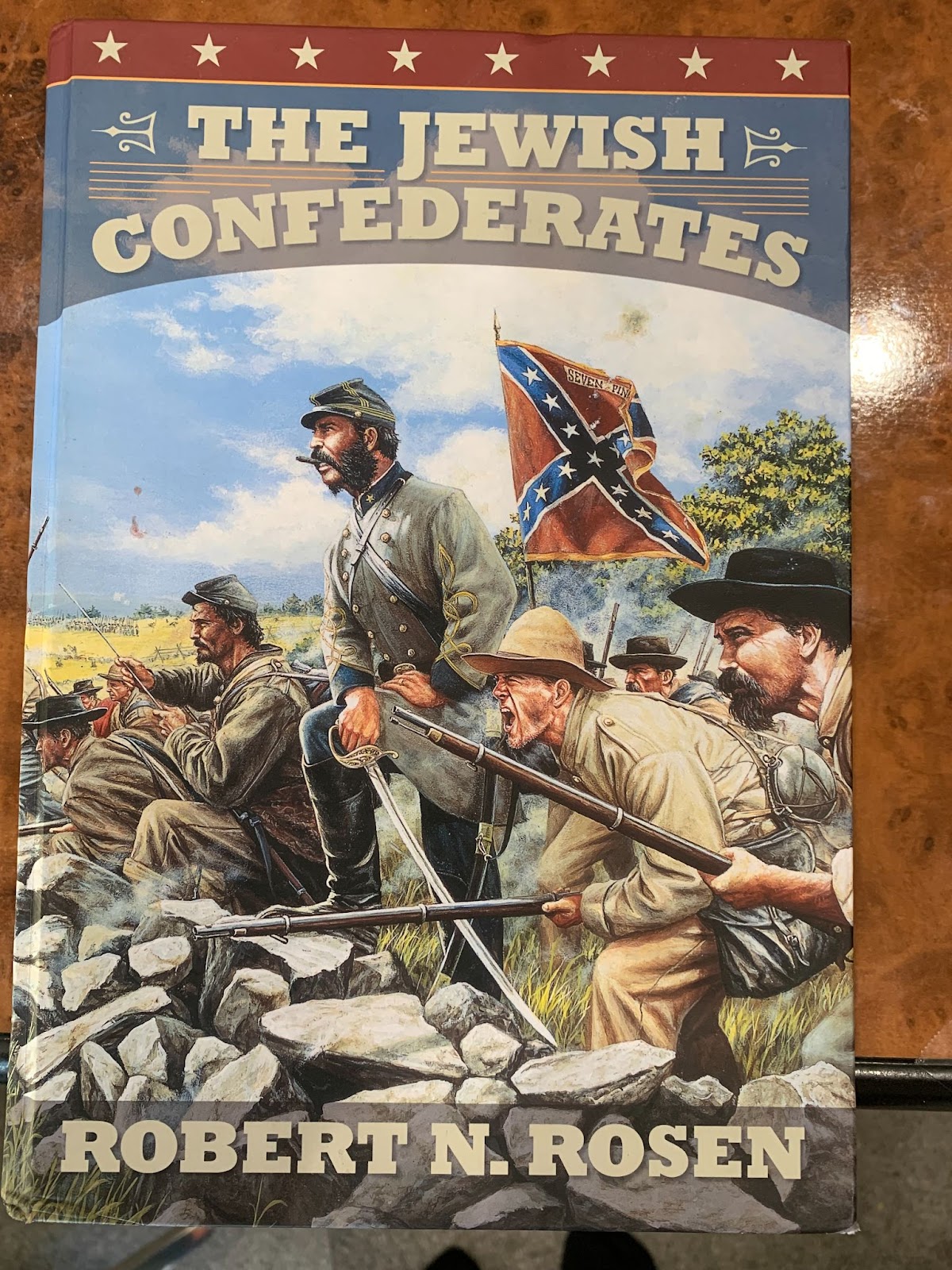
Robert Rosen writes about why Jews supported the Confederacy. The Jewish leaders of the Confederacy, the Jewish fighters, antisemitism, and how the Jews reacted to the defeat of the South. On January 16, 2024 I finished the book.
There were 20,000 Jews in the South and 100,000 Jews in the North. Roughly 2,000 Jewish men fought for the South.
The Jews in the South felt welcome. Many were Jewish immigrants from Germany. They went from oppression in their home countries to freedom in America. They breathed fresh air and not the putrid air of repression in Germany and eastern Europe. They became part of the culture of the South and some had slaves. They supported the Southern cause and hated the Yankees. The Jewish women equally supported the Southern cause. They looked up to Robert E. Lee and Jefferson Davis.
It is true that in Europe the ghetto walls fell down in Vienna in 1848 and in Germany around the same time; however, it did not approach the freedom the Jews felt in America, especially the South.
Page 14 states:
Thus, overwhelmingly, almost unanimously, some with fear and trepidation, others with courage and enthusiasm, some with reservations, other with a firm unflinching resolve, Southern Jewry cast its lot with the Confederate State of America. Many like “Ike” Hermannn, had found the land of Canaan. Othrs, like Gustavus Poznanski, had found their Jerusalem, their Pastime. Still others, l Marcus Baum, Jacob Samuels, Adolph Proskenaur, and Herschel Kempner had found finally their fatherland.
Pages 15 and 16:
Southern Jews had been breathing the free air of Dixie for two hundred years.
The Jews arriving from Eastern Europe, and the German states such as Prussies and particularly Bavaria, which stood first in the row of intolerant states.” infamous for “its Pharaoh-like registration laws,” its restriction of trade, marriage, and even the Jew;s right to reside in the place of his choice.
The Jews of the South lived in a slaveholding society, and they accepted the institution as part of everyday life.
There was some anti-semitism in the South before and during the civil war but by and large the Jews were accepted as part of Southern society.
Many Jews married out of the faith. Judah Benjamin, considered the most successful Jewish man in the South became a confidant of President Jefferosn Davis and in his war cabinet, married out of the faith. Nonetheless he was known as a Jew. Per Wikipedia:
Judah Philip Benjamin, QC (August 6, 1811 – May 6, 1884) was a United States senator from Louisiana, a Cabinet officer of the Confederate States and, after his escape to the United Kingdom at the end of the American Civil War, an English barrister. Benjamin was the first Jew to hold a Cabinet position in North America and the first to be elected to the United States Senate who had not renounced his faith. https://en.wikipedia.org/wiki/Judah_P._Benjamin
Page 356 of Robert N. Rosen books state:
Why did Judah Benjamin’s memory survive? “Without a question,” Rabbi Korn wrote, “he achieved greater political power than any other Jew in American history.” Rabbi Calisch of Richmond explained his meaning for Southern Jewry in 1902: “I stand here in the name of the Jeiwsh community of this city . Judah P. Benjamin was born of Jeiwsh parents and reared as a Jeiwsh child. I have not yet been able to discover if he was an observing Jew or not. But this I know, had he been a traitor we would have had to bear the ignominy of his wrong doing – but as he was a hero, a statement. a gentleman and a partrit, we claim the privilege of sharing in the reflection of his glory.”
The cover of the book depicts Major Adolph Proskauer at Gettysburg. Major Proskauer, a n immigrant from Prussia to Mobile, led the 12th Alabama Infantry at Culp’s Hill during the Battle of Gettysburg. This 1999 painting re-creates the moment described in the history of the regiment by Capt. Robert E Ory Park, “Our gallant Jew Major smoked his cigars calmly and cooly in the thichest of the fight.” (Painting by Dan nance of Charlotte, North Caroline. Author’s collections.) Page 360 details life for Adolph Proskauer after the civil war. https://en.wikipedia.org/wiki/Adolph_Proskauer
Another prominent Jew in the south was David Yulee. He was born David Levy, but he changed his name to Yulee and became a Presbyterian. Pages 60 and 61 discusses Yulle’s life.
It appears that the Jews of the South were assimilating. My guess is that this was also happening in the North and probably by the early early to mid 1900s most of the jews in America at the time of the Civil war assimilated and there are few of their descendants identifying as Jewish.
There were some anti-semitci outbursts but they were short lived and the Jews were defended. Pages 266 through 272 in the book. There is little evidence of anti-semitism in the Army. To restate, overall the Jews had it good in the South.
Robert N. Rosen concludes in his last three pages of the book.
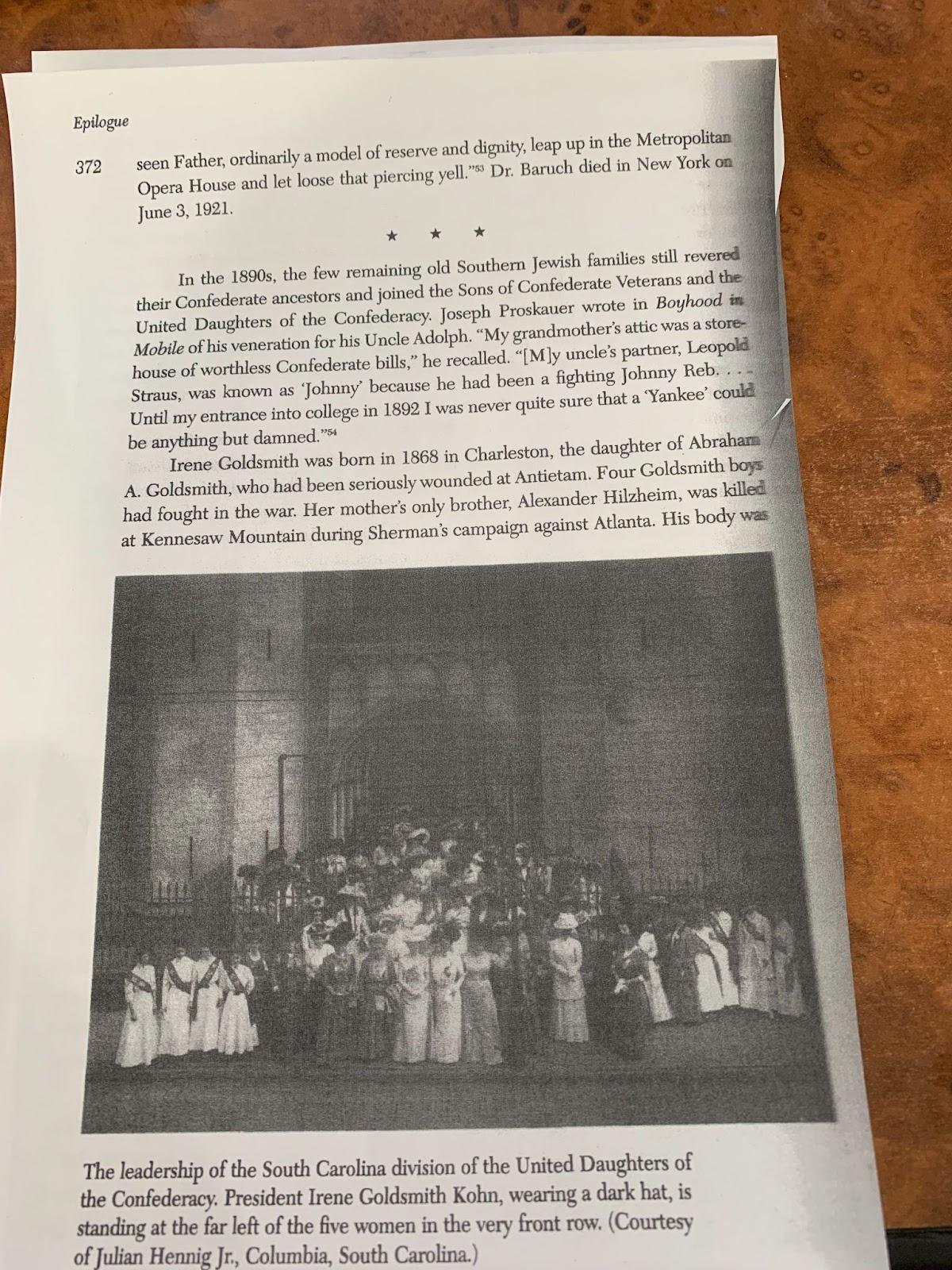
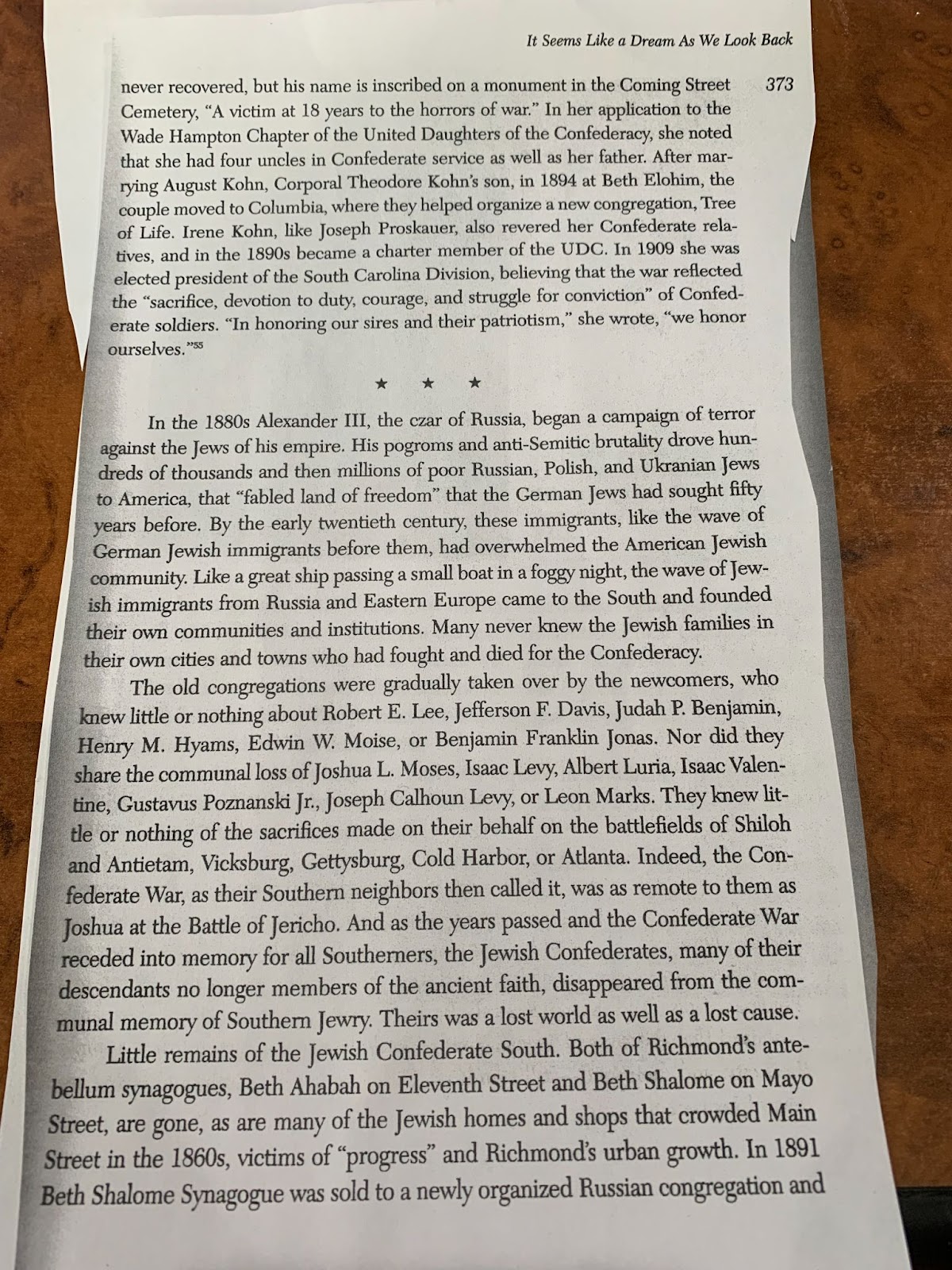
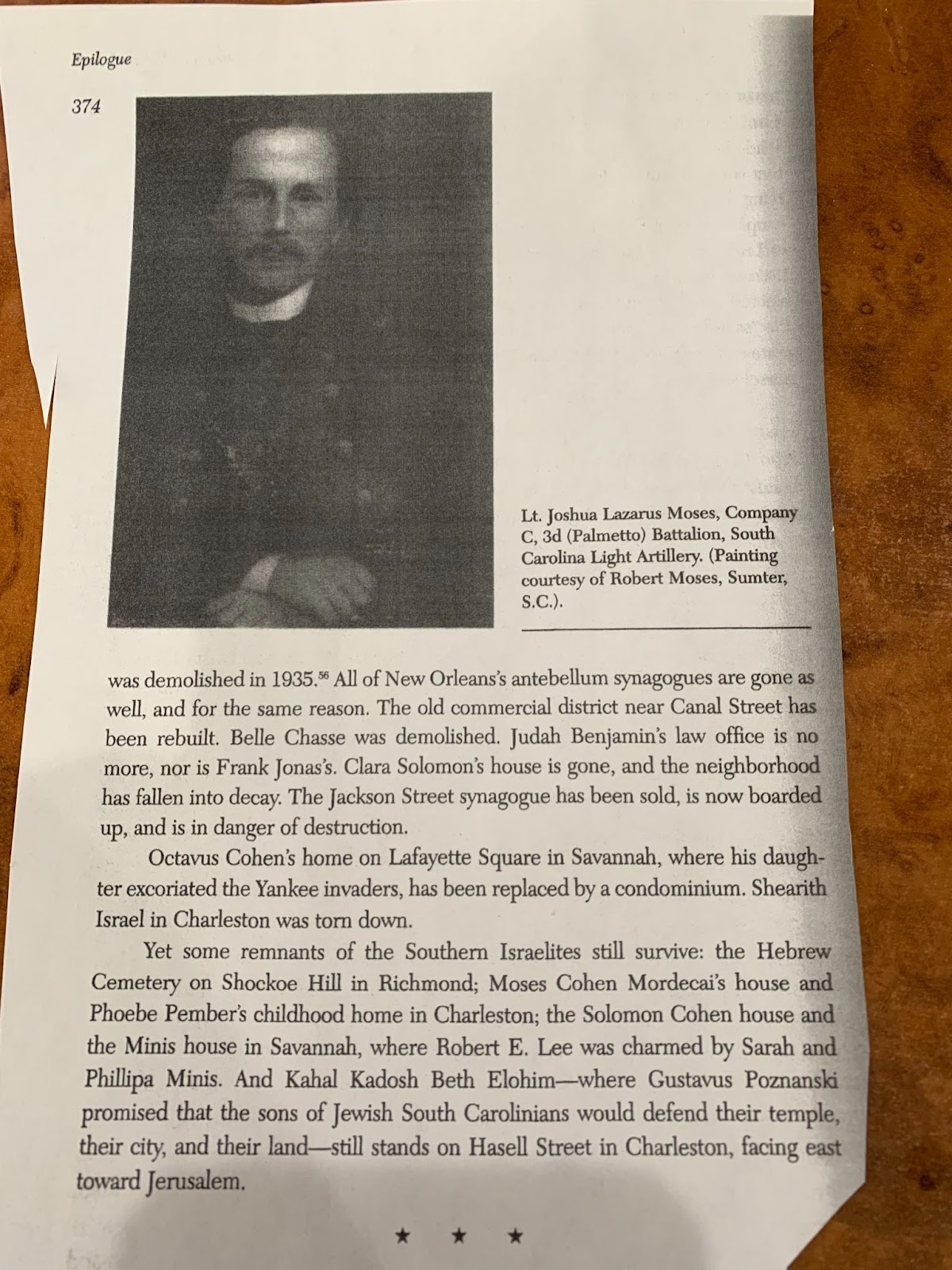
My questions:
1 – how many Jews in the South and for that matter in the North trace their ancestry back to the Civil war?
2 – what was the intermarriage rate both in the South and the North?
3 – what changed in the south after the Civil War that the South is/was considered to be heavily anit-semetic?
4 – were the Jews less accepted in the south after the Civil War and did intermarriage go down.
My answer is that because of the Civil War the South became impoverished. People having troubles blame outsiders and they blamed the Jews. Before the war, the south was a wealthy country. Throughout history when times are hard, jews are blamed.
December 9, 2023
Shabbos Chanukah
Parshas VaYeshev
I loved the following story about Lt. Colonel Marcus Spiegel in the book. Lt. Colonel Marcus Spiegel also has a wikipedia page. https://en.wikipedia.org/wiki/Marcus_M._Spiegel
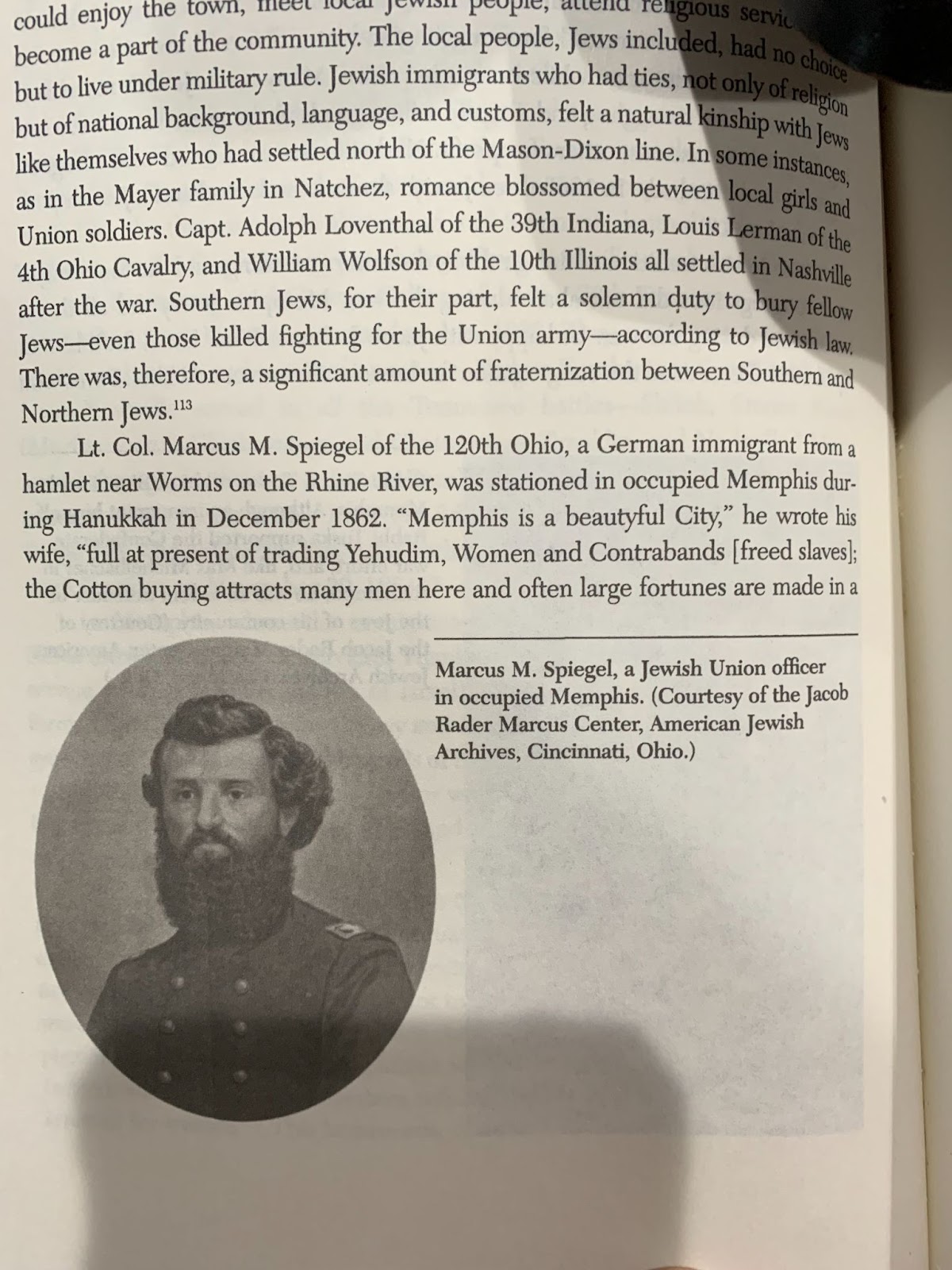
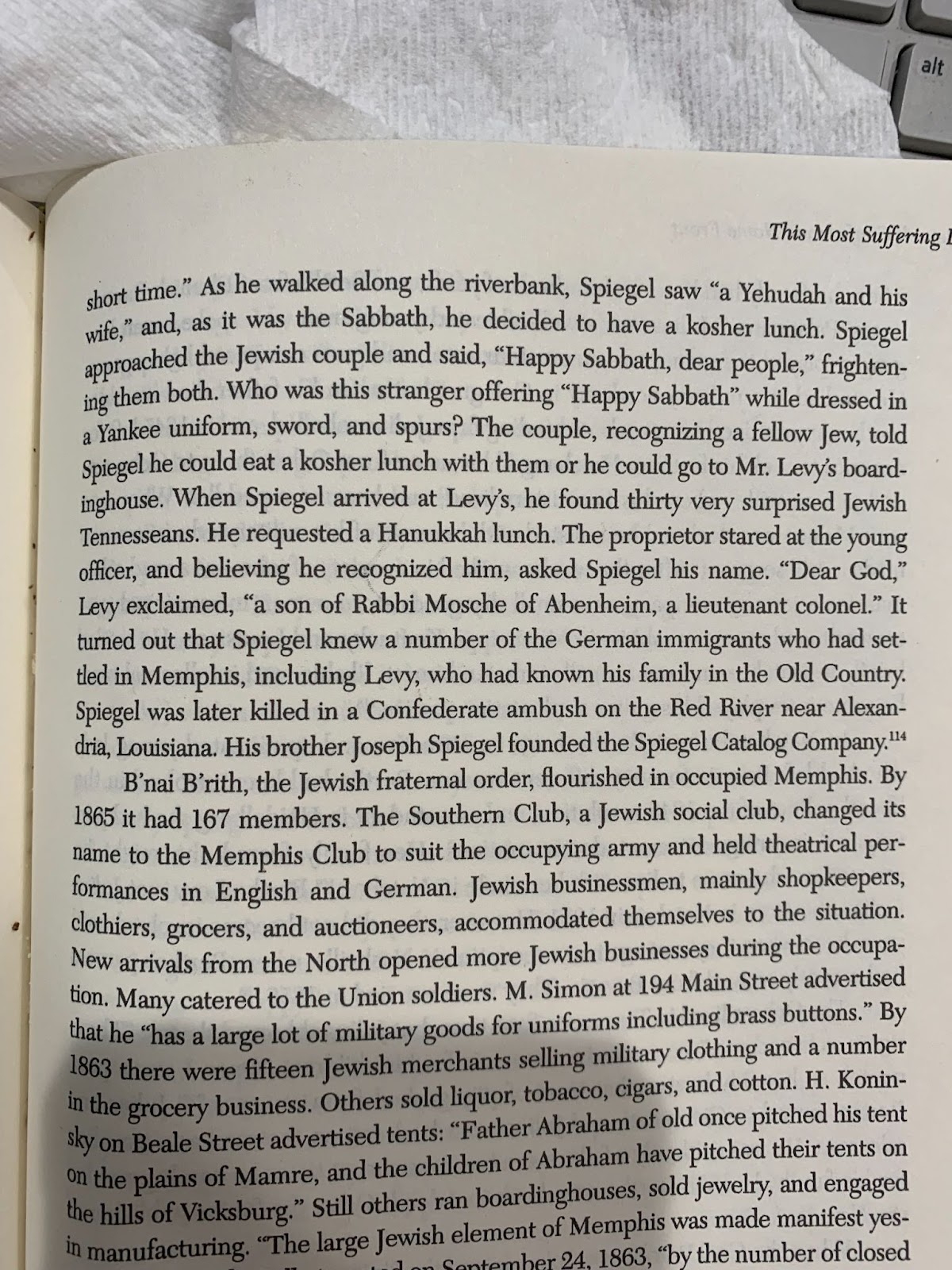
Marcus M. Spiegel (December 8, 1829 – May 4, 1864) was one of the highest ranking Jewish officers in the U.S. Army during the American Civil War.[1] He served in the 67th and 120th Ohio Volunteer Infantry. During the course of the war he became a staunch abolitionist. He served at the Siege of Vicksburg, and was mortally wounded during the Red River Campaign in May 1864.
Early life and education[edit]
Spiegel was born in the hamlet of Abenheim, Germany, near the city of Worms, on December 8, 1829, to a Jewish family that had lived in Germany since the sixteenth century.[2] While peddling in Ohio he met Caroline Hamlin, daughter of a prominent Quaker. They married and moved to Chicago, Illinois where she studied Judaism and German-Jewish cooking. She converted to Judaism in 1853 in Chicago.[3] He was the older brother of Joseph Spiegel, founder of Spiegel Catalog.[4]
Career[edit]
Spiegel volunteered for the Union Army and soon rose through its ranks. He wrote over 150 letters to his wife Caroline during the course of the war, most of which still survive. In one of his letters wrote:
I am [in] favor of doing away with the institution of Slavery…never hereafter will I either speak or vote in favor of Slavery; this is no hasty conclusion but a deep conviction.[5]
In late 1862 Spiegel was transferred to the recently formed 120th Ohio Volunteer infantry, and was promoted to lieutenant colonel. He was officially commissioned colonel on March 20, 1863, and took formal command of the regiment.[6]
He served at the Battle of Vicksburg (May 18 – July 4, 1863). Soon after the fall of Vicksburg, he was badly wounded by an exploding shell. Spiegel survived the incident and was sent home to recuperate, and in March 1864 he returned to front line duties.[6] Several weeks after his return, Confederate forces succeeded in ambushing the Union transport ship City Belle, at a location near Snaggy Point on the Red River, during the Red River Campaign in Louisiana. The result of the ambush was a disaster for the Ohioans; most of the 120th infantry were taken prisoner. Spiegel was again wounded by a shell burst; this time fatally.[6] He died of his wounds on May 4, 1864.
 Exploring Kotzk
Clara Solomon and her family were good friends with Rob Wheat, a well-known Confederate commander. Wheat was particularly solicitous of the two Solomon sisters. When Rob Wheat died, Clara was devastated. “More than that, he was a dashing, gallant man who genuinely cared for the two Solomon sisters, Clara and Alice. Clara adored the man for his kindness. On hearing the news, she was disbelieving. He was so brave, so impetuous, she knew. Clara speculated that he may have died thinking about his mother with his “affectionate” heart.”
Tom