
July 12, 2025 – 16 Tammuz 5785
Shabbos Parshas Balak
My father, Yisroel Yaakov ben Avrohom Meir’s, 23rd Yahrzeit on
11 Tammus, July 7, 2025
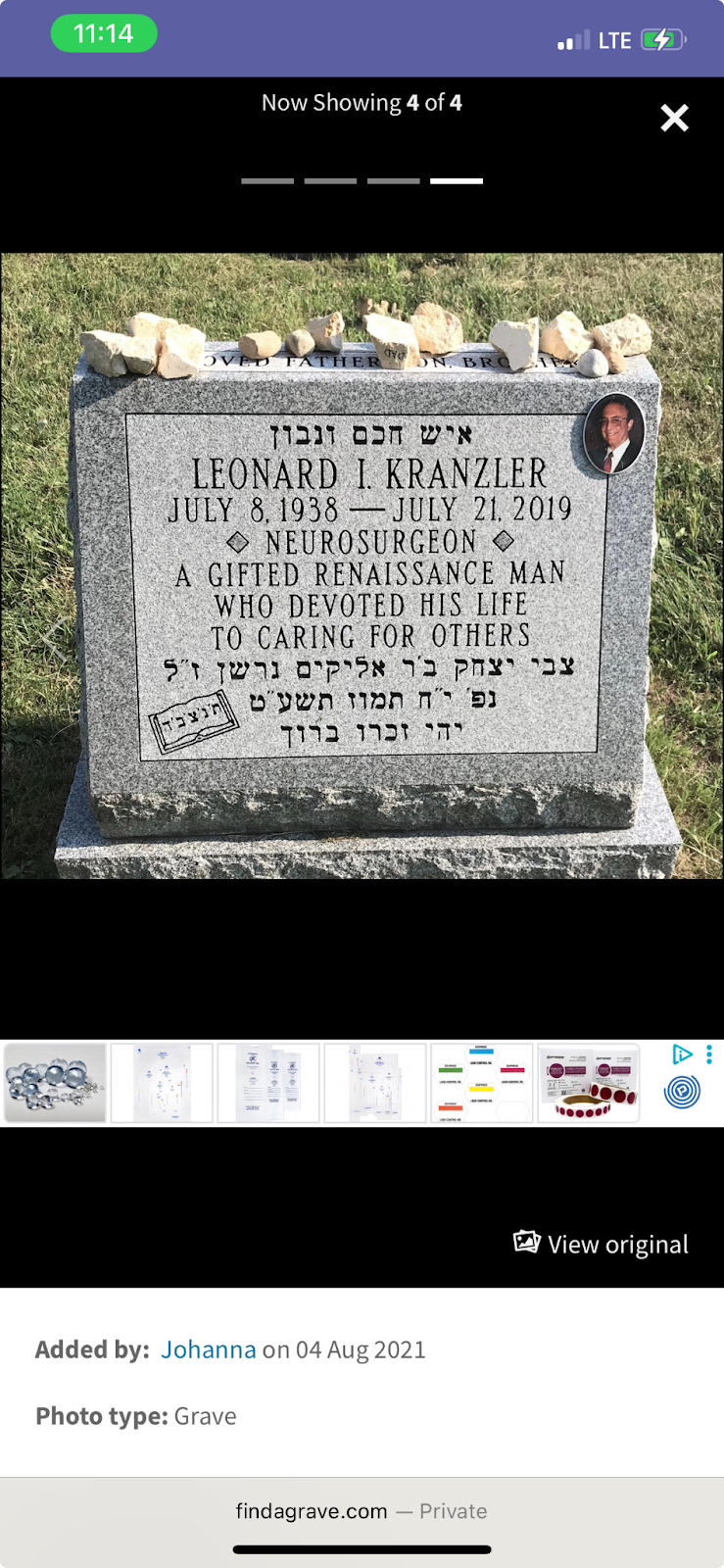
Dr. Leonard Kranzler’s 6th Yahrzeit on 18 Tammuz, July 14, 2025
Torah from Shabbos and Sunday
אֶ֥רֶץ בְּנֵי־עַמּ֖וֹ
The Importance of Money
How to Explain Bilaam’s Actions
My Charity
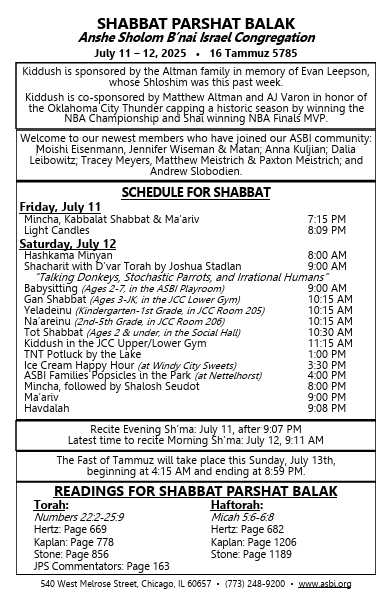
Torah Lecture from Anshei Sholem by Joshua Stadian
I davened at Chabad on Monday, July 7, 2025 and purchased bagels, Lox spread, and American Cheese.
Last Friday, July 4th, I went to Waldheim cemetery to help make a Minyan for Anshei Kranczer’s mother’s Yahrzeit. He did not need me and I debated whether to go or not. I decided to go anyway because I knew his mother, Leah Kranczer. She had a watch repair shop at the Chicago Diamond Center at 5 S. Wabash. I banked her and was able to do some favors for her. At the cemetery, I decided to go to Dr. Leonard Kranzler’s grave. I could not find it as he is not buried near his father. I used Find a Grave. Boruch Hashem I found the grave and discovered that Dr. Leonard Kranzler’s Yahrzeit is the 18th of Tammuz, in a week. Siatta Dishmaya.
I arranged for the Shabbos Kiddush at Chabad in memory of Dr. Leonard Kranzler. A number of people spoke. A lady – I do not know her name, Peggy Kaz, Tamar Genin, Paul, and I spoke about Dr. Kranzler. It was very respectful and we really honored him. Peggy Kaz’s son is an Orthopedic doctor and did a rotation at St. Francis hospital. One day he walks into the break room and there is a man with a Yarmulka learning Gemora. It was Dr. Leonard Kranzler. The future doctor was very impressed.
I left my house for Anshei Sholem at 8:05 AM. I felt great and did not have any heart issues. I made the 5.5 mile trek in 95 minutes, a great time for me. I arrived right after Borchu. The Rabbi is at a Rabbinic retreat so Josh Stadlan spoke and it was an excellent speech. I went to the Kiddush which was good, much better than the previous week. At 12:30 PM I went with Dr. Isaac Kalimi to Chabad. The Chabad Kiddush was great, with the Cholent being as good as always. They make a Pesach Cholent which is perfect.
I led the Shiur. It was pretty good. Professor Kalimi argued with me on the definition of אֶ֥רֶץ בְּנֵי־עַמּ֖וֹ In Verse 22:5. Rashi and all the Reshonim say it is referring to either Balak’s city or Bilaam’s city. Professor Kalimi said they are all wrong and it is the name of a city called Bnei Amo. After Shabbos I looked into it and I am not sure if he is correct.
As I was explaining the Parsha, I kept getting interrupted. Ray hates the interruptions and looks at me with his eyes, saying, what is going on, why do people have to keep interrupting, just say the Pshet. He expressed this concern and people in the Shiur said they are important interruptions. I agree with Ray that I want to get through the understanding before I have to answer questions.
Professor Kalimi, who knows more than anyone in the Shiur, listened to me Darshan. He argued with me on the explanation of Ben Amo in verse 22:5. I am very honored.
Shiur was over at 3:10. It was too hot to walk the six miles back home so I went to Eli’s house. I played with Ezra, my grandchild. It is great because Eli’s in-laws are there and they are always there to take the baby. When I finished playing, I gave Ezra to them. I had a delicious peach and diet coke. I tried to learn but dozed off for an hour. I felt refreshed when awakening and walked to Anshei Sholom for afternoon and evening services. Eli walked me part of the way and we talked.
After Shabbos while waiting to be picked up by my son, Isaac Faier, a teenager from Anshei Sholem who goes to Walter Payton Prep, known as the best high school in Chicago, rode up to me on his bicycle and asked if he could take a haircut tonight, the eve of the fast of the 17th of Tammus. Rabbi Dovid Kotlarski said you cannot as the three weeks actually start the night before the fast. I called Reb Moshe Soloveichik and he told me that per Reb Moshe Feinstein, one can take a haircut and per his Uncle, the Rov, one cannot. I texted this information to Isaac.
Sholem picked me up at 9:45 PM and handed me a cold bottle of diet coke. Living is good.
Isaac, Professor Dr. Kalimi | Sun, Jul 13, 9:40 AM (2 days ago) | ||
to me | |||
Hi Mitch,
It is always nice to hear from you!
I really admire and appreciate your passionate for Torah study, and it was great to talk and hear from you yesterday.
Looking forward…
Isaac
On Sun, Jul 13, 2025 at 8:47 AM Mitchell Morgenstern <mitchellamorgenstern@gmail.com> wrote:
Professor:
I looked to see where Bnei Amo is located and could not find mention of the city.
Torah from Shabbos and Sunday:
אֶ֥רֶץ בְּנֵי־עַמּ֖וֹ
Balak Chapter 22 verse 5 says
וַיִּשְׁלַ֨ח מַלְאָכִ֜ים אֶל־בִּלְעָ֣ם בֶּן־בְּעֹ֗ר פְּ֠ת֠וֹרָה אֲשֶׁ֧ר עַל־הַנָּהָ֛ר אֶ֥רֶץ בְּנֵי־עַמּ֖וֹ לִקְרֹא־ל֑וֹ לֵאמֹ֗ר הִ֠נֵּ֠ה עַ֣ם יָצָ֤א מִמִּצְרַ֙יִם֙ הִנֵּ֤ה כִסָּה֙ אֶת־עֵ֣ין הָאָ֔רֶץ וְה֥וּא יֹשֵׁ֖ב מִמֻּלִֽי׃
Rabbi Charles Kahana in Toras Yesharah translates.
He sent messengers to Balaam the son of Beor, to the city of Pethor, which is situated on the Euphrates River, Balak’s native land, inviting him with the following message: “Masses of people have come out of Egypt, and they are so numerous that they cover the face of the earth, and they are stationed opposite me.
אֶ֥רֶץ בְּנֵי־עַמּ֖וֹ – Rabbi Charles Kahana tranlslates אֶ֥רֶץ בְּנֵי־עַמּ֖וֹ as Balak’s native land. This Rashi. Others say it is Balaam’s native land.
Professor Kalmi said that they are all wrong. Bnei Amo is a place in the near east.
Where was this city of Pethor? It was along the Euphrates River. Devorim Pasuk 23:5 additionally identifies it as follows:
עַל־דְּבַ֞ר אֲשֶׁ֨ר לֹא־קִדְּמ֤וּ אֶתְכֶם֙ בַּלֶּ֣חֶם וּבַמַּ֔יִם בַּדֶּ֖רֶךְ בְּצֵאתְכֶ֣ם מִמִּצְרָ֑יִם וַאֲשֶׁר֩ שָׂכַ֨ר עָלֶ֜יךָ אֶת־בִּלְעָ֣ם בֶּן־בְּע֗וֹר מִפְּת֛וֹר אֲרַ֥ם נַהֲרַ֖יִם לְקַֽלְלֶֽךָּ׃
because they did not meet you with food and water on your journey after you left Egypt, and because they hired Bilaam son of Beor, from Pethor of Aram-Naharaim, to curse you.—
Pethor was in the region of Aram-Neharaim. Where is Aram-Neharim? Wikipedia says it is interchangeable with Paddan-Aram. Paddan Aram is generally known as Aleppo, Syria. However, Aleppo is 60 miles from the Euphrates River. It could be that Aram-Neharim is a general location which encompassed Aleppo, Syria.
Per Wikipedia:
Aram-Neharim:
- Biblical Significance:
- The term appears in Genesis, where it’s associated with Abraham’s family’s origins and the search for wives for Isaac and Jacob. It’s also mentioned in other books like Deuteronomy, Judges, and 1 Chronicles, describing events involving figures like Balaam, Cushan-rishathaim, and the Ammonites.
- Geographical Location:
- While the precise boundaries are debated, it generally encompasses the region between the Tigris and Euphrates rivers, with some interpretations extending it to include the area between the Euphrates and the Orontes or the Chaboras (Habur).
- Interchangeable Names:
- The Bible uses Aram-Naharaim, Paddan-Aram, and Haran somewhat interchangeably, often referring to the same general area around the upper Euphrates.
- Other Names:
- In Egyptian texts, it’s known as “Naharin,” which also means “land of the rivers”.
The Importance of Money
The other “Torah” I said was on the Pasuk Balak 22:20.
וַיָּבֹ֨א אֱלֹהִ֥ים ׀ אֶל־בִּלְעָם֮ לַ֒יְלָה֒ וַיֹּ֣אמֶר ל֗וֹ אִם־לִקְרֹ֤א לְךָ֙ בָּ֣אוּ הָאֲנָשִׁ֔ים ק֖וּם לֵ֣ךְ אִתָּ֑ם וְאַ֗ךְ אֶת־הַדָּבָ֛ר אֲשֶׁר־אֲדַבֵּ֥ר אֵלֶ֖יךָ אֹת֥וֹ תַעֲשֶֽׂה׃
The command of the Almighty came to Bilaam at night, saying to him: “If these men came to you for consultation only, arise and go with them, but only the word which I will speak to you, that alone must you do.”
Rashi focuses on the word לְךָ֙ in the Pasuk and says:
אִם הַקְּרִיאָה שֶׁלְּךָ וְסָבוּר אַתָּה לִטֹּל עָלֶיהָ שָׂכָר, קום לך אתם:
If the call is for you, (for your benefit), and you think to take payment for it, arise and go with them.
Rashi, I think links the word לך to Parshas לֶךְ־לְךָ֛ where Hashem says לֶךְ־לְךָ֛ and Rashi explains the word לך to go לַהֲנָאָתְךָ וּלְטוֹבָתְךָ – for your own benefit, for your own good.
Fascinating Rashi. God is telling Bilaam, if you can make money going with Balak, go ahead. Huh! What!
Two answers:
First Answer:
On Friday, July 18, 2025 I was editing this blog post and came up with the answer. Hashem is initially telling Bilaam that you will not be effective and there is no reason to go, in essence telling Bilaam not to go, Hashem is now giving him a reason to go, to make money. This ultimately led to Bilaam blessing the Jewish people. Additionally, Hashem was giving Bilaam the rope to hang himself. However, as I discuss later this led to the tribe of Shimon sinning and losing 24,000 men.
Second Answer:
My initial understanding when I said this at the Shiur was that: “I think Rashi is saying, yes, Hashem wants the world to have money. Going out on a limb, perhaps you can say that making money is Godly, when you do it with honesty and according to Jewish law. All the good we can do with money.”
This is a lesson for capitalism. You need a profit motive for things to be successful. If there is no profit motive, then the project will stagnate, deteriorate, and have terrible customer service. This is why in Communist and socialist countries services are terrible.
Other Torah:
As I am writing this on Sunday, the 13th, which is the fast of the 17th of Tammuz, a number of questions opened up to me.
Question 1 – Why did Hashem initially not give Bilaam permission to go, if he ultimately told him he could go? The answer probably is to tell Billam do not go because you will not be successful, implying also it will not be good for you. Bilaam insisted so Hashem relented based on the concept that Hashem lets people go the way they want to go, even if it is detrimental for them.
Question 2 – Balak asked Bilaam to curse the Jews. Why did Bilaam ask God for permission? Bilaam should have told Balak that I will curse them and not ask God. He knew that God would not give him permission. Just curse them or use black magic.
It seems that Bilaam wanted God to curse the Jews. What arrogance. God told him that the Jews are blessed, what did he hope to accomplish? How could he expect to succeed? It may be just as the Medrash says that God gets angry every day for a split second and Bilaam knew the time. Amazing Medresh. However, it can better be said on a simpler level. We know that at least in the first two years of the 40 years and last year, many times God got angry at the Jewish people. Maybe Bilaam knew this and due to his hatred for the Jews, Bilaam thought he would ask God what to say and it may be that he is asking God at a time of anger against the Jewish people and God will instruct Bilaam to curse the Jewish people.
Question 3 – Why did Hashem let Bilaam go with Balak to curse the Jewish people, even if God was not going to let him curse the Jews. It ended up bad for the Israelites. He unleashed a Hitler, a Stalin on the Israelites. Bilaam gave Balak counsel on how to damage the Jewish people and tear them away from God. That is through promiscuity. Promiscuity is a huge test for people. Bilaam is evil and evil people think about evil all the time. It exists in their subconscious. A thief thinks how to steal 24/7, not consciously but subconsciously. When a thief says good morning to a person, the thief is thinking, how can I steal our money.
Perhaps you can answer. Cursing the Jewish people is not dependent on man’s free will. God will not allow the Jewish people to be cursed. They are blessed. However, when they sin and because they have free will and decide to do a bad thing, they are punished and are cursed.
Bilaam’s advice was a strategy that depended on the free will of the Jewish people. I admit it hardly seems fair, but we have to always have the inner strength to do good. When Bilaam asked for God to curse the Jewish people, God said that cannot be done. However, testing the Jewish people happens all the time and as hard as it was the Jewish people, they should not have succumbed to their passions. We see all the time that evil people are allowed to hurt Jews. We know that this is when they sin, however, it still still seems unfair to release a Bilaam, a HItler, a Stalin on the Jewish people
Hatred disrupts the correct order of things- מִכָּאן שֶׁהַשִּׂנְאָה מְקַלְקֶלֶת אֶת הַשּׁוּרָה
My Charity
I want to record for posterity the charity I did the last two weeks.
1) Paid my bill at Slices Tel Aviv in the amount of $2,500. I have an open account for Meshulchim and others who need a good meal. I think Slices is the best restaurant in Chicago. The owner is a good friend and a good person.
A Meshulach told Meyer Chase that he had a meal on my account and he felt good and it gave him the strength to continue collecting money that day.
Label Polsky called and asked if a family driving back to Cleveland could have a meal. I said of course and thanked him for bringing them to Slices for a delicious meal. He asked me if he could also have a meal and I said of course. I love Label Polsky, a good guy.
2) July 2, 2025 – Gave my cousin $300
3) July 4, 2025 – Going to the cemetery as mentioned above. I was rewarded for this by finding Dr. Leonard Kranzler’s gravesite and realizing that his Yahrzeit is the following week. Perfect timing, almost as if Dr. Kranzler was reaching from the grave for me to find his gravesite, so the Shiur can honor him.
4) I purchased books from the Professor. I had previously purchased books from him which cost $300.00. This new set is costing me $460.00. He did not remember but he had already sold me two of the books. I decided to purchase them anyhow and gave them to Reznick, who davens at Reb Moshe Soloveichik’s Shul. Reznick expressed interest in the Professor’s books as he has one of them. I did this for altruistic reasons. I felt the Professor needed the money and since the books were already out of his house, he would feel let down if I gave them back to him.
5) July 7, 2025 – Gave $150 to David Sokoloff for his brother
6) July 7, 2025 – Purchased bagels and lox cream cheese for my father’s Yahrzeit.
7) July 9, 2025 – I sponsored the ending Zman barbecue at the Mesivta of Chicago. Sidney and Lisa attended. I spoke about my father. I did speak well.
8) July 10, 2025 – Gave Chabad $200 for the Doctor’s Kiddush and for my father’s Yahrzeit.
9) Drove Howard home a few times.
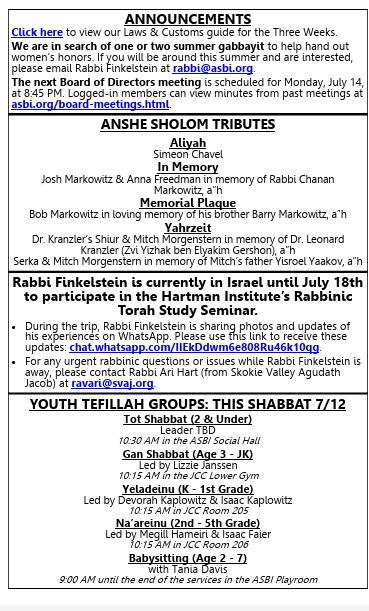
10) Put two Yahrzeit messages for my father and Dr Leonard Kranzler in the Shabbos weekly of Anshei Sholem. Refer to Anshei Sholem weekly.
11) Called Linda Kahn and I will be going to bring her lunch next Tuesday, the 15th. I purchased six Buddy Bergers from Great Chicago and cole slaw.
12) Naftali Gleener came to my house a few times/
Parashat Balak 5785
Talking Donkeys, Stochastic Parrots, and Irrational Hu
Joshua Stadlan
This week, Grok, the Artificial Intelligence chatbot on X (formerly Twitter), started making antisemitic comments. The company has since taken down the hateful posts, but as far as I’ve heard, Grok has yet to apologize. That said, as an Al model, could Grok truthfully say the usual “I didn’t mean it,” “I wasn’t thinking through my actions” or “these don’t represent who I am and what I actually think?” Does an Al model even “think” in the first place?
Grok, like more familiar Al chatbots ChatGPT, Gemini, or Claude, is a Large Language Model, or LLM: a model with billions of digital knobs that are fine-tuned to store patterns from processing trillions of words from human writing. A debate rages over whether LLMs are reaching human intelligence and even consciousness.
One camp, including the likes of the “Godfather of Al” scientist Geoff Hinton and the chief scientist of Open Al Ilya Sutskever, believes that current LLMs exhibit deep reasoning, as evidenced by the sophistication of their output: LLMs can perform complex logic, identify connections across concepts, synthesize knowledge into coherent essays, reflect on their answers, and work toward goals. They’ve reached human intelligence and might even reach consciousness.
The other camp, including the likes of linguist Emily Bender and Meta’s chief Al scientist Yann LeCun, is unimpressed with the ability of “large language models” to “reason.” They call these Al models “stochastic parrots,” where “stochastic” means random but in a pattern predictable with statistics. These researchers emphasize that the model is just parroting information from existing human texts, spitting out phrases based on the probability the phrase is connected to the question being asked.
In this view, when you give ChatGPT a math problem, it doesn’t think, “oh this question needs arithmetic, let me apply rules I learned from elementary school math.” It just has seen enough arithmetic problems to say, “this output number usually goes with these math words and these input numbers.”
A useful tool, this camp believes, but not a path to real “thinking.”
I personally think, in determining the moral status of Al, that its level of advanced reasoning is beside the point. After all, as humans, we use shoddy reasoning all the time! And our parsha, with the help of chazal, highlights plenty of examples of the flaws of typical human thinking.
Far from a stochastic parrot, the character with the most logical argument in the parsha is a talking donkey.
To remind you of the scene we read this morning:
Midianite prophet Bilaam is riding his donkey on the way to curse Bnei Yisrael on behalf of Balak, king of Moav. Unbeknownst to Bilaam the prophet, an angel with an outstretched sword stands in their way, to deter Bilaam from carrying out his plan. The donkey turns off course to save her rider; as the angel approaches, she tries to squeeze by the wall, squishing Bilaam’s foot in the process, and she eventually halts completely. Bilaam, still oblivious to the angel, beats his donkey upon each deviation. The donkey speaks up, what have I done to you to deserve this treatment?” And Bilaam replies, “You’ve been mocking me!” To which the donkey argues along the lines of, ‘if I’ve been your reliable donkey all these years, isn’t it more likely that something external is obstructing me than that all of a sudden I am intending to mock you?’ A solid inference-based argument!
Bilaam had assumed the donkey all of sudden harbored ill-will towards him, contrary to all prior evidence. He’s committing what psychologists call the Fundamental Attribution Error. The Fundamental Attribution Error describes the cognitive bias that, when we see behavior we don’t like, we generally assume bad intentions and personality flaws behind it- except of course when we do the same behavior, we tell ourselves it’s due to the external environment; not our fault.
When YOU fall asleep during the guest drasha, it’s because you don’t like me and you’re disrespectful people; but when I, myself, fall asleep during someone else’s drasha, I tell myself it’s not my fault, it’s because I didn’t get enough sleep last night and the sound is not carrying well in this oversized sanctuary. Prophet Bilaam’s biased thinking isn’t the only flawed human reasoning in the parsha. In fact, the whole parsha is premised on King Balak’s confusion of correlation with causation.
King Balak hired prophet Bilaam, in the first place, to curse the people;e of Israel because
“For I know that whomever you bless is blessed indeed, and whomever you curse is cursed.”
King Balak mistakenly believes that prophet Bilaam can induce God to curse a nation, but as we find out by the end of the story, prophet Bilaam can only curse nations that God has already cursed! Just because the subjects of Bilaam’s curses appear cursed does not prove that Bilaam is the one who causes the curse – this is the logical fallacy of “cum hoc ergo propter hoc.
Had King Balak been a more careful thinker, he might have avoided this whole embarrassing episode. Instead, King Balak ends up facilitating prophet Bilaam blessing his enemies- not only once, but three times, as King Balak repeatedly insists that prophet Bilaam try to curse again, and again. What a great example of the adage, the definition of foolishness is doing the same thing over and over and expecting different results. . .
The Rabbinic interpretations of the thinking and actions in this parsha shed light on other human biases, too.
In Sanhedrin 105, we learn that our decisions are not only prone to flaws in logic, but also to the influence of our emotions and attitudes. Rabbi Shimon ben Elazar teaches that Love and Hatred break the consistency of our behavior, citing two people of prominence – Avraham and Bilaam whose proper standard is to have servants saddle their donkeys for them. Yet, Avraham saddles his own donkey when on a mission for God, out of love for his Creator. On prophet Bilaam’s journey to curse the people of Israel, hatred compels him to saddle his own donkey as well.
Clearly, we humans are not consistent, rational beings. An artificial intelligence with flawless logical processing, unaffected by feelings, would not be thinking like a human at all! But perhaps, in aspiring to become more God-like, we should be trying to adopt more superreasoning, and strive to overcome the dependence on our emotional and mental states?
But would that be God-like?
While we can’t really know what this means, the same Talmudic passage in Sanhedrin teaches that God actually gets angry – for a brief moment, but every day. And, like the humans made in God’s image, God acts differently during those moments of anger compared to the rest of the day.
This fact about God, according to the Talmud, is central to Bilaam’s evil plan. Bilaam planned to exploit God’s daily moment of anger. Bilaam knew he didn’t have any power, independent of God, to successfully curse anyone. Rather, his great prophetic power was in knowing exactly what time of day.
God is angry, when God would be open to facilitating a curse of Bnei Yisrael.
And, it should’ve worked. Rather, a different “attitude” saved Bnei Israel-God’s compassion displaced the anger. The gemara continues, “The Holy One, Blessed be He, said to Israel: Know how many acts of kindness I performed on your behalf, that I did not become angry during all the days of Bilaam the wicked, as had I become angry during all those days, no remnant or refugee would have remained…”.
Bilaam didn’t succeed in exploiting God’s kiveyachol mental state, to harm Bnei Yisrael, but he did manage to exploit the mental states of the men of Israel. The Talmud provides the backstory to the sinning Bnai Yisrael, in engaging in impropriety with the Moabite women and performing 3 idolatry, right after the story of prophet Bilaam’s attempted curse. According to the Talmud (Sanhedrin 106), Bilaam employed Moabite prostitutes to entice the men of Israel into secluded quarters under the guise of selling linens at an excellent price; lure them into a false sense of comfort, push them to drink wine, exploit them and their desires while they drank, and trick them into idolatry. God finally becomes angry and sends a plague on the people.
Had the men of Israel replaced their human minds with logic machines, would the tragedy have been avoided? Maybe. However, the response to our impaired thinking doesn’t have to be the pursuit of cold rationality, as even God, kivyachol, is described as “feeling.” Instead, we can try to channel our feelings, attitudes, and motivations into pursuit of mitzvot and living out our values.
After all, Rav Yehuda teaches based on this parsha, that
שֶׁמִּתּוֹךְ שֶׁלֹא לִשְׁמָהּ בָּא לִשְׁמָהּ
A person should always engage in Torah study and performance of a mitzva even if he does not do so for their own sake, as through engaging in them not for their own sake, he will ultimately come to engage in them for their own sake.
Rav Yehuda’s proof is that King Balak gets rewarded for offering forty-two sacrifices to God, even though he was doing so under the instruction of Prophet Bilaam, with evil intentions to support the cursing of Bnei Yisrael. Through the ill-intended but positive action of sacrificing to God, King Balak merits to be an ancestor of Ruth, who demonstrates one of the most intense and intentional devotion to God and Bnei Israel in Tanakh.
Indeed, we can lean into our current emotions and motivations, and channel them for Torah and mitzvot. If you’re feeling angry – attend a protest for a cause you care about
Feeling grief for a lost loved one? Adopt a positive practice of theirs, or dedicate Torah learning in their memory.
Feeling lonely? Attend a minyan or shiva or perform Bikkur Cholim.
Feeling undervalued at work? Spend an afternoon supporting a neighbor.
Looking for social attention? Invite a bunch of newcomers to a shabbat meal. If you’re stuck on coming up with a menu, an Al ChatBot can think about it for you. Or can it?
Shabbat Shalom!





 Exploring Kotzk