I discovered this lecture and have given it numerous times. It is exceptional.
The Rabbi’s Daughter
A Lecture by Professor Shnayer Leiman
Anything in blue is what I added.
January 7, 2015
Congregation Bnei Yeshurn, Teaneck, NJ
We now move to the second part of the program, which I cannot introduce at length: A) because there is no time to, and B) because introducing Professor Leiman requires either a few days or virtually no time at all.
I am generally allergic to using terminology about human beings that is usually applied to God, but the fact that what passes through my mind involves such terminology says something about our speaker.
One expression that flitted through my mind about introducing him is “for him, silence is the only praise one could give.” Another was the word omniscient. But the blasphemous character of these terms serves as a deterrent.
So I will only say that Professor Shnayer Leiman has a level of expertise in the Jewish experience—from the ancient Near East until today—that is, and I say this without a smidgen of hesitation or exaggeration, unparalleled by anyone else. There isn’t anyone who really comes close.
And so it is my pleasure to introduce Professor Shnayer Leiman.
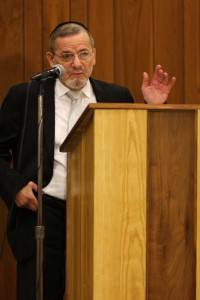
Professor Leiman:
Thank you, Dean Berger, for those words of introduction.
I want you to know that I was very troubled, and lost much sleep before I came here, because I knew I would be introduced by Professor Berger, and I thought he might exaggerate. But thank God, he didn’t even say half of what he could have said about Dean Berger.
Associate Dean Berger, members of the Manevitz family, and if he is present, Rabbi Panski: it is a privilege to present this lecture in memory of Mrs. Ethel Manishevitz, a disciple of great teachers and a distinguished educator in her own right, as we heard. And in many ways, I hope this presentation that you are about to hear is also about her.
In this lecture we will meet the following people, places, and events:
Yeshivas Maharsha
Ostroh or Ostrog
Rabbi J. Bercovich (Yosef)
Rabbi DJ Chazanovich (Dovid Yosef)
Rabbi Chaim Ozer Grodzinski
Maharsha
Lithuania as an independent state
Vilna
Kovno
Molotov-Ribbentrop Pact
June 22, 1941 – Operation Barbarossa
Fagel Boegel – the Rov’s Daughter
Stutthof
Ponary
Trochenbrod
Chelkas Yosef
Rebbetzin Bercovich
Miriam Bercovich
Rabbi Chaim Yakov Goldvicht – Rosh Yeshiva of Keren B’Yavnah
Rabbi Meir Goldvicht – nephew of Rabbi Chaim Goldvicht
Start of Lecture
The Rabbi’s Daughter: Spiritual Resistance in the Holocaust
Several years ago, a dealer in Jewish antiquities approached me with about ten or so different objects and documents. I dismissed nine of them almost immediately, and one, of course, caught my eye.
You have it, if you would open your folders. You have a four-page handout, and I’ll ask you to turn to page one.
Page one presents a copy of the document that I saw, and the one that I acquired.
Look at it carefully.
As you can see, it is a printed letterhead—blue on cream paper—and printed in Vilna in 1940. It is dated Vasario, which is February, so it is February 14, 1940.
And I have the original document with me. In case anyone has any doubts about it, you are welcome to come up after the presentation, and I’ll show you the original.

This is quite an incredible document.
So let us look at it a little more closely and get a sense of what it is about.
We can all read the Hebrew—or most of us can.
In the upper right-hand corner it says:
Yeshivat Maharsha
So this is a yeshiva—the yeshiva of the Maharsha.
Maharsha is a name familiar to most of us: Rabbi Shmuel Eidels, one of the great gedolim of the seventeenth century. He died in 1631, and he was Chief Rabbi of Ostroh (sometimes pronounced Ostrog), often part of Poland, sometimes part of Russia. In the period when he was there, it was part of Greater Poland. In later periods—and today—it is in Ukraine.
Kotzk Chassidim said that if you do not learn Gemara, Rashi, Tosafos, and Maharsha, you have not learned Gemara.
So there was such a yeshiva.
Then it says, in smaller Hebrew letters, that this yeshiva is now found in Vilna, the capital of Lithuania.
If we look at the left side of the top of the page, we see two names of rabbis.
For the moment, we will simply note that the names are written in Lithuanian. It appears as something like:
- Rabbi J. Berkovichius
- Rabbi D.J. Chazanovicus
Also in Vilna.
It is a good guess that these were the two heads of the yeshiva—the two Roshei Yeshiva.
In the middle, in Lithuanian, they have the equivalent of the Hebrew on the right:
This is the Rabbinic Seminary of Ostroh, known as the Rabbinic Seminary of the Yeshivat Maharsha, again in Vilna.
Aside from the date, the document itself is basically a certificate—an identification form, if you like—attesting to the bearer’s right of residence in Vilna.
This is a yeshiva student. The name is David Safran, and it is signed by one of the two Roshei Yeshiva, as you can see: Rabbi D.J. Chazanovich, saying that this is a member of our yeshiva, and therefore he has a right of residence in Vilna.
So it is a simple document.
But, as we shall see, it is a very significant document.
I bought it because it was clear to me immediately: this is a treasure.
It may be the last remaining record of a yeshiva that functioned in Vilna in the year 1940—a yeshiva that was destroyed in the Holocaust.
Why was the yeshiva in Vilna in 1940?
On August 23, 1939, the Molotov–Ribbentrop Pact was signed.
Ostensibly, it was a non-aggression pact agreed to by Stalin and Hitler.
Secretly, it was a pact between Stalin and Hitler that divided Eastern Europe between the two of them. It divided Eastern Europe into two spheres.
Everything east of the Vistula and Bug Rivers would belong to Stalin, and everything west of those two rivers would belong to Hitler.
Independent Poland no longer existed.
And on September 1, 1939, as we all know, Hitler invaded Poland to take the land that now belonged to him.
Jewish life in Poland ceased to exist.
And Jews began to run in every direction.
We have eyewitness accounts of how Jews met on bridges near Warsaw: Jews who were in the eastern part of Poland, now belonging to Stalin, were running westward to get away from Stalin; Jews who were in the western part of Poland were running eastward to get away from Hitler.
There was nowhere to run.
A small miracle occurred.
In October 1939, Stalin created an independent state of Lithuania.
There had been an independent state of Lithuania between World War I and World War II, with Kaunas (Kovno) as its capital. But the eastern portion of Lithuania had belonged to Poland between the wars.
Now Stalin announced that he was not going to keep that land for himself. He was creating an independent country with Vilna as its capital.
And so, from October 1939 until May 1940, when Stalin changed his mind and invaded Lithuania, Lithuania was an independent state.
And this created an eight-month window of opportunity for Jews.
During this time, thousands of refugees poured into Lithuania. The capital of Lithuania was Kaunas, also known as Kovno. Kovno is where the Japanese Embassy was located and where Chiune Sugihara handed out thousands of transit visas to desperate refugees, most of them Jewish.
The leading rabbi in Vilna, the Gaon Rabbi Chaim Ozer Grodzenski, immediately announced—and indeed ordered—all the yeshivot of Eastern Europe to come to Vilna.
All those yeshivot—Mir, Kamenetz, Radin, and so on and so forth—were urged to move to Vilna.
And indeed, they moved to Vilna.
So I am going to ask you now to turn to the second page of the handout.
What you see is a copy of a wonderful document that has been preserved. The original is now in YIVO in New York.
Professor Lucy Davidowicz worked in YIVO in Warsaw in 1938 and returned in 1946 to Warsaw. The main YIVO archives are in New York.
The YIVO Archives was founded in Vilna in 1926, a year after the founding of the YIVO Institute in 1925. It holds about 1,800 separate provenance based collections, registered as “record groups,” occupying about 17,000 linear feet and comprising an estimated 23,000,000 documents, manuscripts, printed materials, posters, photographs, films, sound recordings, art and artifacts. The collections pertain to Jewish life around the world, focusing on the 19th and 20th centuries, with some documents dating from the 14th through 18th centuries. The collections, which include papers of individuals, records of institutions, and subject collections, concentrate on four main fields, reflecting YIVO’s historic research interests:
- Yiddish language, literature and culture, including the Yiddish press and theater;
- European history with a focus on East European Jewish history;
- The Holocaust and its aftermath;
- Jewish life in the United States with a focus on the period of migration from 1880-1960.
YIVO Document:fe
ובסערה בסופה .Bnei Brak, 2000), pages:395-396)
רשימת הישיבות ומספר התלמידים ששהו בוילנא בס”ה הגיעו 2,336 תלמידים של 23 ישיבות. הם נשארו בוילנא מספר חדשים בלבד, עד שנצטוו על ידי הממשלה בינואר 40 להתפזר בעיירות שונות על פני כל מדינת ליטא. בהתאם לצו פיזור התפזרו הישיבות כדלהלן:
ישיבת מיר, בקיידאני – 273 תלמיד
ישיבת קלצק, ביאנובה – 241 תלמיד
ישיבת קאמניץ, בראסיין – 235 תלמיד
ישיבת ראדין, קצתם נשארו בווילנה וקצתם באיישישוק – 198 תלמיד
ישיבת בית יוסף מביאליסטוק, בבירגאש – 186 תלמיד
ישיבת פינסק, בווילקומיר – 128 תלמיד
ישיבת לומזה, נשארה בווילנה – 125
תלמיד ישיבת באראנוביץ, בטרוקי – 145 תלמיד
ישיבת מזריץ, בנימצינצין – 94 תלמיד
ישיבת גרודנה, בווילנה – 75
תלמיד ישיבת אוסטראה, נשארה בווילנה -57 תלמיד
ישיבת בית שמואל מווארשה, בווילנה – 40 תלמיד
ישיבת וולוז’ין, בזאגרי – 41 תלמיד
ישיבת אוסטרוב-מאזובייצק, בווילנה — 42 תלמיד
ישיבת חכמי לובלין, בווילנה – 63 תלמיד
ישיבת לובאביץ, בווילנה – 43 תלמיד
שיבת לוצק-פינסק, בווילנה – 48 תלמיד
ישיבת סלונים, בווילנה – 38 תלמיד
ישיבת רמיילס, וילנה מקומית – 58 תלמיד
כולל מיר, בווילנה (22 משפחות) – 65 איש
כולל בית יוסף, בווילנה (18 משפחות) – 75 איש
ישיבת תורת חסד, באראנוביץ, בטאווריג – 49 תלמיד
ישיבת בריסק, בווילנה – 27 תלמיד
It is a list of 23 yeshivot that escaped and made their way to Vilna.
You can see on the first line that a total of 2,336 yeshiva students made their way to Vilna, representing twenty-three different yeshivot.
Then you have a list of the yeshivot.
You can see:
- Yeshivat Mir
- Yeshivat Kamenetz
- Yeshivat Radin
- and many others.
In the middle of the page, underlined for you:
Yeshivat Ostroh
The Yeshiva of Ostroh—that is the name that appears on our document on page one.
It remained in Vilna with 57 students.
Fifty-seven students from that yeshiva made their way to Vilna and were there.
What do we know about this yeshiva—this strange Yeshivat Maharsha?
And the answer is:
Almost nothing.
The few surviving records of Ostroh indicate that in 1933, when a revered rabbinic figure died, Rabbi Chaim Ozer Grodzenski decided to create a new yeshiva in memory of that loss.
He selected scholars to become the heads of a new yeshiva in Ostroh that would be named after—and in a certain sense continue—the great yeshiva of the Maharsha that had existed there in the seventeenth century.
And so it was called Yeshivat Maharsha.
Indeed, these two Roshei Yeshiva were successful. The yeshiva was thriving when the Holocaust broke out.
As late as 1939, it had approximately 100 students in Ostroh.
What do we know about the Roshei Yeshiva?
Again:
Almost nothing.
Their names are not mentioned in any of the Yizkor memorial books that were produced after the Holocaust in order to memorialize famous towns and cities that were destroyed.
We have several memorial books for Ostroh. They barely mention the existence of this yeshiva. Some do not mention it at all.
Even those that mention the existence of the yeshiva say absolutely nothing about it, and do not provide the names of the two Roshei Yeshiva.
Even in the two greatest Hebrew works that list the martyrs who died in the Holocaust—and specifically rabbis who died in the Holocaust—neither mentions the two names that appear at the top of page one.
So we have:
- a yeshiva,
- surviving in Vilna in 1940,
- with 57 students,
- led by two rabbis,
- and almost no trace of them in the historical record.
But a survivor of the Vilna Ghetto, Joseph Foxman, left us an account of Vilna during the Holocaust.
Joseph Foxman, born in 1905 and died in 1977, was born in Baranovich (today in Belarus) and died in New York.
He was a writer of note even before the Holocaust. He published widely in the European Yiddish press prior to World War II, and he contributed significantly to the memorial volumes that were published after the war.
With the outbreak of World War II, he escaped from Slonim to Vilna, and ultimately was imprisoned in the Vilna Ghetto.
An activist and intellectual, he was a founding member of the FPO (Fareynikte Partizaner Organizatsye / United Partisan Organization) in the ghetto.
He escaped the ghetto, made his way to Poland in 1945, and then to New York in 1949.
Abraham Foxman, later national director of the Anti-Defamation League, is Joseph Foxman’s son.
Foxman’s account—which is absolutely incredible—was written in Yiddish and first published in 1957.
But the 1957 version is very rare.
We will come back to it a little later.
That version was reprinted by the noted Yiddish historian and writer Menashe Unger in 1970, and you have the Yiddish text in front of you on pages three and four.
I am going to ask you to turn to page three of the handout.
I am going to read it in English translation—not all of it, but most of it.
If you are adept in Yiddish, please try to follow along in the text in front of you.
And we are all going to become detectives now.
So listen carefully.
Remember: I am trying to solve the problem of:
- Who were these two Roshei Yeshiva?
- What do we know about this Yeshivat Maharsha?
- And what happened to these two rabbis?
Did they survive the Holocaust—or not?
The title of the essay is –
Feygl dem Rovs — The Rabbi’s Daughter
In the version you have, the title differs slightly: The Circle of Feygl dem Rovs.
“Feygl dem Rovs” means
Feygl, the rabbi’s daughter.
Feygl was the daughter of a rabbi.
She was a young woman, perhaps twenty-one years old at the time.
The daughter of Rabbi Bagel of Trochenbrod in Volhynia. Volhynia is in present-day Ukraine.
In September 1941, following Nazi actions in Vilna, she was imprisoned together with all the Jews of Vilna within the walls of the narrow ghetto.
Feygl, together with a group of other young women—all of them Bais Yaakov students and teachers from a variety of towns and villages—were housed together.
From the very first day of entry into the ghetto, Feygl took upon herself the task of organizing all the religious girls in the ghetto into a separate group.
The first girls to join the group were women from:
- Brisk
- Mir
- Lutsk
- Pinsk
- Bialystok
- Frankfurt am Main
- and other communities.
Later the group was joined by wives and daughters of distinguished rabbis of Vilna.
A majority of the group used to pray together every day, where they engaged in communal prayer and the recitation of Psalms.
The services and recitation of Psalms were led by Feygl.
Every Shabbat, the group studied:
- the weekly Torah portion,
- Rashi’s commentary,
- other commentaries,
- practical Jewish law,
- and excerpts from mussar literature.
Feygl’s popularity, and that of her circle, grew from day to day.
The number of listeners to her Torah and mussar lectures increased considerably.
Rabbi Leiman pauses here because this is where the mystery begins to intersect with our lost yeshiva.
We now have women in the Vilna Ghetto, among them wives and daughters of rabbis—some carrying names that may connect directly to the names on our mysterious 1940 document.
And so the detective work begins.
Rabbi Eich’s apartment soon became too small and could no longer house such a large group of women.
So the women’s house of study moved to the home of another woman from Lutsk, on one of the streets of Vilna—all of these streets, incidentally, still exist today.
It was not long before the women’s house of study outgrew that venue as well.
Then, thanks to the intervention of Rabbis Landau and Jacobson, the public kitchen on Dysna Street 31 was placed at the disposal of Feygl.
There, the prayer services, study sessions, Torah and mussar lectures, and the recitation of Psalms continued.
These activities were for women only.
We are aware, however, of several instances when Feygl invited men to teach and deliver sermons.
One such invited guest was Rabbi Yaakov Zeldin, one of the great mussar exponents in prewar Poland.
A lecture on the topic:
“Shabbat: The Cornerstone and Foundation of Jewish Life”
was delivered to the women’s group by a young religious poet.
Another speaker presented a short mussar discourse.
Yet another lectured on Kiddush Hashem.
The male presenters were always introduced by Feygl herself.
At gatherings held in the public kitchen on Dysna 31, the walls would be decorated with slogans and large posters.
Some of them read as follows:
- Redemption for any particular generation comes only by means of the merit of its righteous women.
- Israel was redeemed from Egypt through the merit of its righteous women.
- Jerusalem was destroyed only because of the profanation of the Sabbath.
- Be holy.
- Watch over the Sabbath, and the Sabbath will watch over you.
This is a very beautiful phrase.
יותר משישראל שמרו את השבת שמרה השבת אותם (emphasis in the original)
Many of us know it from later formulations, but Feygl’s wording goes back to earlier Jewish sources, already appearing in print in the seventeenth century.
I am skipping a little bit of the complete Yiddish text.
When despair and demoralization prevailed inside the walls of the ghetto, Feygl taught the young and forlorn Jewish daughters how to preserve the ancient and holy Jewish values of:
- honesty
- integrity
- modesty
- purity
- morality
Then the account reaches its tragic conclusion.
On a bright and beautiful summer day in September 1943, Feygl and her followers—heroes of holiness and of passive resistance—were driven by the bayonets of Nazi criminals, Ukrainians, and Lithuanians through the assembly point in Vilna.
Part of the group was ordered to the left.
Feygl and the larger portion of her closest companions were ordered to the right.
That meant they were designated for deportation.
In cattle cars they were sent on their way to Riga.
In July 1944, when the Soviet Army reached Latvia, the vast majority of Jews who had been incarcerated in the Latvian concentration camps were transferred by the Nazis to the infamous concentration camp of Stutthof, near Danzig.
Feygl, together with many of her devoted friends, was among those transferred there.
So she survived as late as July 1944.
She was now in Stutthof.
Only two of the women survived.
And that is how the essay ends—as it was published in the version before us.
Only two of the women survived.
But no indication is given as to which women survived.
Well, the first thing anyone learns at the Bernard Revel Graduate School is:
Never trust a source—especially if there is an earlier source.
You must always go back to the original.
I already told you that this version was published by Menashe Unger in 1970.
But there was an earlier version, published by Foxman in 1957.
Unger shortened the essay slightly and omitted the last few lines.
So at the bottom of page four, I present for you the lines that were omitted.
Let us now read what it really said in the original account.
Only two of the women survived:
Rebbetzin Berkovich and her daughter.
If you look earlier in the passage, you will see listed among the many people who attended the lectures was Rebbetzin Berkovich, who at the time the article was written was now living in Israel.
All the others died of starvation and disease.
Feygl dem Rovs died of typhus just prior to the liberation of Stutthof.
Very, very sad.
Stutthof was liberated by the Soviet Army on May 9, 1945.
She died only a few days earlier.
English translation of Foxman’s article. https://traditiononline.org/from-the-pages-of-tradition-faigel-dem-rovs-by-joseph-foxman/
So now you are wondering:
How does this help us?
Someone was alive.
A Rebbetzin Berkovich was alive.
And what was one of the names on the document on page one?
Rabbi Berkovich.
So at least it suggested to me the possibility that there may be some relationship here.
At the same time, I pursued another method.
We have the names of two distinguished Roshei Yeshiva.
It is possible they wrote something.
If I could find:
- a Torah article they wrote, or
- a sefer they authored,
then perhaps I could identify them.
Now, it is rather easy to make a search once you have names.
Of course, I did not have the full names.
I had only initials.
If you look at page one:
“J. Berkovich” could be:
- Yosef
- Yaakov
- Yitzchak
- Yehudah
Anything beginning with the Hebrew letter Yod.
And “D.J. K…” could be:
- דוד יוסף (David Yosef)
- דב יעקב
- many other combinations.
So I tried every possible permutation and combination to see if I could find a sefer by either one of these two people.
And I struck gold.
In 1938, a sefer was published in Bilgoraj, Poland.
I am holding a copy of that sefer.
If you open to the title page, we see immediately that it was written by:
Rabbi Yosef Berkovich.
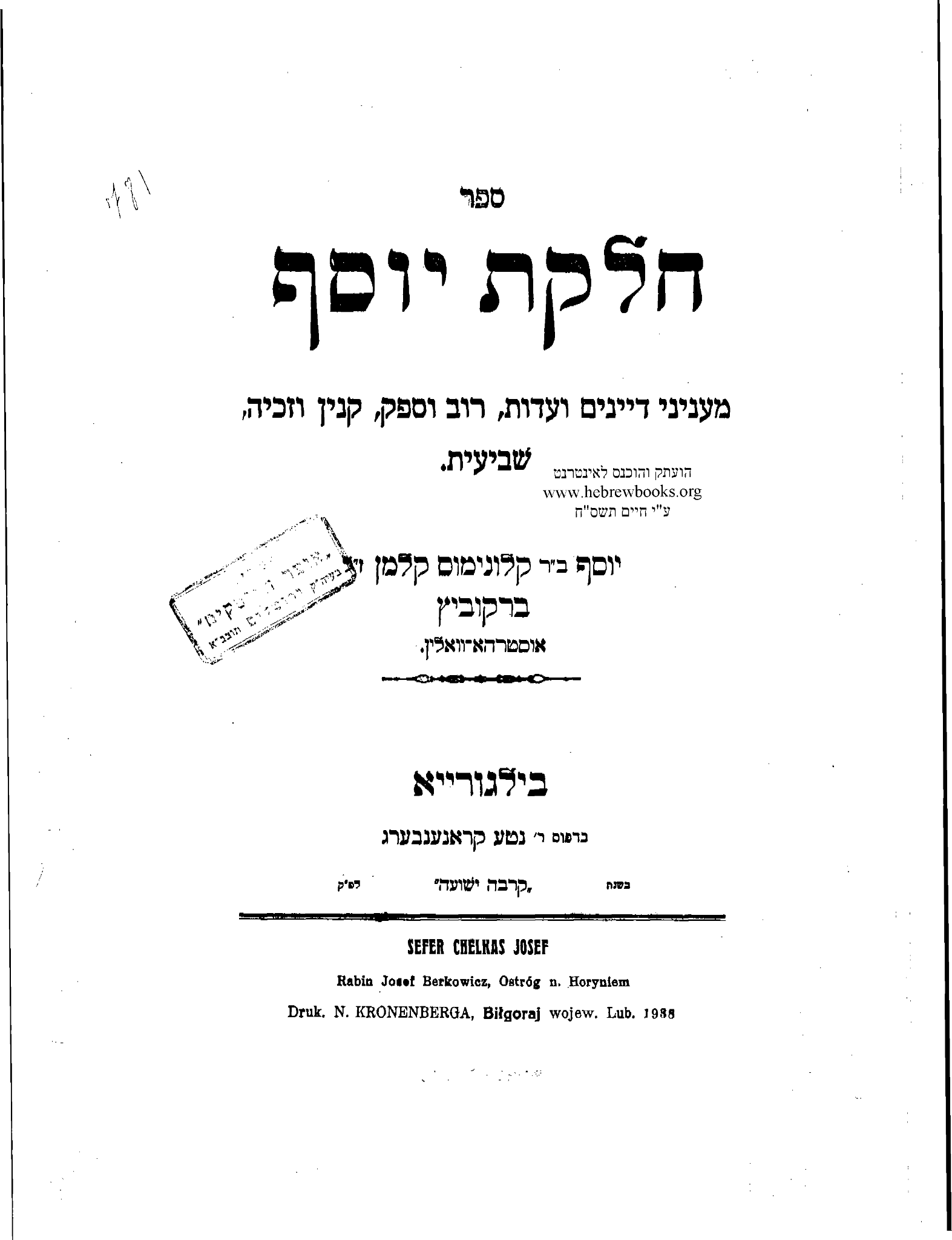
It is a very rare sefer.
There are no copies in any of the great libraries of Judaica in New York. Almost all of the original copies were destroyed in the Holocaust.
Not surprisingly.
But one or two copies made their way to the Land of Israel, and the volume has since been mechanically reproduced many times.
So now I held in my hand a surviving work by one of the names on the mysterious letterhead.
And on the Polish title page it reads:
Rabin Yosef Berkowicz
So now I knew that his name was Yosef.
In the author’s introduction to this wonderful book of profound Torah learning, he writes about the state of the yeshivot of Europe.
Even now, in 1938, he says, the yeshivot are crowded all over Europe.
He refers with reverence to the great academies of Poland.
And then he mentions our yeshiva, still functioning in 1938, where students continue to learn.
So the yeshiva certainly existed and was active immediately before the war.
Then, two paragraphs later, he writes:
“I reserve a special blessing for my dear friend and brother-in-law…”
And he names:
Rabbi David Yosef Khazanovich
So now we have the second man.
We know that one was:
- Rabbi Yosef Berkovich
and the other was:
- Rabbi David Yosef Khazanovich
That explains the initials on the Lithuanian letterhead:
D.J. = David Yosef.
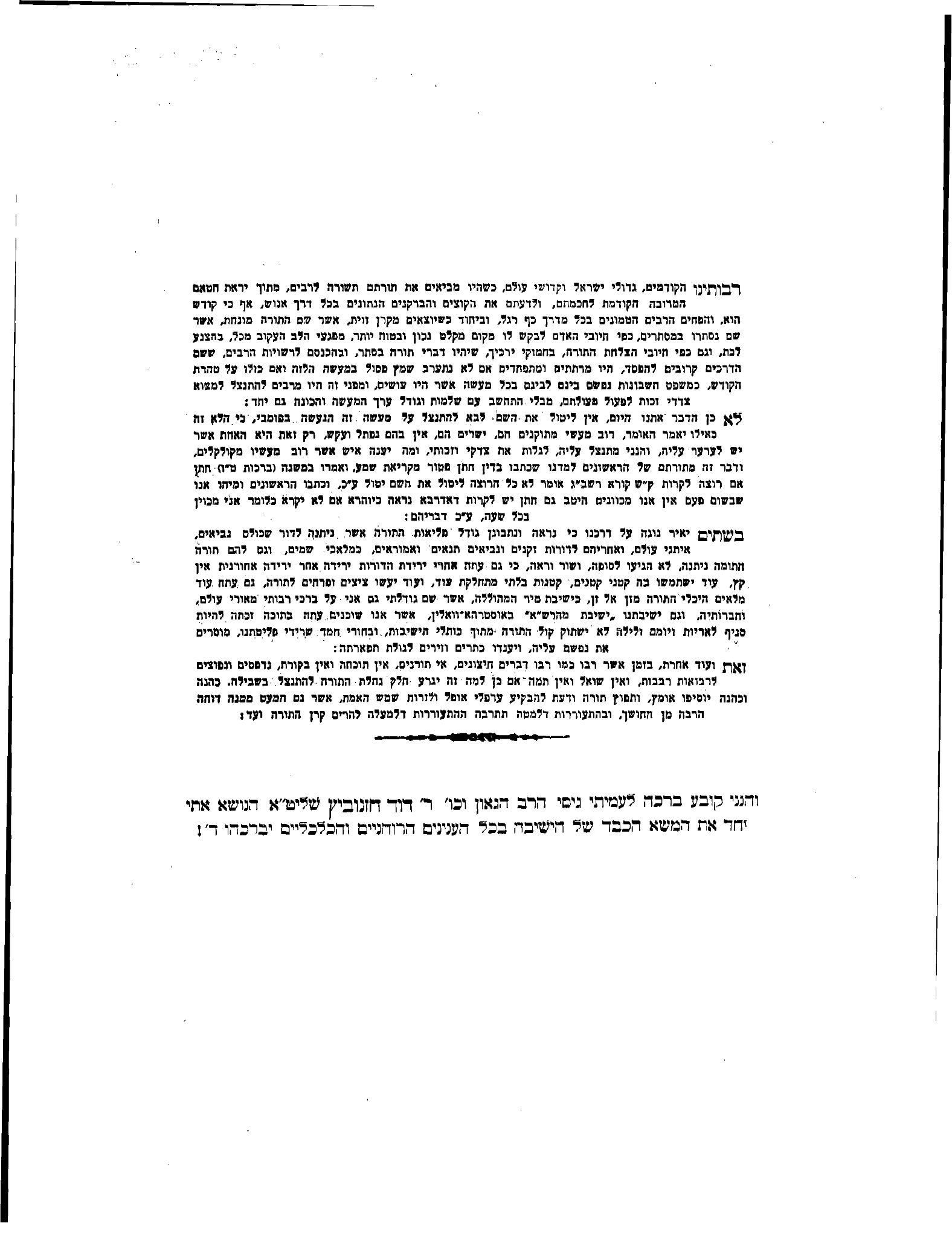
And the sefer also carried a letter of approbation from none other than:
Rabbi Chaim Ozer Grodzenski
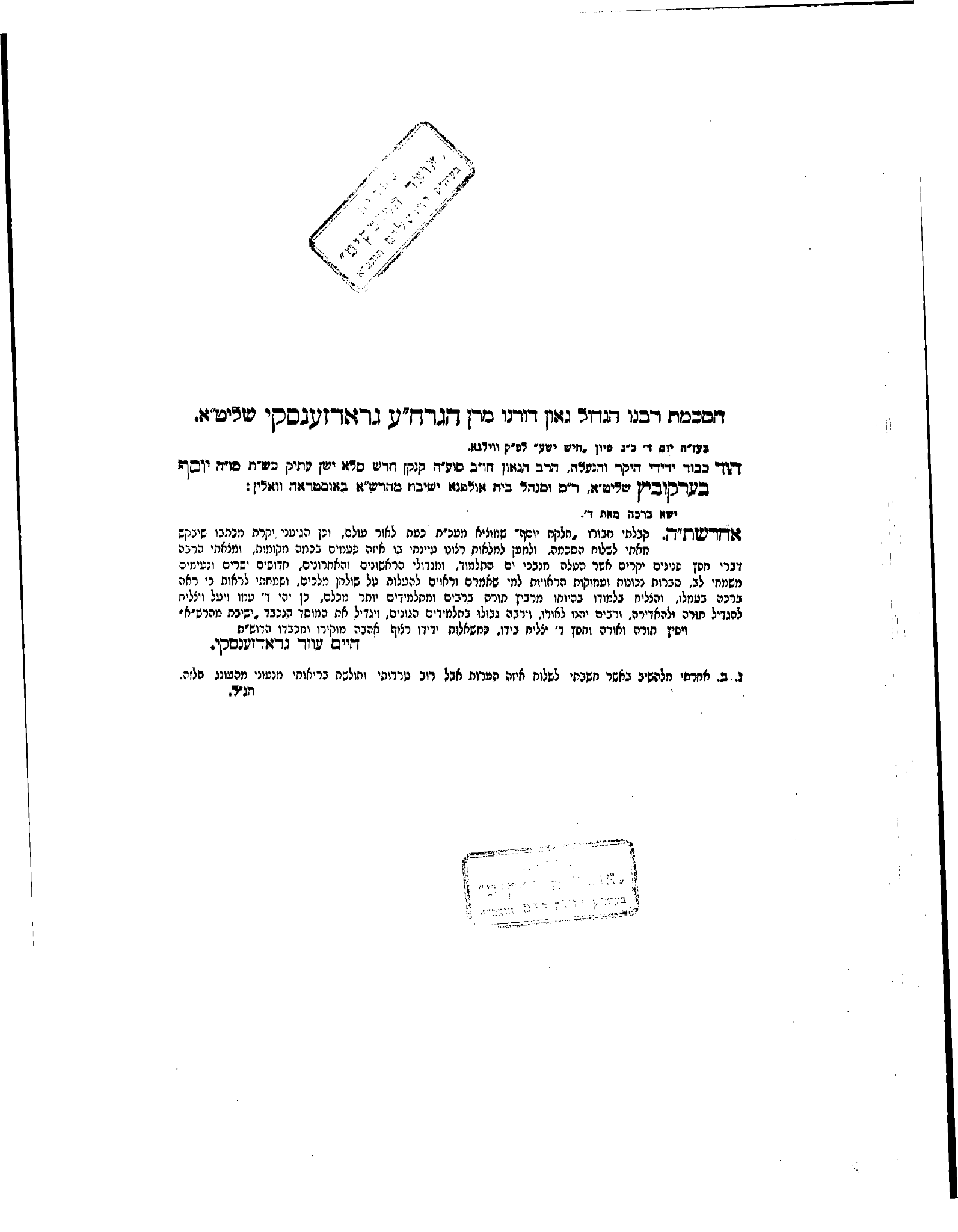
Now for Rabbi Chaim Ozer to write a letter of recommendation was itself significant.
But this particular letter goes beyond his ordinary style.
Among other things, he writes:
“I read your book.”
That is extraordinary praise.
Rabbi Chaim Ozer was not a man who casually wrote such things.
So we now have firm identification of the two rabbis on the letterhead.
But I still knew nothing about their fate.
Then came another discovery.
In 1959, this rare book was republished.
I am holding the 1959 edition.
But it was not a simple photographic reprint.
It was completely reset in new type.
Larger pages, larger print, Rashi script—done at considerable expense.
Quite remarkable.
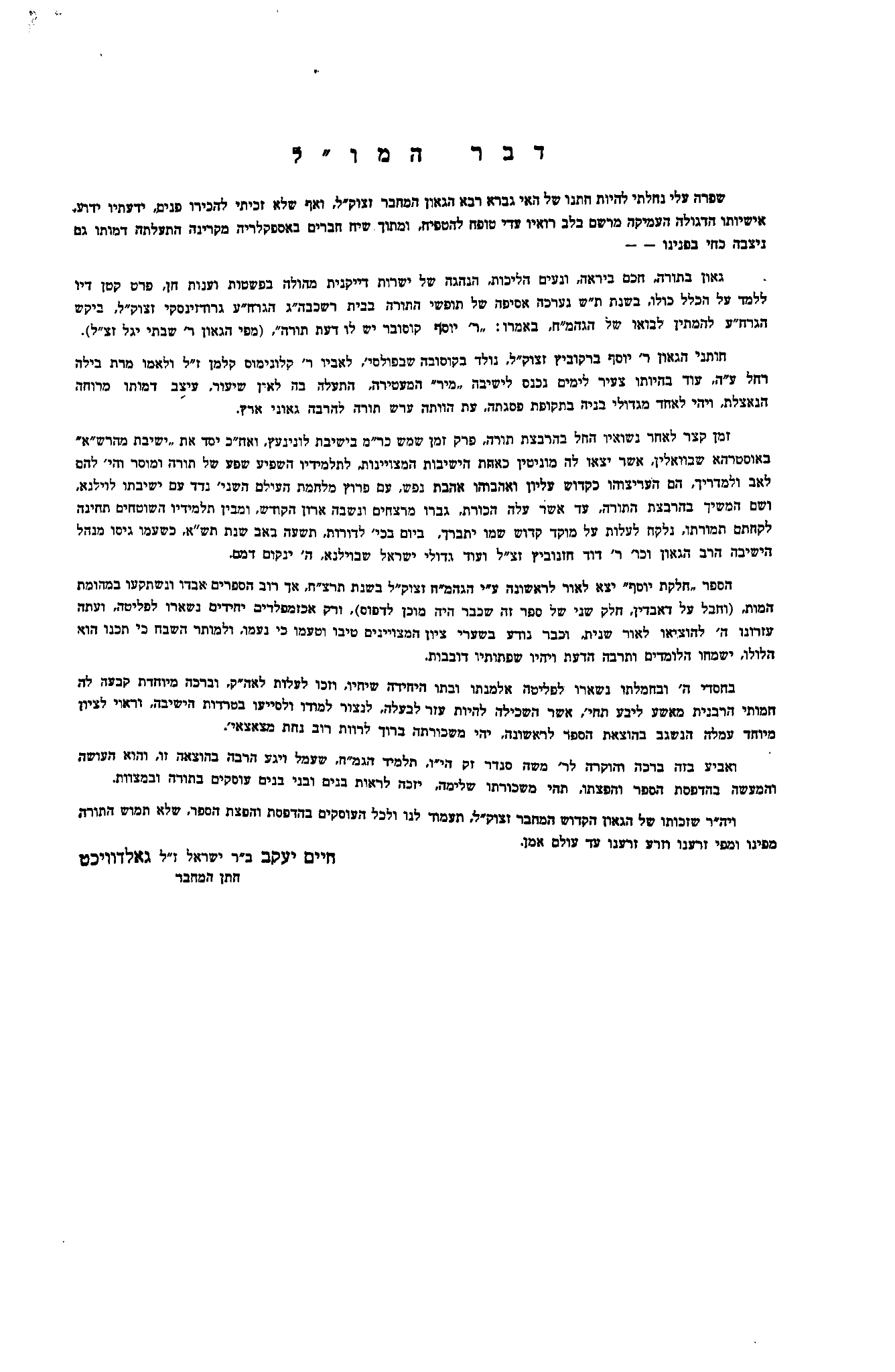
And this edition carried a new introduction by the man who brought it to press.
That man was the late Rosh Yeshiva Rabbi Chaim Yaakov Goldvicht, died in 1994.
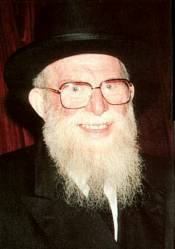
Rabbi Chaim Yaakov Goldvicht was the founder and Rosh Yeshiva of Keren B’Yavnah, known as KBY. In 1954, the heads of Bnei Akiva turned to Rabbi Goldvicht, then studying and teaching in a kollel in Bnei Brak, if he would accept the position of Rosh Yeshiva for a new Religious Zionist yeshiva – Yeshivat Kerem B’Yavneh. Before accepting, Rabbi Goldvicht asked the Chazon Ish for his advice. According to one account, the Chazon Ish told him: “If [the Religious Zionists] want to learn Torah, we need to help them.” Rabbi Elyakum Schwartz told me that the story is that Rabbi Goldvicht asked his rebbe, the Chazon ish, whether he should pursue opening the yeshiva, and the response was, if Mizrachi wants to open a yeshiva, run, do not walk.
Rabbi Goldvicht took a critical part in establishing the Hesder yeshiva program with the Israel Defense Forces, and KBY became the first Hesder yeshiva, combining Torah study with active service in the Israeli army. In recognition of his contribution, he was awarded the Israel Prize in 1991, on behalf of the entire Yeshivat Hesder movement.
The yeshiva was founded in the late 1950s. Some of you may remember him or knew him.
He was my teacher.
I was learning in yeshiva in 1959, and he was my teacher.
Never did he say a word about the fact that he had republished a sefer of Rabbi Yosef Berkovich.
In those days, teachers did not spend much time socializing with students.
We were frightened simply to be in the same room with him.
Years later, when Rabbi Goldvicht would come to New York and the United States to raise money for the yeshiva, he would often come with his wife and stay in my home.
We became the best of friends.
Once I was no longer a student, we hosted him many times.
It was a delight.
And never did they ever say a word about the Holocaust, or about any relationship they had to anything that happened during the Holocaust.
So all of this was an incredible surprise to me.
In that introduction to the 1959 edition, he writes as follows:
“I am the son-in-law of Rabbi Berkovich.”
I never met him, he says, but I know him very well, even though I never met him in my life.
He goes on to describe Rabbi Berkovich as one of the outstanding graduates of the Mir Yeshiva in Poland.
He was the founder of the yeshiva in Ostroh, which had a reputation as one of the great yeshivot of its time.
Then he writes:
He died as a martyr.
He was one of the 70,000 Jews of Vilna murdered in Ponary.
And on that same day, his brother-in-law was martyred with him.
That brother-in-law was Rabbi David Yosef Khazanovich.
So both Roshei Yeshiva were murdered together.
But his wife survived the war.
And his only daughter survived with her.
They made it to the Land of Israel.
And of course, he—the editor of the 1959 edition—married Miriam, the daughter of Rebbetzin Berkovich.
I remember Miriam very well.
I remember the Rosh Yeshiva very well.
So there is no question:
We have not only properly identified the two Roshei Yeshiva—
We have now learned their fate as well.
https://www.hebrewbooks.org/pdfpager.aspx?req=40924&st=&pgnum=3
The Nazis could number and kill millions.
But they could not extinguish the eternal light of Torah.
That fiery flame was kept alive in the Vilna Ghetto by Feygl dem Rovs, and handed over to Rebbetzin Berkovich and to her daughter Miriam—the only two members of Feygl’s circle who survived the Holocaust.
In turn, they brought that eternal flame to Israel, where it continues to glow in all its glory.
Foxman’s closing lines in the original essay read—and I will read them first in Yiddish and then translate them into English.
And with that, we close:
May these lines serve as a tombstone
for the unknown grave of a holy Jewish daughter
who taught others how to live and die
by sanctifying God’s name,
and who herself died sanctifying God’s name.
May her memory forever remain holy.
Thank you very much.
Story about Abe Foxman, son of Joseph Foxman:
Abraham Foxman, a Holocaust survivor and national director of the Anti-Defamation League from 1987 until 2015, died on Sunday, May 10, 2026. He was 86 years old.
“America and the Jewish people have lost a moral voice, a passionate advocate for the Jewish people and the State of Israel, and a remarkable leader,” stated Jonathan Greenblatt, CEO and national director of the ADL. “Abe Foxman was an iconic Jewish leader who embraced the ideal of an America free from antisemitism and hate and who strongly believed that these scourges could be defeated if good people opposed it.”
On Sun, May 10, 2026 at 3:24 PM Martin Brody <martinlbrody@gmail.com> wrote:
..favourite story.about him.
We often re-enact the Simchat Torah ritual of picking up a child and dancing.
May his memory be a beautiful blessing.
Soldier, survivor have emotional reunion
In the fall of 1945, a Soviet soldier hoisted a 5-year-old boy aloft and paraded him through a Lithuanian synagogue that had been closed throughout a long Nazi occupation.
For 65 years, the boy and the soldier carried that moment in their heads and hearts. Unknown to each other, they told the story to family and friends. A Toronto songwriter memorialized it in song. The boy became a man and included the anecdote in his 2003 book.
On Thursday, they met and embraced for the first time since then in Rabbi Leo Goldman’s Oak Park living room.
“It was very emotional, much more than I would have expected,” says the former small boy. He is Abraham Foxman, the New York-based director of the Anti-Defamation League. In that role, he is a public voice against racial and religious intolerance.
The soldier is Goldman, 91, an Orthodox rabbi in Oak Park and an educator who continued to work as a Beaumont Hospital chaplain until a few months ago.
“We tell this story every year,” says Rose Brystowski, the rabbi’s daughter, who says her father has become too frail to interview. “It’s very moving to us, because it’s about survival, about a child symbolizing the future of our people.”
The memory remains vivid for Foxman: He had lived with his Catholic nanny, separated from his parents and concealed from the Nazis as a so-called “hidden child” for four years.
The nanny saved his life — but also taught him to spit on the ground when a Jew walked by.
In mid-1945, he was reunited with his parents. His father waited four months to take him to a synagogue on the holiday of Simchat Torah, an ancient and festive holiday that celebrates the reading of the Torah — the Old Testament — on hand-written scrolls. “That was very smart of him because it is a fun holiday for children,” says Foxman, who remembers walking by a church and making the sign of the cross entering the synagogue for the first time.
For Goldman, who had been wounded twice as a soldier, and lost his parents to the Nazis, the return to the synagogue in Vilna that day was also momentous. The concentration camps had been liberated, Jews were reuniting with their families across Europe, and in Lithuania, it was no longer a capital crime to be Jewish. Most had been dispersed or exterminated. Only 3,000 of Vilna’s 100,000 Jews remained.
“Are you Jewish?” the Soviet soldier, asked the boy. When he nodded yes, Goldman said, “I have traveled thousands of miles without seeing a Jewish child.” Then he stooped down, lifted the boy and danced around the room with him.
Neither man ever forgot that day, that celebration of religion and survival under extraordinary circumstance.
But only last summer, after an Israeli researcher finally put together a song, “The Man From Vilna,” about the incident with a Michigan rabbi, did Foxman learn that the Jewish Soviet soldier he wrote about in his 2003 book, “Never Again?” was Goldman, still alive and living in the United States. The songwriter had credited Goldman as the story’s source.
Getting to Thursday’s reunion was circuitous: Three years ago, Foxman told the story at Yad Vashem, the Israel Holocaust Memorial Museum. There, a researcher embarked on a quest for the dancing man in uniform that Foxman described: Eventually, she found the song, inspired by Goldman’s story, and the rabbi’s name in the credits. For Foxman, that day “was a memory, a bittersweet memory.” The soldier — a stranger — had embraced him in public, in a synagogue. He had carried him like a trophy around the synagogue.
“That was for me the first time anyone took pride in me,” says Foxman, who as “a hidden child didn’t know who or what I was.”
For both men, the memory was frozen in time, unattached to any living person.
“I thought that story was a kind of legend,” recalls Brystowski. “I always believed it in my heart, but on another level, I wondered, did that really happen?”
She was stunned when she learned last summer, when Foxman called, that “this prominent, grown man” was the little boy she had grown up hearing about.
The mythic boy had become a very real and prominent man. “It shows us that any gesture, any mitzvah or good deed, can have an impact,” she says.
On Thursday, the two men hugged and talked and recited a Hebrew prayer, a blessing that’s a reminder of the importance of celebrating life in the moment.
“It is a privilege to have lived long enough to have this moment,” Foxman says Goldman told him.
Goldman’s parents and older brother were killed by the Nazis. Foxman’s early years as a “hidden child,” living with secrets and lies, led him into a career of speaking out publicly against injustice and hatred.
For each man, the memory of dancing in a Vilna synagogue was a pivotal moment. “I came home and told my father that I wanted to be Jewish,” recalls Foxman. “It was the beginning of my life as a Jewish person.”
Each man had a memory of a moment — a dance in a synagogue — that symbolized then and throughout their lives the promise of freedom and faith and life.
At long last, the boy and the soldier who carried phantom memories, now know each other as two grown men who have, against the odds, survived to find each other.
From The Detroit News: http://www.detnews.com/article/20100409/OPINION03/4090372/1293/OPINION0319/Soldier–survivor-have-emotional-reunion-after-65-years#ixzz0kef0RZPQ
http://traditionarchive. org/news/_pdfs/0089-0094.pdf


Leave a Reply